Firsts are a tricky thing. The Old East Perth Cemetery was certainly not the first colonial burial site in Western Australia. The unmarked graves of the thirty-odd settlers who died at Clarence by what is now known as Woodman’s Point were filled around about the same time in early 1830, when the first recorded interment at East Perth was taking place. Talking of records, the record-keeping skills of the early Swan River Colonists were pathetic. There is no formal burial register for the unified aggregation of denominational Christian cemeteries that make up Old East Perth Cemetery. There has been a lot of research into who actually might be buried in the ground, but there are certainly many gaps in our knowledge.
Educated guesses are just that—guesses—there is always the possibility of being proved gloriously and magnificently wrong.
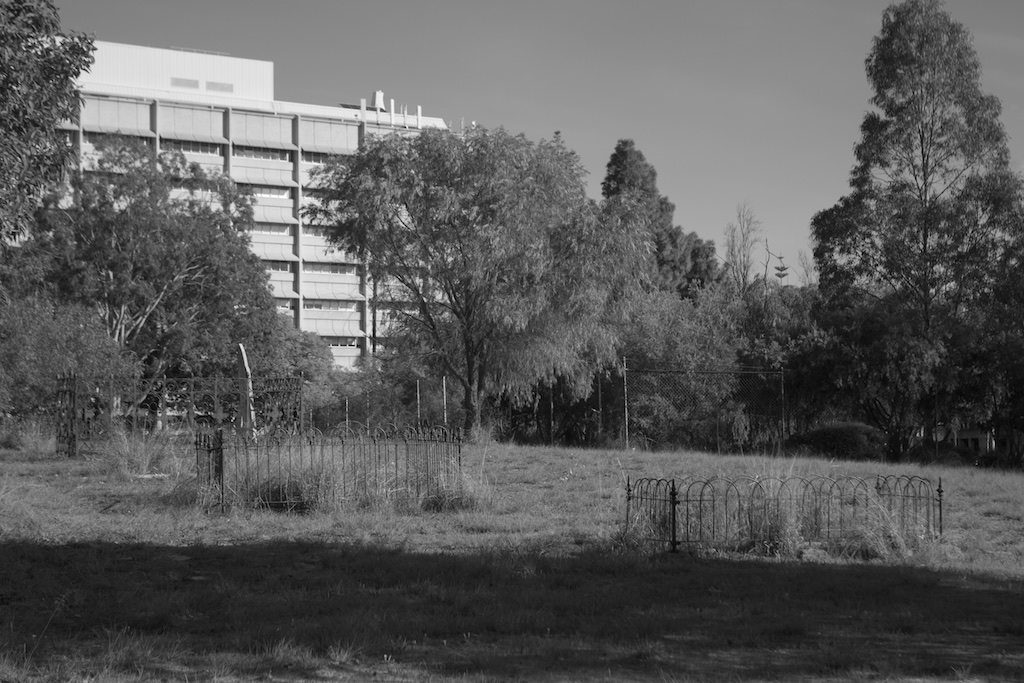
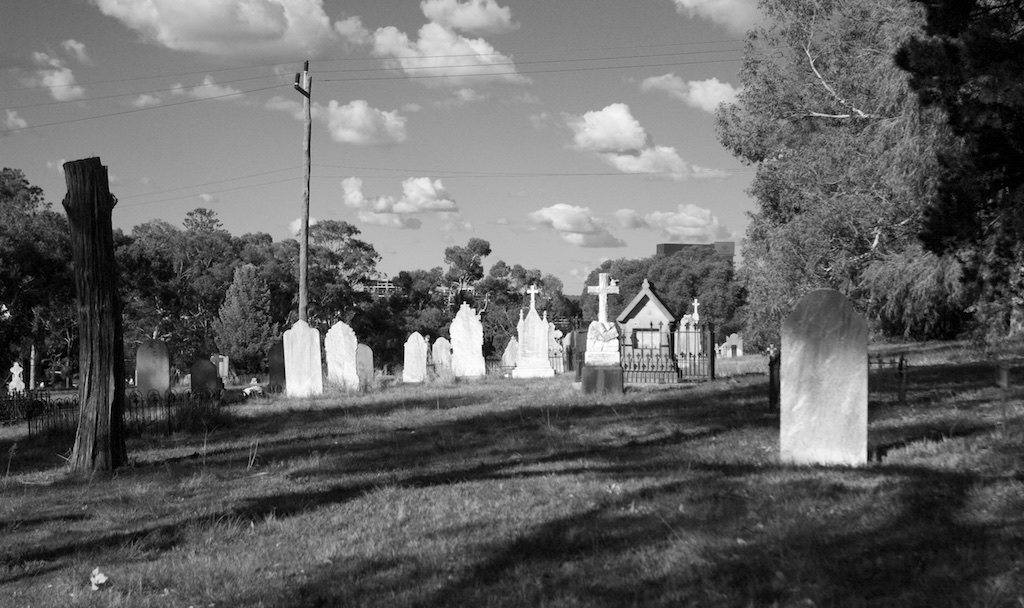
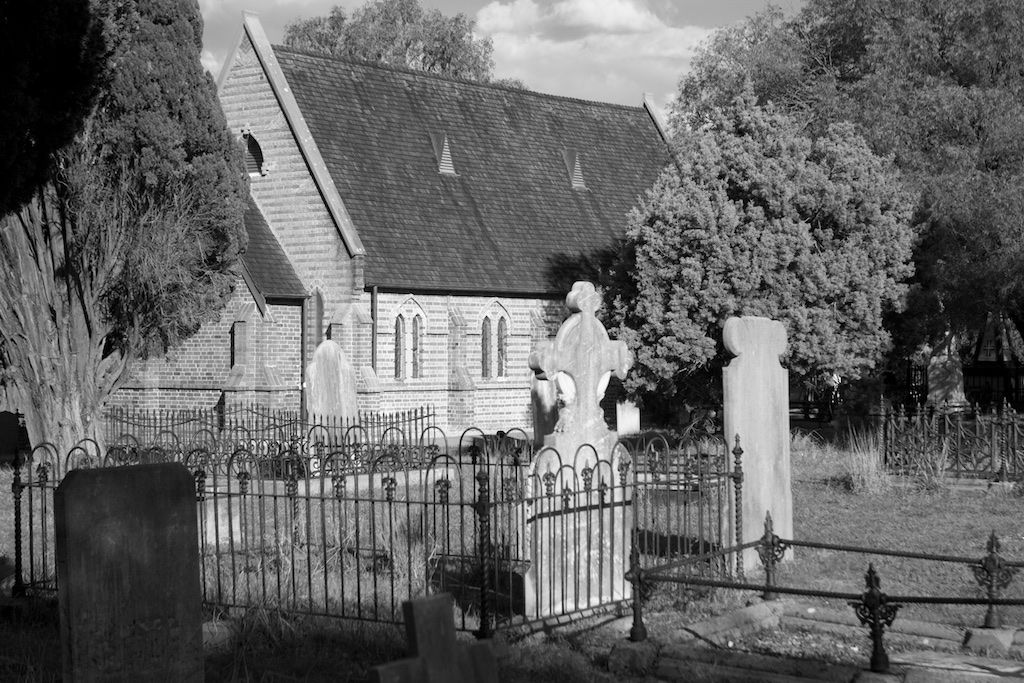
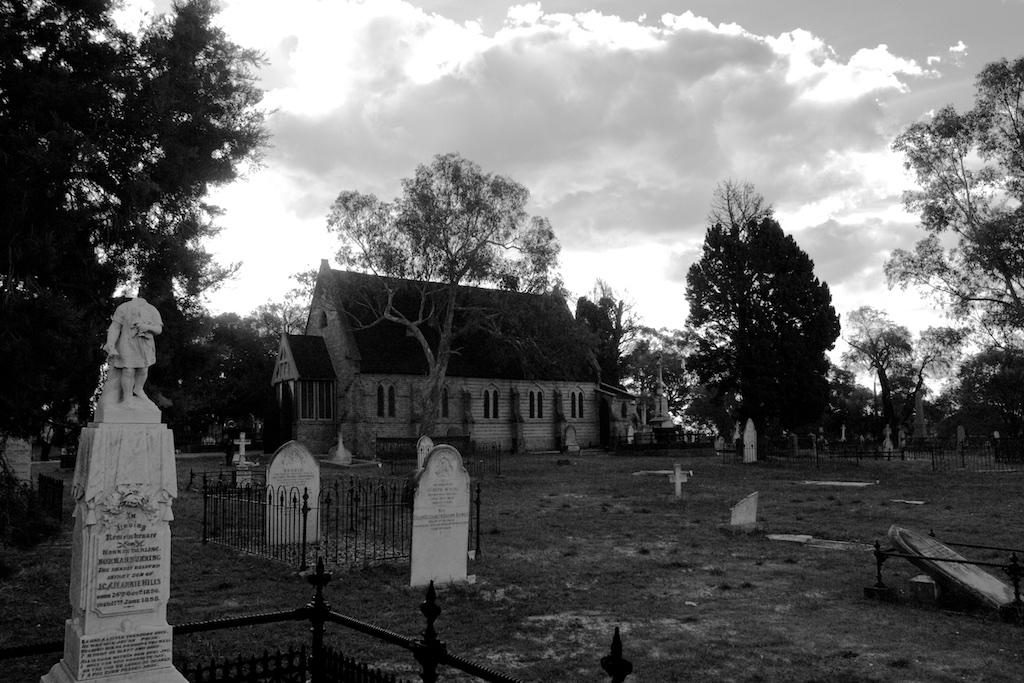
The colonial burial ground today.
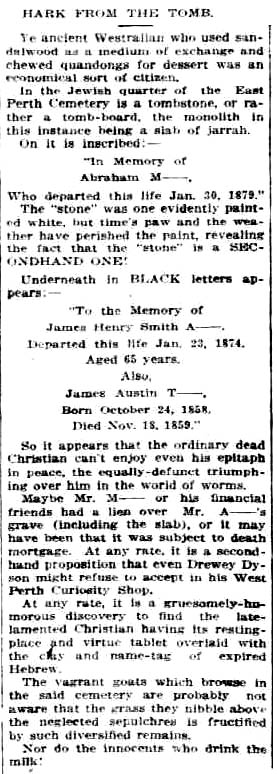
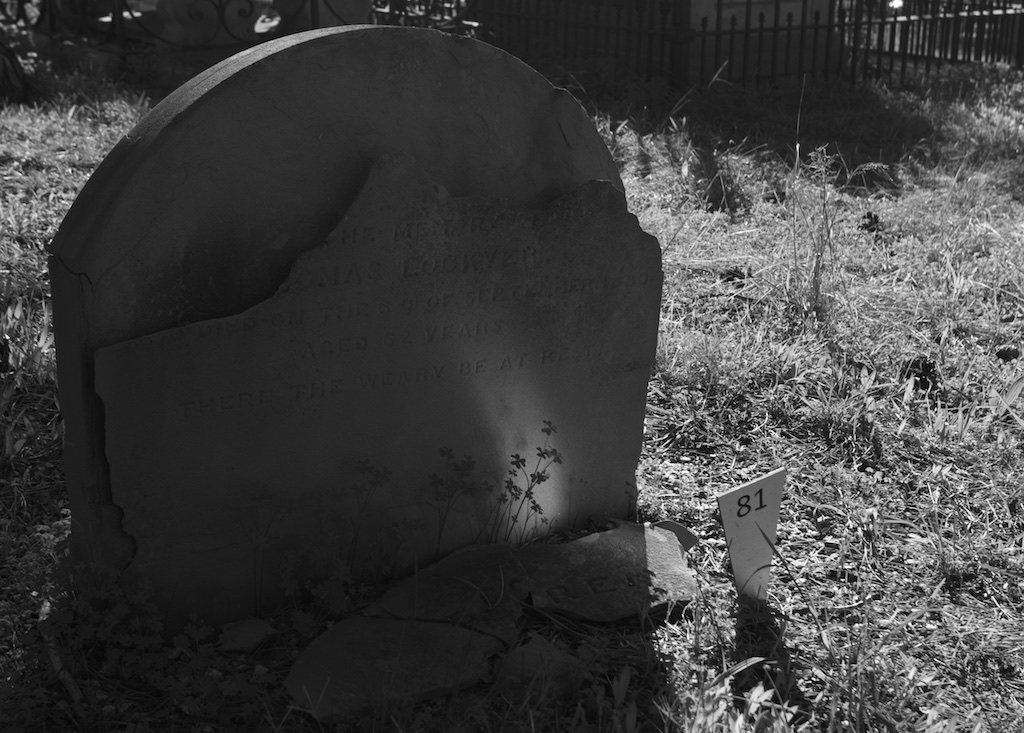
For a site with at least 10,000 interments within it over a seventy year period of use (roughly 1830-1899), there are mere handful of headstones surviving. While wilful vandalism during the 20th Century can account for a lot, haphazard usage over the course of its life (If Cemeteries can be said to be alive?) account for much:—
Sunday Times, Sunday 26 February 1911 p6
Most of the surviving monuments appear to be from the last years of East Perth’s formal operations in the 1890’s. There were probably many more family crypts on the ground than are visible today. Wood rots, Slate delaminates, sandstone crumbles, iron rusts, lead lettering peels away.
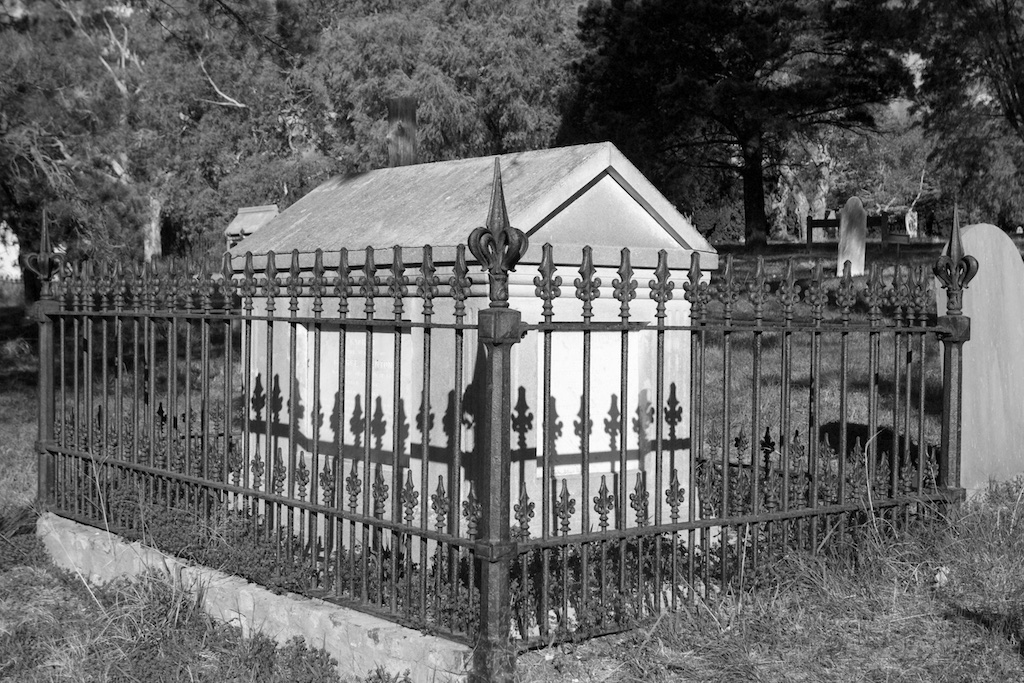
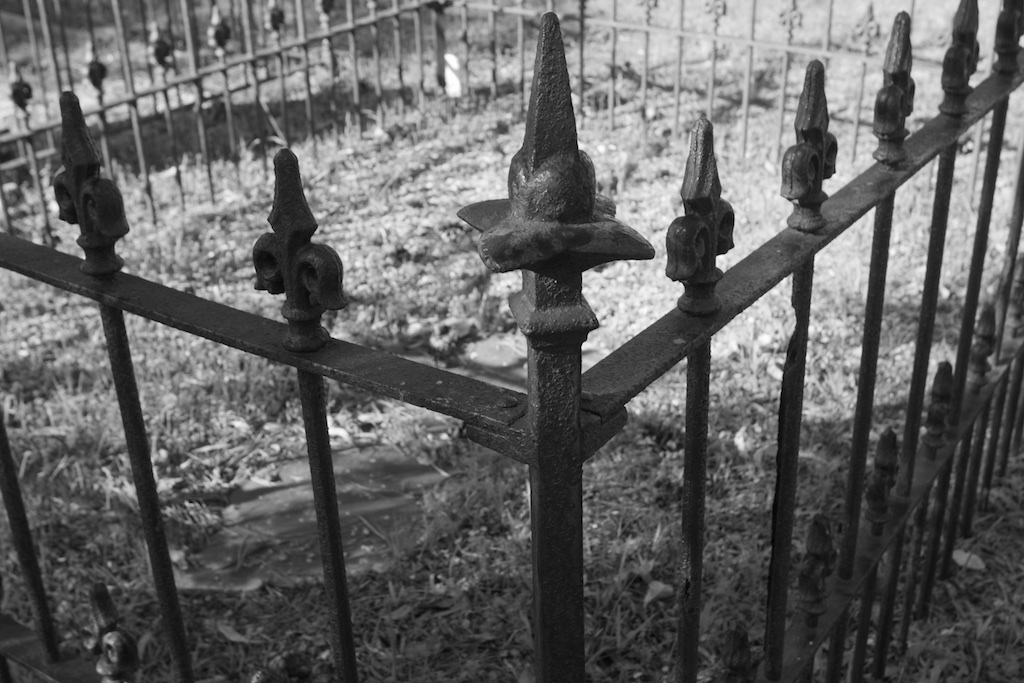
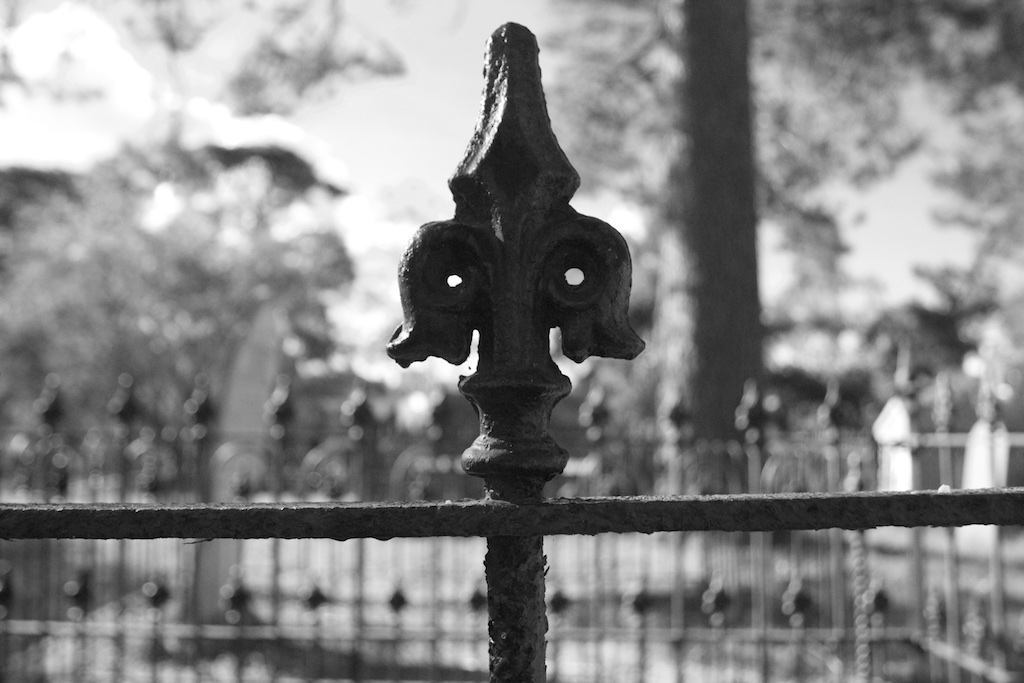
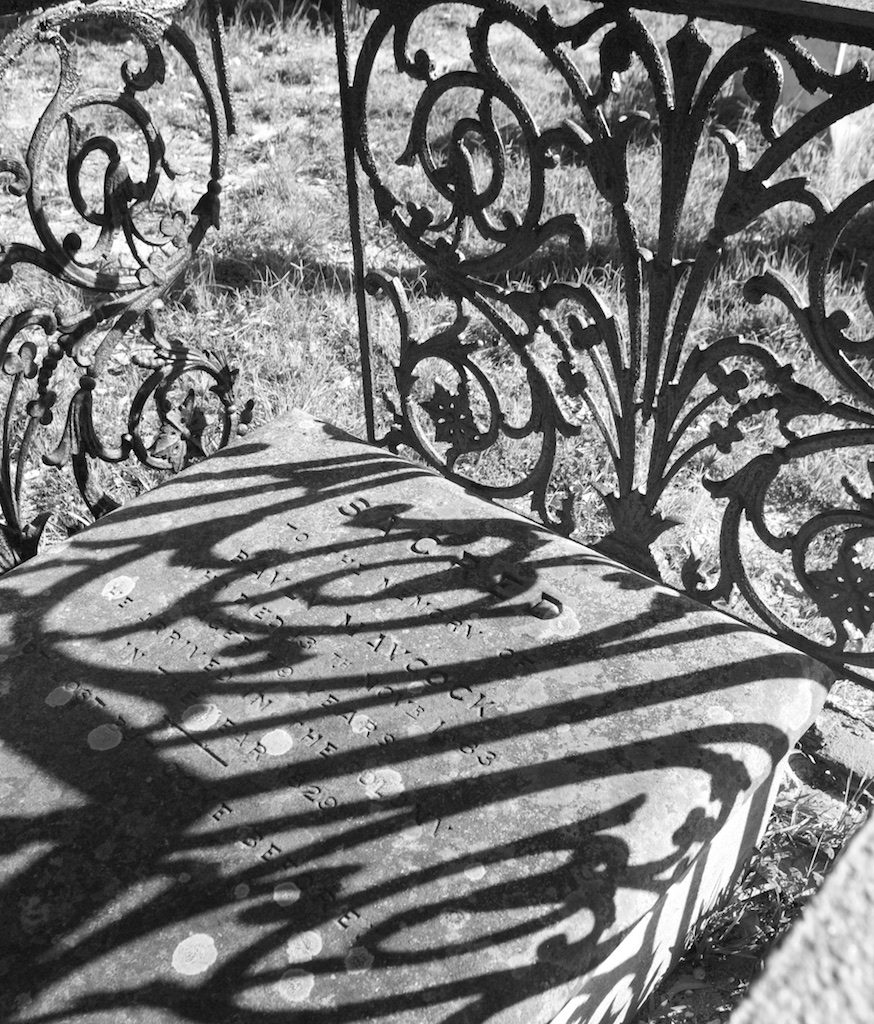
Drewy Dyson’s name is taken in vain when discussing the state of the cemetery in 1911. Of course most of Drewy’s immediate family were buried in a family plot on the site. The iron railings and tombstone that still exist in situ were most likely erected by Drewy himself in his capacity as funeral director:—
WHY live miserable when you can be buried comfortably by A. DYSON, Undertaker?
But the occasion of his mother’s death as an excuse for a refurbishment of the family plot was the one time Drewy did not spare every expense. It contained a tribute to his late father who had died eleven years ago and his father’s first wife who, according to Drewy’s monument, died forty-nine years ago. The problem is, Drewy was almost certainly— deliberately— lying about the dating of certain events.
The Dyson family plot lies in the Wesleyan Section of the Old East Perth Cemetery. A stone’s throw away (but I could not condone this sort of behaviour) is the monument to George Shenton, the pious druggist, the merchant philanthropist whose story seemed to intertwine with that of the Dyson family (and every other significant family in the early years of the Colony).
The Grave of George Shenton, senior.
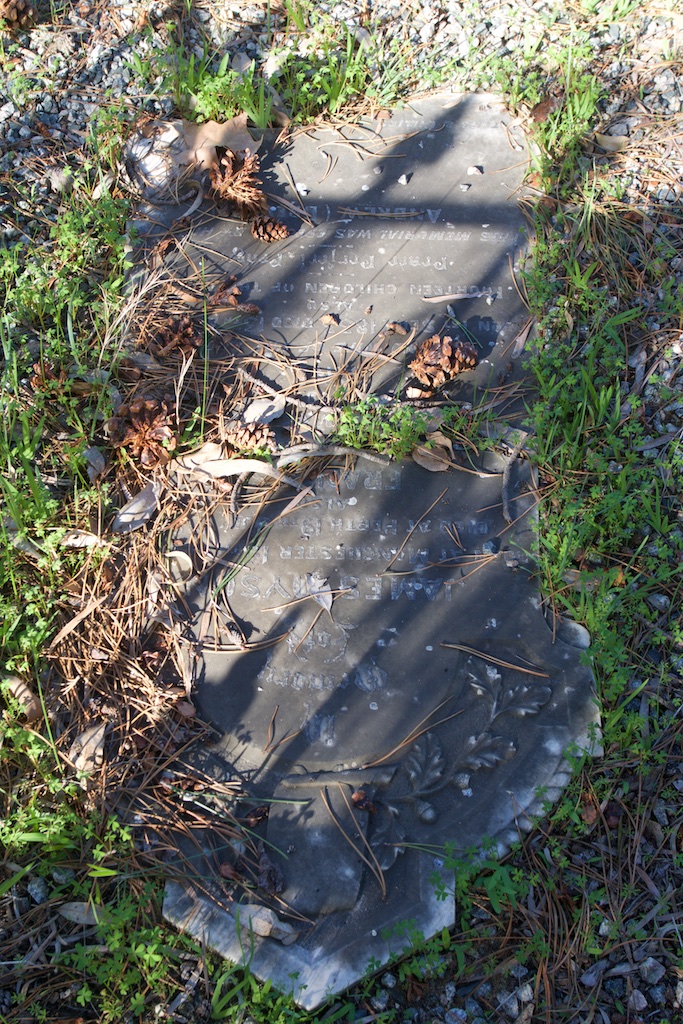
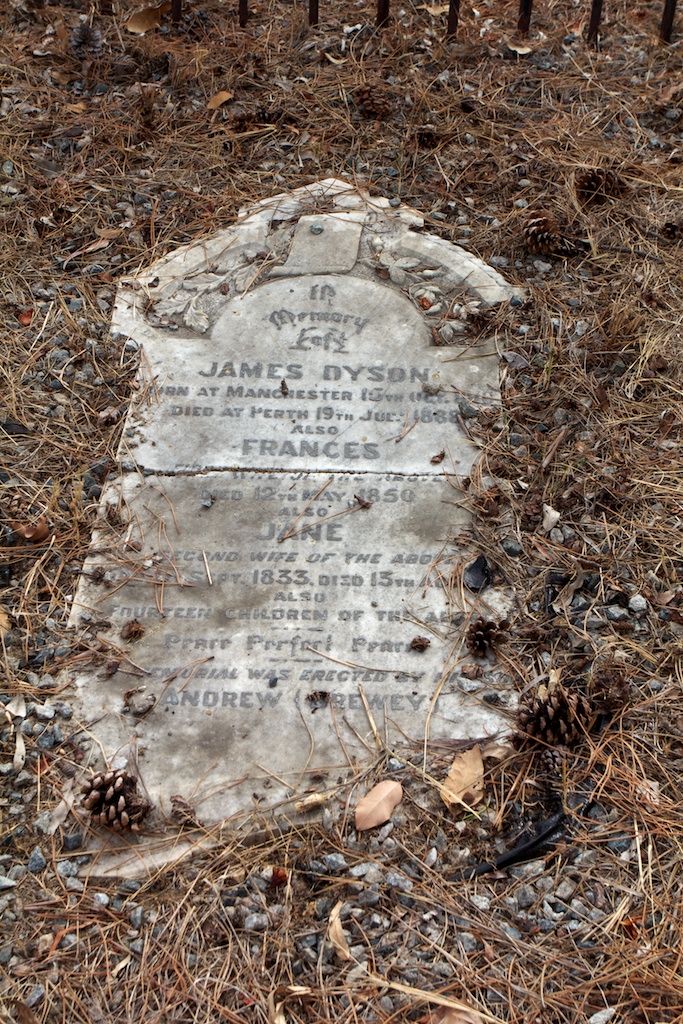
The Wesleyan Methodist portion of the cemetery was not inaugurated until 1854, so, as the helpful guides from the National Trust can point out to you, how could Frances Dyson have been buried in that location in 1850?Visiting the family grave in June 2018, I was sorry to see how much the Dyson grave stone has deteriorated in the five years since my last visit:—
The Dyson stone in 2018The same stone in 2013
I hasten to stress this is no reflection on the current custodians of the cemetery grounds. The grave is surrounded by iron railings and its hard to see how it could be better protected, short of obscuring the stone entirely. The reality is that the money available for any sort of restoration is not there, and while I’d love to see all the surviving stones in East Perth stabilised, possibly something else, like reinstating marker numbers for lost grave sites— they have numbers for existing headstones only— would be more worthwhile. This way many more hundreds, if not thousands of now anonymous grave sites could be identified for visiting, providing a focal point for the pilgrimage of many more families.
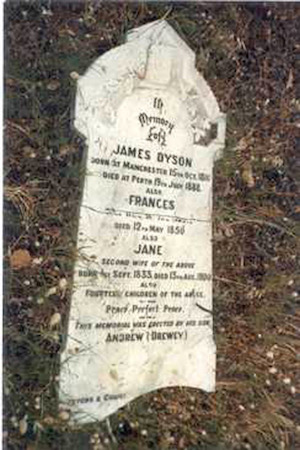
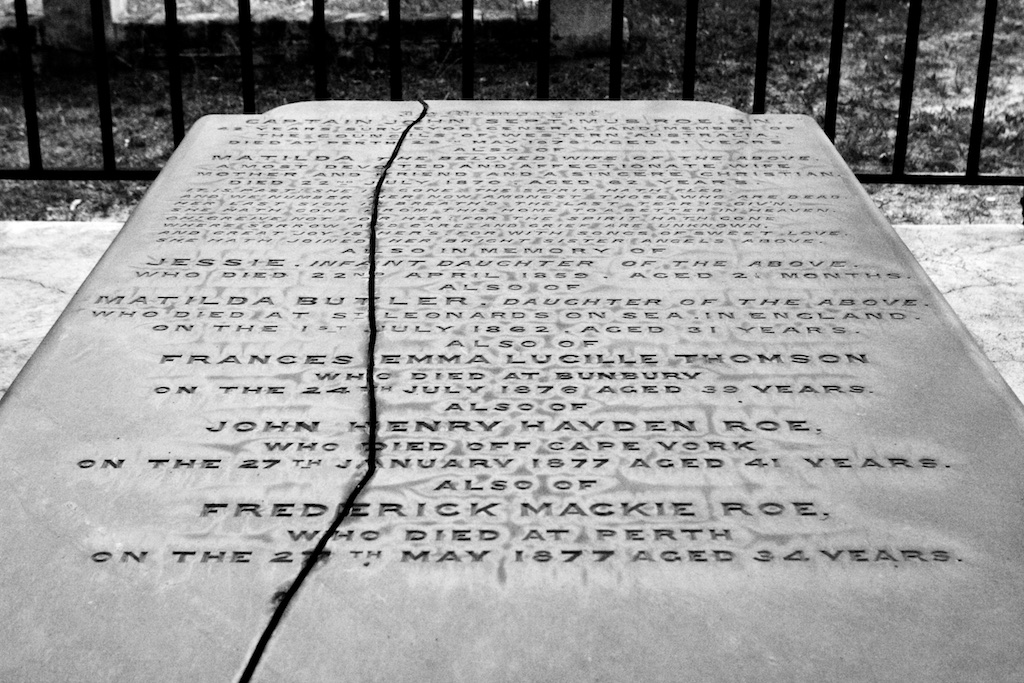
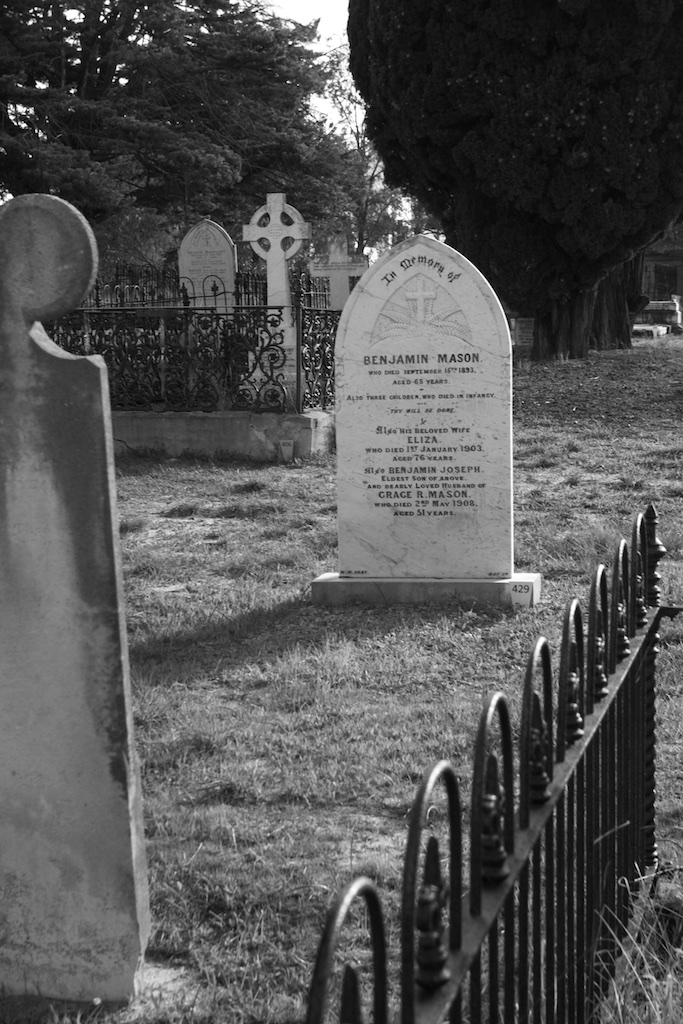
Bloody hell! its worse than I thought. This was the Dyson grave circa 1980. [thanks to Lorraine Dyson for the photo]More grave numbering please!This Star Wars-opening scroll-type stone is for Captain John Septimus Roe who surveyed the site for this cemetery back in 1829.Our old friend, Ben MasonAlso in the Wesleyan section, Francis Fraser Armstrong himself.
The Old East Perth Cemetery is located (surprise surprise!) in East Perth, Western Australia. It is only open to the public for a couple of hours on Sunday afternoons. There is a small admission charge. I cannot over-stress how helpful the volunteer guides of the National Trust on duty at the cemetery have been to me for my research, particularly on the Dyson family, over many years.
A bit over a decade ago I was recording a corporate video out on the Burrup peninsula up in the Pilbara region. Without naming names — myself and a young local film-maker were supposed to be filming some of the rock carvings for which the region is famous. They were in a site controlled by a certain big resource corporation. I had to talk to a minion of that company to finalise the details of access. This dickhead told me that while the company would be fine with me being out there, they wouldn’t allow my colleague out with me. According to this white guy, it would give great offence for my colleague, a local man, to see certain rock carvings.
Not these ones
Offence to whom? Not apparently, to me — a white guy — who had only been there for a few months — and wouldn’t have known what was restricted or not — and would have filmed everything he had seen, rebroadcasting it unknowingly. Offensive to the local Aboriginal community? My colleague, although a young man, was a member of that same community and had been initiated into the Law. This meant he had been extensively tutored in the customs and laws of his culture by his Elders. So were “they” protecting him from the trauma of seeing something that might be personally offensive to him, or were “they” protecting someone else from being offended that he might have seen something that they felt he was not entitled to see? Who the hell were “they?”
The situation was that an untutored white guy would be given access to an Aboriginal sacred site but an educated Aboriginal person would be barred. “I” was offended by this development. Needless to say, after I reported this situation to the Aboriginal boss of the Aboriginal media organisation I was then employed by, we did not go filming out on the Burrup that day — or the next.
This was my first proper introduction to the casual unthinking institutional racism in this State that my co-workers had to endure on a day-to-day basis. Petty discrimination enshrined in the very rulings that were supposed to protect their “feelings” even as it barred them from accessing their own country. But unknown then to me, at the same time, something just as insidious was taking place nineteen-hundred kilometres to the south. In the city of Perth, Western Australia, a programme was in place on to digitise all the official records of Births, Deaths and Marriages from the time such records were started in 1840’s until the present.
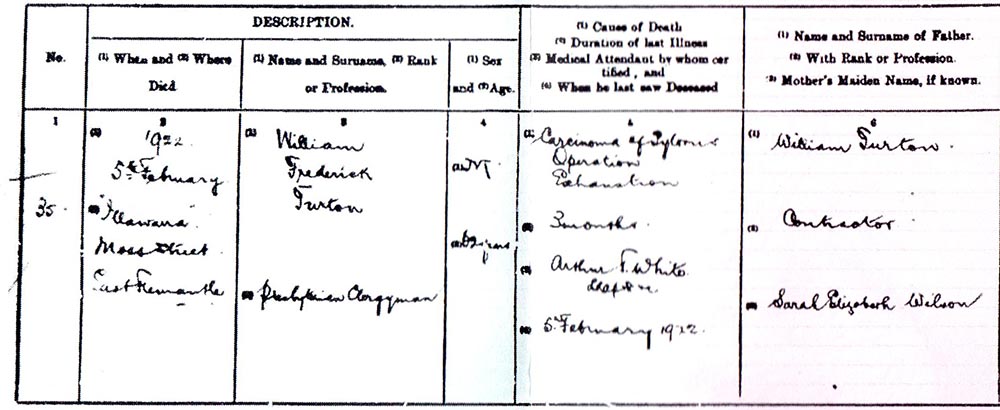
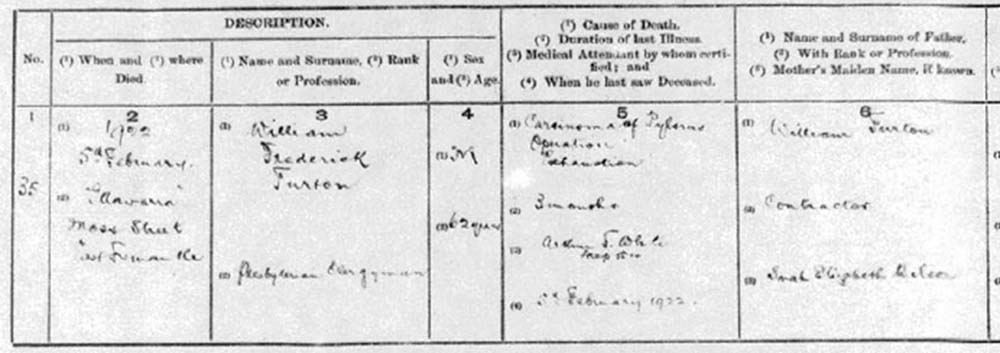
When you order a duplicate of an original certificate you will receive (provided you have not asked for a transcription) a very dark single colour reduction of the document printed on patterned and coloured paper. Not being in grey scale, the black and white image will be so small as to be nearly (if not actually) illegible. In the case of death certificates, it is sometimes possible to compare the modern scan to the original by calling up the micro-filmed photographs of the Probate files of that particular individual (if it exists). These microfilm records can be accessed FOR FREE at the State Records office next to the Alexander library in Perth. Take a USB drive along if you want to make a copy.
Here is an example of a purchased digitized record and one from the microfilmed source. You may judge for yourself which is easier to decipher:—
Scan of official printout (click to enlarge)
Scan of microfilm photograph (click to enlarge)
“Any alteration of the substance of this certificate will render the document valueless. Any person attempting an alteration is liable to prosecution”
This slogan is printed on the bottom of the officially issued, certified copy of the duplicated original register. Fair enough, you could falsify someone’s identity by changing these documents. However that is what some faceless bureaucrats have been doing between 2004, when the digitisation process started, and 2015 when it was concluded. Although it wasn’t formally required, many certificates have (up until the nineteen eighties when it became obligatory) listed whether the child being registered was aboriginal or not. Historically, being considered aboriginal in this state meant that you would be discriminated against— you could be arbitrarily removed from your parents or your children taken away from you. Your wages could be confiscated if you worked, or you could be paid nothing at all for the same, then gaoled for refusing to work. Your property rights would not be respected and you could be randomly killed in the street or in judicial custody without any notice being taken by the authorities at all.
It is these same “authorities” who have decided that being confirmed as “aboriginal” on a historical birth certificate is “offensive” to someone. I ask the question again: To whom?
I will not speak on behalf of who, or who does not, claim to be offended by being described as “aboriginal,” or whether they have the right to be offended (or not) at all. A lot of the past can be deemed offensive—That does not necessarily make it untrue. If some offensive remark does prove to be factually false, how on earth can you learn to understand the mind-set of the culture that uttered such a falsehood when the evidence of their malfeasance are suppressed because evidence of that lie might be “offensive”?
But to move on to a subject I do feel qualified to quantify my disgust thereon:— It is not just Aboriginality that is being censored on these government documents that it is supposed to be a criminal offence to tamper with: “bastard”, “illegitimate” and “incinerated” are all words on the redacted list. There are probably other interesting terms as well that we don’t know about because we haven’t been told that they are no longer there.
Speaking as an illegitimate bastard from a long line of illegitimate bastards I am deeply offended that someone else has taken it upon themself to decide what I may or may not be offended by. I am offended that my ancestors’ stories—even the ones who were complete and utter bastards—have been suppressed even in (my case) such a trivial way.
Consider this a sequel to the article The Stranger in the Mirror where I bemoaned the lack of available images of the earliest generations of the Dyson family in colonial Western Australia.
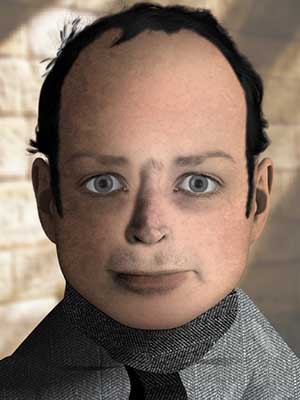
Of the patriarch, James Dyson—at best, we have an identikit image based on his alleged convict record. Of his two wives, and the vast majority of his twenty-two children (his own and the one he inherited), we have little or nothing.
It unlikely there ever will be any images to be found of the seven who died as infants, children or teenagers. Then there were his children who lived to adulthood but never were able to have children of their own. If their photographs survive in any anyone’s family album they may not even have a name attached to them.
Then there were the regrettably prominent number of Dyson’s children who had families but probably shouldn’t have. When the going got tough, these big tough men ran like hell. Sometimes their families survived, sometimes they did not. It’s nearly seventy-five years since the last of James Dyson’s children passed. I can’t really blame the descendants of those who were abandoned for not keeping the family portraits—assuming they even possessed any in the first place.
The family of John Dyson (1860-1913) is one example. He abandoned his three young surviving children after the death of his wife in Collie in 1906. Many decades later one of his grandsons had the temerity to ask a question about his grandfather’s family. The conversation went something like this:—
“Who was Drewy Dyson?”
<Whack!>
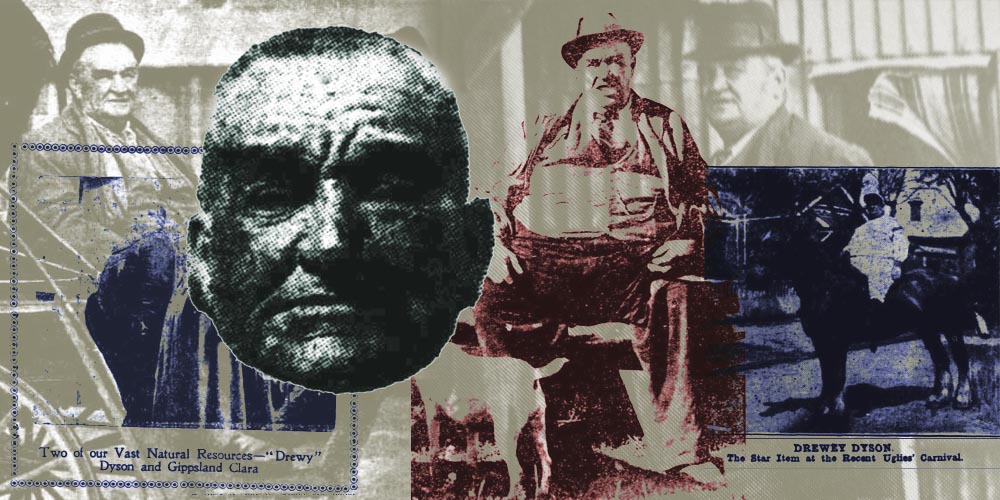
Andrew “Drewy” Dyson is the metaphorical and literal elephant in the room when it comes to any discussion of Dyson’s children. There are seemingly more images of Drewy than the count of all his siblings, and this was a man who also ‘enjoyed’ a turbulent family life. Until a short time ago Drewy was the only one of Dyson’s children for whom a photograph was known to exist— And being Drewy, this meant many photographs were available.
They date mostly from towards the end of his life, from the mid nineteen-tens to the time of his death in 1927, and are a testament to how much the press of the day loved him for his ability to fill column inches of content in the scandal section for pretty much every newspaper in town.
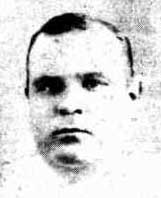
But there is now in circulation the image of another of James Dyson’s children, and dating back to 1906, this is the earliest photograph of a Dyson that I know of.
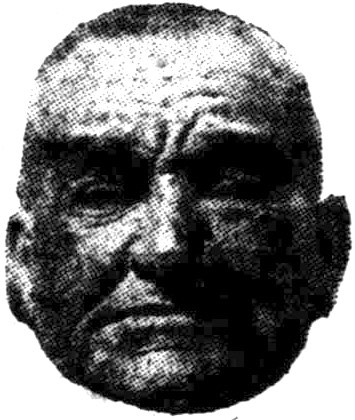
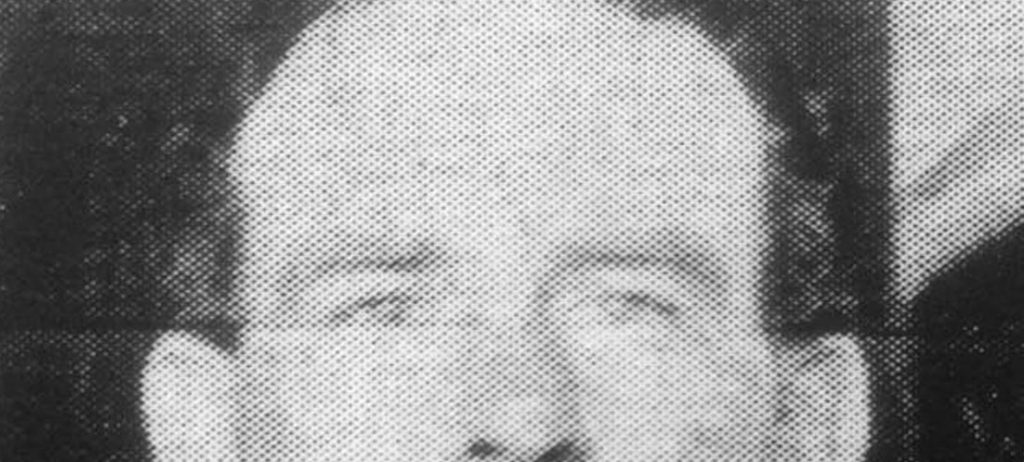
I have a good reason for not reproducing the full face here. This image appears in the book “Prisoners of the Past“, Compiled by Calliope Bridge, Celene Bridge, Angela Teague, Mark Chambers & Tom Hogarth and published by Hesperian Press in February 2017. The book contains mug shots of all prisoners released from Fremantle Prison between 1899 and 1919. There was a certain inevitability that one or more Dysons would be among their number.
Octavius Charles Dyson was the youngest surviving son of James Dyson and Jane Devling. I was not planning to ever say to too much about Octavius on this blog. His wife, Maud May Broun, (niece of Western Australia’s first Colonial Secretary Peter Broun) was finally able to divorce him in 1922 and a good thing too. One of his sons died on the battlefield of the Somme aged 20 during the first world war. Another drowned in the surf off Scarborough (The Perth suburb, not the English town one) in the mid 1930’s. This one may also have had a hand in introducing mechanical refrigeration into Western Australia.
All I have to go on about Octavius Dyson as a person is his criminal record as listed in the pages of the local papers of the time. It is not pleasant reading. However this is not the reason I obscure his face. I suspect the photographs published in “Prisoners of the Past” are all in the public domain and I likewise suspect that if I had asked I could have got permission from someone to publish in full what is, after all, a 112 year old image. I don’t because the publishers of “Prisoners of the Past” have taken the time and effort to make this material available to the general public and both the book’s introduction and this review by Julie Martin on the Western Australian Geneology Society Web site make it clear this is very rare material indeed.
If you want to see the picture buy the book, and make sure that those who try to make this stuff available get some sort of encouragement.
“Prisoners of the Past” is available for sale from the Hesperian Press. I have also seen copies for sale at the bookshop of the Alexander Library in Perth.
…Captain Benjamin Avery stated, as he stood once again before the magistrate in the Water Police Office and denounced nearly half his crew now paraded before him in the dock. Seventeen large and aggressive men shouted angrily as they were, as one, sentenced to twelve weeks hard labour in prison. They cursed their Captain in the vilest language and their threats grew louder and more violent. They had, after all, been found guilty of disobeying his orders, and one had even stuck the master and started to draw a knife on him. In a military service such as the Navy, they would have all been hanged—if they were lucky. But this was a civilian court and the three suddenly very civilian-looking Police Constables on guard duty that day began to realise that if the prisoners chose to act on any their blood-curdling threats, there was very little they could do to stop them…
What Mary Chapman, spinster, twenty-six years of age, from Carlow, in County Carlow, Ireland, thought about this ugly sequel to her journey to Australia, on the sailing ship Australia—we have no record at all. Had George Astley (her beloved) been down there waiting on the docks for her, waiting to catch sight of the lass he had not seen for two long years? He had part-paid for her passage to join him, so it would be more than slightly odd if he had not. But both would have been disappointed on that day.
8 June 1853, as the ship Australia hove into sight of the harbour, that was the final spark which Captain Avery was unable to keep clear of his powder keg of a crew. They had been at sea for one hundred days. One hundred days during which they had been expressly forbidden from even speaking to their cargo of one-hundred-and-forty-four young, nubile, single, Irish maidens…
James McCloud was the ringleader, it seems. He struck the Captain and was about to draw his knife when his limited powers of self-preservation (perhaps) exerted themselves. The crew (not quite to a man) refused any further orders from the Captain and sat down. They hoped this would induce the Captain to dismiss them so they could jump ship and head to the gold-diggings which had probably been their plan signing on to Avery’s vessel in the first place. The Captain had soon realised that only seven out of his crew of thirty-seven were real sailors, so the remainder probably had no idea how this scheme of theirs must inevitably play out. One would suppose, so close to their destination, that all the immigrants who were able to would have crowded on the top deck for their first proper sight of their new land. Presumably they would have seen what was going down—namely their Captain and protector from the lascivious gaze of McCloud and his comrades, felled by a blow. They had travelled so far, would it really now all end here?
But Captain Avery did re-assert his authority. On shore, in the government depot some time later, Mary Chapman was interviewed by a immigration inspector and gave the same answer to the question asked of every immigrant who had been on that particular voyage.
“Any complaints reported [of] treatment on board the ship: None.”
Captain Avery had well and truly earned the bounty payment for delivery of his cargo.
Miss Mary Chapman provided some other details about her situation on the immigration form. Her “calling” was as a kitchen maid, her state of bodily health and strength was classified as “good”, as was her “probable usefulness” to the colony. Confirming that she was an orphan, and knew nothing of her own parents, the inspector would not have been surprised when she stated that she had no relatives in the colony. However, unlike most of the other immigrants from this arrival, she did not have a future employer’s address recorded against her name. Which raises an important question: Where was George Astley at this time?
Was he outside the immigration depot gates awaiting her to walk beyond them? (its unlikely they would have let a single man in to visit a single woman. Totally inappropriate!) To re-iterate, there is a large gap in the record at this precise time, but it’s worthwhile stating just where the immigration depot Mary was probably housed was located.
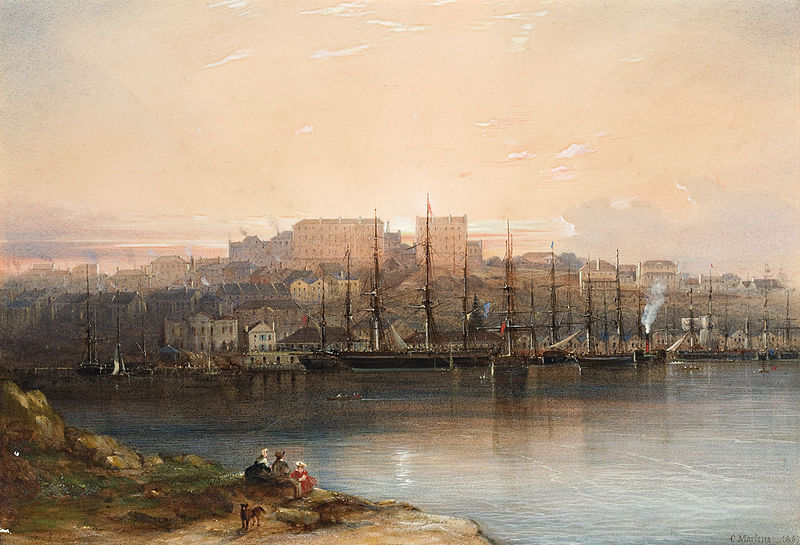
In the days after her arrival, the ship Australia was moored at Campbell’s Wharf in Sydney Cove. It is nothing less than gobsmacking to me that nearly 170 years after the fact, the warehouses associated with this wharf that Mary Chapman might have seen with her own eyes still exist in their original location between the famous Circular Quay and even more famous (much later Sydney landmark) The Opera House.
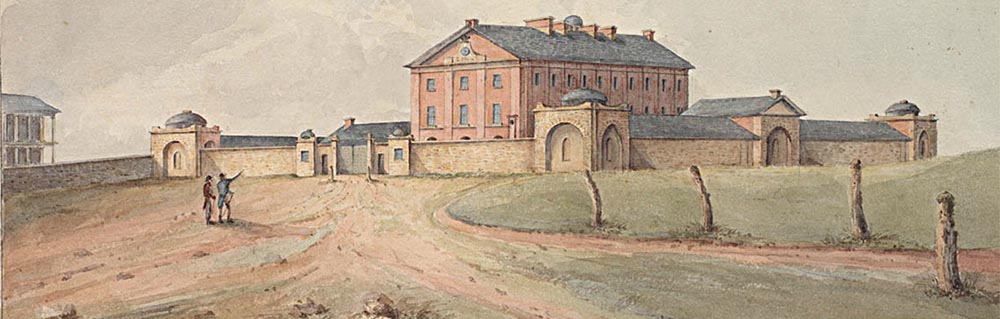
If Mary Chapman was not collected immediately by George Astley, nor was hired by some local family as a house servant, she would have been lodged in what is another miraculous survivor to the present day in the form of the Hyde Park Barracks. Now a museum, it appears to contain a permanent display for the 4114 Irish orphan girls that passed though the building, housed in a structure first built for convicts. Although Mary exactly matches the description of “Irish orphan girl”, she was not one of that particular number. But she would have matched the candidacy pretty much perfectly for the “Earl Grey Scheme” that operated between 1848-1850 during the height of the Irish Famine. She may even have been in an Irish workhouse during that time. But this immigration scheme was well and truly over by 1853 and prejudice against the Irish Catholics was one cause of its curtailment. Mary would have been housed with a non-specific cohort of female migrants recruited by immigration agents who were paid a bounty for their safe delivery. Some as yet unidentified agent was paid £1 for Mary’s arrival into Australia. How much George Astley’s contribution to the ticket fare counted for anything is not known.
Hyde Park Barracks c 1820 (when it was used to house convicts) [SLNSW]
The point to be made is that Mary Chapman was now in Sydney, capital city of the self-governing British Colony of New South Wales. When last heard of, her lover was working for a punch-drunk farmer on the outskirts of Melbourne, once part of the Port Philip District of the Colony of New South Wales, but now capital of the wholly independent Crown colony of Victoria.
As a famous song of the time reminded everyone, Australia was “ten-thousand miles away” from the British Isles. Looking at a map when contemplating such a voyage, the 444 miles between the two capitals must have seemed trifling… It’s not, though. Even in this age of asphalt highways its still an all day drive by automobile and you still have to cross a mountain range.
By 1853, Astley’s employer (from the time had had stepped off the boat in Hobson’s Bay a year ago), Mr Edward Bailey (or Bayley), the Pentridge farmer, had not quite yet reached peak lunacy, but was probably well on his way there. In later years he (Bailey) would locked up for being out of his mind—this was attributed to drink. It is probably a coincidence, (as we know nothing of his parents’ actual habits), that the Astley’s future son George (defying all cultural stereotypes and societal norms) attributed his eventual long life to rarely touching alcohol.
Bailey’s mental health could not have been aided by an incident in 1856 when Mrs Bailey and he left their home for a few days to visit friends in Melbourne. In their absence, a recently dismissed employee who came from Ireland ransacked their house. I know what I’m trying to make you think, and you would be right…Miss Mary Ann M’Cormack was arrested in central Melbourne a few days hence, red-handed with all the stolen property. Regardless of the fact that I am shamelessly trying to ramp up the drama, there is next to no chance the Astleys were involved. Yes, Astleys: plural.
At some time in 1856 (The registration record is lost or was never created), George and Mary Astley were celebrating the birth of their first child, a daughter they called Susan. They were probably living somewhere near the present settlement of Huntly, a few kilometres north of the gold mining boom-town of Bendigo and some 142 kilometres north-north-west of Melbourne. Susan was the first of ten children they would produce together over their three decade marriage. But theirs was not a goldfields marriage.
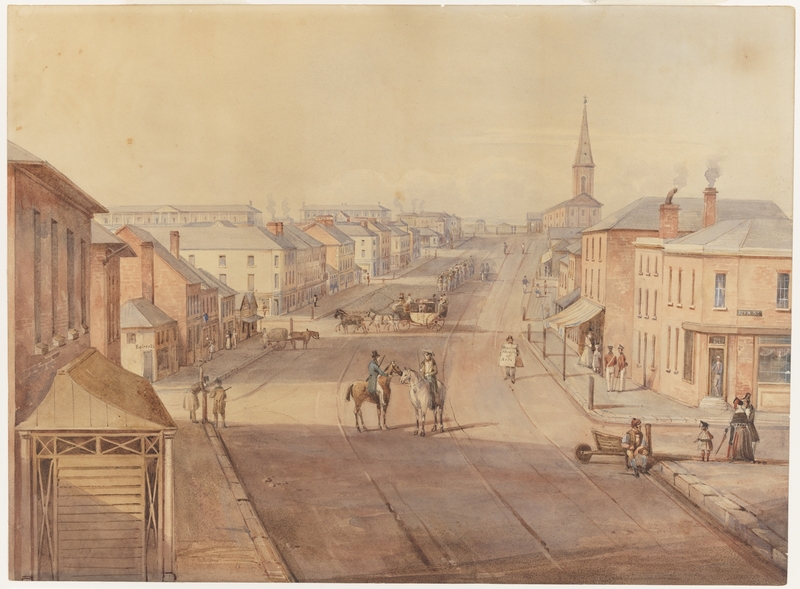
King Street, Sydney looking east, ca. 1843 watercolour by Frederick Garling.
On the 17 April, 1854, a year after arriving in Sydney—another year of uncountable travails— a ceremony took place in the Church of St James, Sydney town, conducted by the Reverend Charles F. D. Priddle, pastor of the Church of England. George Astley was married to Mary Chapman in another building that remains today— and It is worthwhile to observe that from this church’s convict-built (and designed) spire you could look down onto the Hyde Park Barracks building that was located just across the road. Their witnesses were Abraham Summons and Ann Marshall (connection with the happy couple unknown).
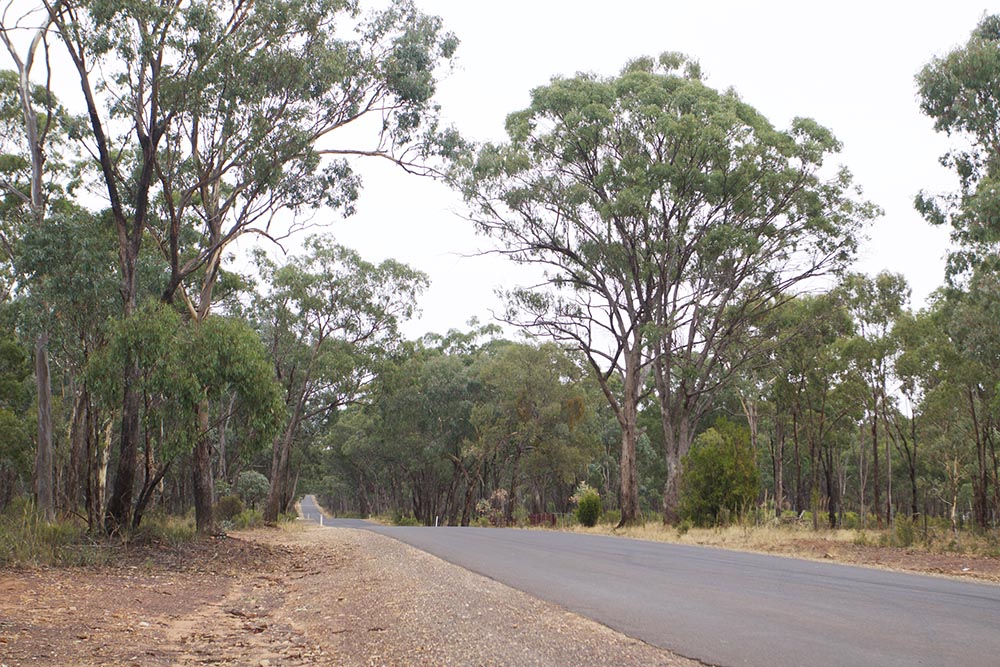
The back road in to Huntly, Victoria, 2017.
They had made it. They had survived. They were together. By the end of that year, by another route unrecorded, George brought his bride back to Victoria and they made their way out towards the Bendigo goldfields, one of the richest goldfields the world would ever find. There they would find their fortune. Not monetary fortune perhaps, but a home and a family who would outlive them…
…and remember them, as I do.
Postscript
SYDNEY POLICE COURT. […] WATER POLICE OFFICE.—Friday.— […] Seventeen seamen belonging to the ship Australia, recently arrived with emigrants from Plymouth, were charged with refusing duty. Captain Avery produced the official log, containing an entry of the refusal, which had been duly read over to the men. The second mate gave corroborative evidence. The prisoners on being asked for their defence, made the usual groundless complaints of ill-treatment. They were found guilty and sentenced to 12 weeks’ imprisonment with hard labour. A disgraceful scene then took place, the men abusing the Captain in the Court, and as they were such a numerous body, and evidently reckless and disorderly characters, the position of the reporters, who were in personal contact with them, was anything but agreeable. They were ultimately removed and locked up.
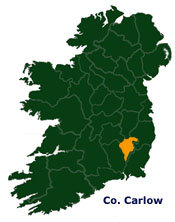
They were two young orphans who had somehow survived the worst years of the Great Irish Famine, if not together, then at least near by. If they had, as George Astley’s younger sister had been, compelled to enter the local poorhouse, George and his sweetheart Mary Chapman would have been strictly segregated. But George’s sister would never leave the poorhouse and was buried in a pauper’s grave in the poorhouse grounds in Carlow, County Carlow, on 14 March 1848. George and Mary were both aged twenty-one, no longer children, so no school or orphanage could protect them now. If they wished to have any future together they would have to get out of Ireland.
On 5 November 1851, a ship sailed from Portsmouth, England with a cargo that included 287 mostly Irish emigrants. The Joshua was under the mastery of Captain H. H. Varian and this was her maiden voyage. Constructed in only three months at Bideford, in the English county of Devon, she (and ships are always she) was bound for the south-eastern colonies of Australia, passage paid for by one of the Colonial governments. Gold had recently been discovered in the colony of Victoria and while it may have seemed that the entire population of the planet were attempting to flock to that place only for their piece of the fabled yellow wealth, yet more souls were needed to replace those farm workers, mechanics, servants and menial labourers who had abandoned their regular employment for the hope of striking it rich on the fields.
But only George Astley sailed with this ship. Mary was still back in the old country. On 15 November, ten days out, in the North Atlantic Ocean, 1000 km from the nearest land, a squall blew up. For a young man who might have spent his entire life in the land-locked Irish county of Carlow and may never have seen the sea until recently, yet alone a storm at sea, this would have been nothing like he could ever have imagined. Then the ships’ masts came crashing down.
Ships disappeared at sea all the time. There was no such thing as GPS, It would be another half century before wireless radio was invented. Passing vessels hailed one another and exchanged names with their captains, who would report who they had encountered, where and when, at the next port they arrived at. It was at the very best, a three month voyage from Britain to Australia. To send a letter and receive a reply would take half a year—If you were lucky. Mary Chapman waited. A whole year passed. Then the letter arrived.
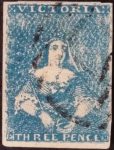
Example of a stamp from the Colony of Victoria circa 1852
If it had a stamp, it was probably similar to the one illustrated here, but this letter was not written by her love. George Astley was alive and living in Australia, but neither he, nor she, knew how to write. If the letter had a postmark, it was probably for the best that Mary would have been unfamiliar with the evil reputation that name was acquiring. George Astley, from the day of his landing in Melbourne, capital of the Colony of Victoria, had been bonded to live and work seven kilometres or so north of the city in a place called Pentridge.
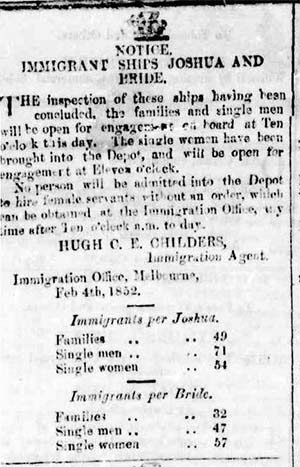
The Argus (Melbourne, Vic. : 1848 – 1957) Mon 2 Feb 1852 Page 2
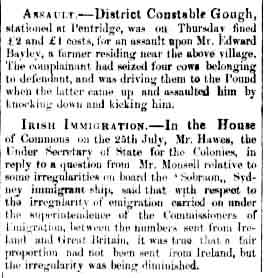
The Argus (Melbourne, Vic. : 1848 – 1957) Wednesday 4 February 1852 p3
The walls of Pentridge Prison in 2011
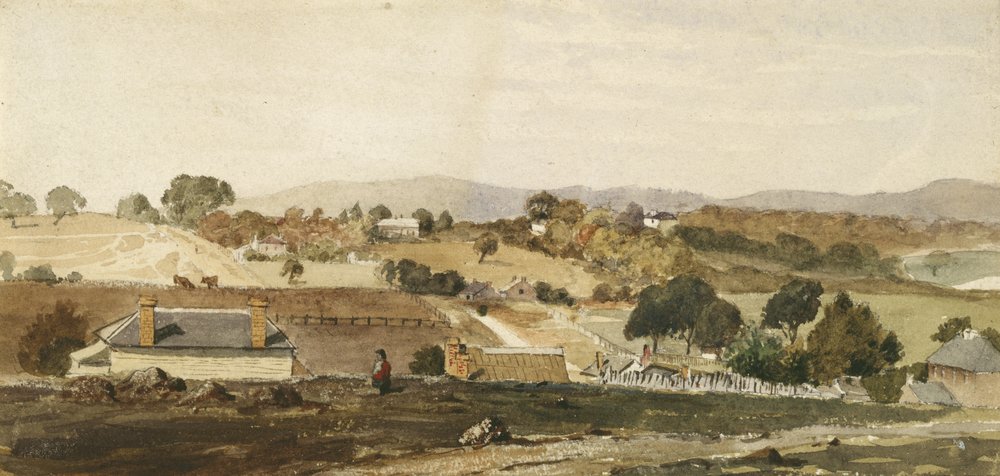
The remains of Her Majesty’s Prison, Pentridge, are located in the Melbourne suburb of Coburg. The locality of Coburg was once also known as Pentridge, but such was the embarrassment associated with the name that the locals changed it in 1870, when the final form of the prison was established. Victorians embarrassed very easily.
In 1849, a year before the stockade that became the prison was inaugurated, Edward Bailey (or Bayley) was the owner of a farm located near the local watering hole, which in turn was located somewhere between the Police compound and the land of a neighbour named Francis Gough. Gough had released some cattle from the station pound and was driving them towards his home when he decided to stop for some liquid refreshment. While he was so engaged, his cattle wandered off into the nearby fields and proceeded to feast upon the young crop of barley. When Gough finally emerged from the tavern, his cows were gone. Following what must have been a pretty obvious trail, he came upon Mr Edward Bailey herding his cattle—right back to the Police pound from whence they had originated. Gough proceeded to beat the living daylights out of Bailey (and presumably retrieved his cattle). It should now be mentioned that Gough was also the local police constable.
The Argus (Melbourne, Vic. : 1848 – 1957) Mon 12 Nov 1849 Page 2
This story has an ending you may not expect—Bailey took Gough to court for assault, and what is more—he won. The jury did not buy Gough’s version of events wherein Bailey just tripped and fell on a fence post—which then brutally kicked him while he was down multiple times. Gough was fined £3 but seems to have remained a policeman. Any policeman, good, bad or just plain terrible was increasingly very hard to recruit in the colony. Bailey remained on his Pentridge farm, even as gold was discovered in the hinterland and the labourers he required to tend his fields (quite literally) headed for the hills.
On 4 February 1852, Bailey travelled down to Melbourne and paid a visit to the Immigration Depot. From there he collected a young man, twenty-two years of age, whose trade was listed as that of a farm-labourer. Mr Bailey seems to have been a realist—although his new employee was only bonded to remain in his service for six months, the fee for his services, which included food and board, was much higher than the colony’s average wage for a farm labourer. Servants were known to head to the goldfields regardless of their legal obligations to their masters. George Astley was contracted to Mr Edward Bailey for the sum of £36. Now it would be only a matter of time he could raise the money he would need to pay for the passage of his beloved to join him…
The Pentridge Stockade as it appeared in 1852 [SLV]
Nearly the same date, in a police court in Sydney, Captain Benjamin Avery, master of the sailing ship William and Mary (and there’s a fine Protestant name for a ship) was eyeballing the five members of his crew he had up on charges of mutiny. Avery was entrusted with the care of immigrants to Australia and he took that responsibility very seriously indeed, well beyond the fact he was unlikely to get paid his if charges were harmed.
WATER POLICE OFFICE.—FRIDAY. (Before the Water Police Magistrate.) MUTINOUSLY COMBINING, &c.—James Cain, Thomas Evans, Lot Gooding, James Jackson, and Henry Evans, five seamen belonging to the William and Mary, were brought before the Court, charged with mutinously combining to disobey the lawful commands of their captain, Mr. Benjamin Avery. This gentleman having been called, produced the ship’s articles and log book, proving that the prisoners had engaged with him on the 19th of August last, for a period not exceeding three years, that on Sunday last they refused to stow the maintopsail when commanded so to do, making use of the most offensive and disgusting language, to the great annoyance of the emigrants and all on board. One of their remarks was, “that the captain wanted to give them a drill, and they would like to knock his b—— head off.” They also quarrelled with the emigrants, and if it had not been for the interference of the captain, serious consequences might have resulted.
The prisoners persevered in their insubordinate conduct for two or three days, still threatening the captain, and using the most offensive epithets, at times rushing aft in a body and making themselves masters of the poop. In cross-examination by the Bench, witness stated that both himself and the surgeon-superintendent, and the surgeon’s lady, had done their utmost to induce the prisoners to desist, but they met with nothing but insult and annoyance in return. He believed, however, that the prisoners were mad drunk the most of the time, and that if it had not been for one or two of them, who appeared to be the ringleaders, it was probable this disturbance would never have occurred.
Cain, on being asked what he had to say in his defence, denied that he and his companions had taken possession of the poop in a body, explaining that he alone was on the poop, and that he happened to be there for the purpose of asking the captain for a glass of grog. Thomas Evans, on being called upon to defend himself, admitted that he had refused to furl the sail, but contended that if he and his four companions were to be brought up for this offence, the whole of the crew ought to be brought up also, as they were all equally guilty. Gooding, in his defence, simply stated that the Captain had called him a lazy idle fellow, and promised to kick him out of the ship when she arrived in Port Jackson. On being asked what he had to say in defence, wanted to know what he was brought here for, and receiving no answer, he said nothing further. On the question, “what have you to say in defence?” being put to Henry Evans, he replied, that after the manner in which the answers of his companions had been treated, it was very little use for him to say anything, as it was very evident that a poor seaman would stand very little chance in that court.” He concluded by observing, that the Captain had not “treated any of the seamen like gentlemen.”
They were each sentenced to 12 weeks’ imprisonment with hard labour, at the expiration of which time, to be returned to their ship.
Avery might well have wished the five were not returned to his ship, but in common with nearly all employers within the land and territorial waters of the Australian colonies during this mining boom-time era, he had to make do with what he could get. At least at sea, employees could not run away. Benjamin Avery was one of the most experienced mariners on the route from Britain to Australia and his reputation transporting immigrants was good. Maybe he had just been unlucky with his crew on this occasion. His next ship, surely, would have a superior crew?
A little over a year later, Avery sailed from Plymouth, England with his latest command, sailing once again for Australia on what would be his fourteenth voyage on that route. He had a similarly experienced ship’s surgeon on board in the person of Dr Davidson (four tours), who was the superintendent in charge of the welfare of the 326 emigrants his brand new ship was carrying, — there was even a school master, Mr. Pennington, to instruct the fifty-four children of the requisite age. Being a new ship, he had recruited a fresh crew of thirty-seven, and he had learnt his lesson from what had gone wrong last year and introduced some new strict regulations to ensure that after what his former passengers, particularly the female ones, had gone through last time, they would never had to experience that kind of thing ever again, under his watch.
What must of given Captain Avery some cause for concern, was that close to half of his charges, 144 of them, were single young women. One of them was Miss Mary Chapman from Carlow in Ireland, bound to be reunited with her beloved in a far distant land…
Avery’s new ship was called the Australia, and this was her maiden voyage. What could possibly go wrong?
I started writing this story for posting about the time of Valentine’s Day but only now that it’s St Patrick’s Day do I find myself completing it. This is not altogether inappropriate as ultimately this is a love story from Ireland. It was difficult to complete for all the usual reasons all family history can be difficult to write: There is always the hope that some new fact will come to light, but when it does every thing you thought you knew has to change. But also:— this is a love story with a happy ending, and religion plays a positive role in the couple’s happy ending even as it compounded the inexpressible misery and horror of events swirling around them. All these facts are as confronting to my worldview as it would be to discover proof positive unicorns are real.
Potato blight is a form of water borne mould.
First: some backstory. In the year 1845, the island of Ireland stood on the brink of disaster. Two out of every five people depended solely on the potato crop for their survival. That year the potato crop failed. Seven is a nice apocalyptical number and that is roughly the number of years the great famine endured. At the end of that time one in every four man, woman or child who was in Ireland in 1845 was no longer. Over one million were in their graves, the rest were over the seas, some in the colonies of Australia; such was the fate of two young orphans: George Astley and Mary Chapman.
Being orphans, they were without family protection. Mary’s parents had died when she was an infant. She was never taught their names. George was in the care of an uncle for a while, but he too may have been gone before his time. His uncle’s family name was either Astley or Fulton. Whether he was the brother of George’s father, named George or his mother, Mary, is not known. George Astley, junior, also had a sister, and by her record we also have a good idea that George’s uncle was dead or no longer in a position to look after his nephew and niece by the middle years of the famine.
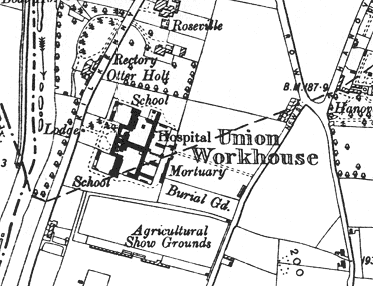
1908 map of Carlow
Mary Anne Astley died in the poor house of Carlow town, County Carlow and was buried in an unmarked grave at the institution’s burial ground on 14 March 1848. She was only twenty years old. George Astley and Mary Chapman were both about the same age, perhaps a year older. Whether they were also in the poor house, also known as the workhouse, is not yet uncovered. To be in such a place was the last resort for those with no other hope. Yet George and Mary did have hope, and the vehicle for that hope was part of the same mechanism that had bogged Ireland and the two young orphans in the slough of despair that currently engulfed it: British misrule and the Protestant church.
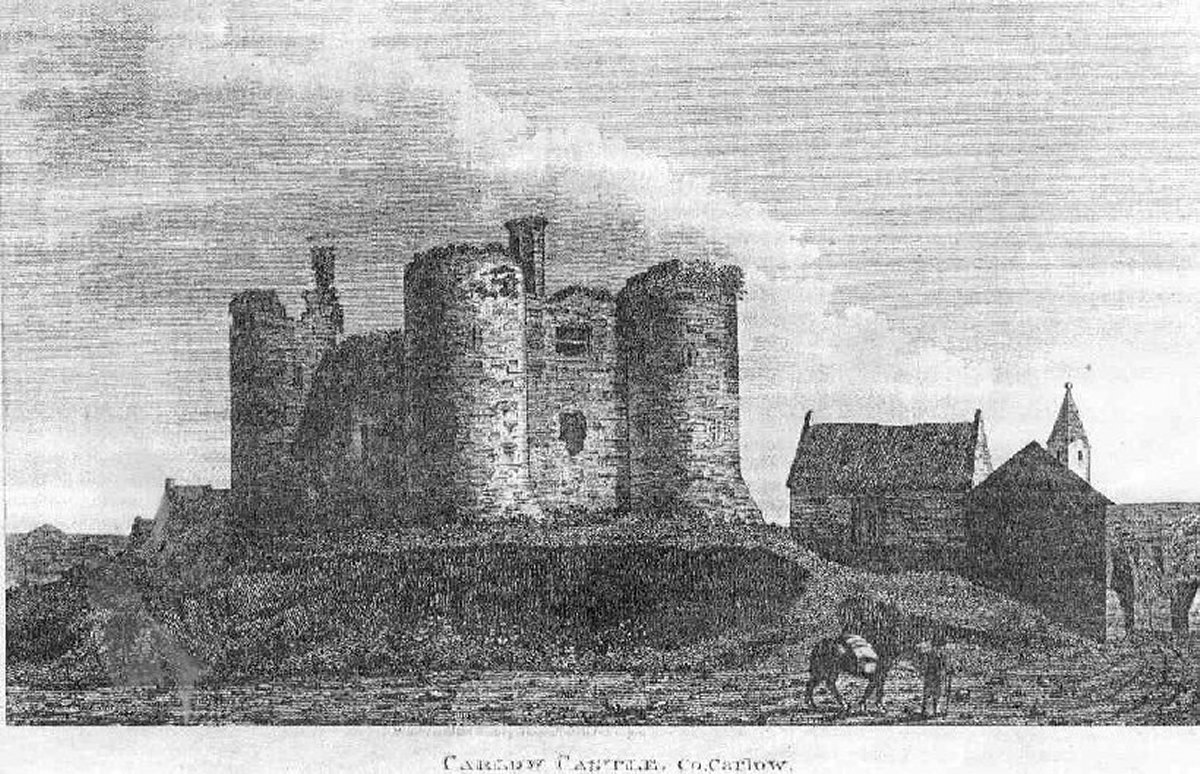
Carlow castle in the eighteenth century. There is much less of it now.
Young Mary and George would have known well the ruins of an ancient castle that dominated the centre of Carlow town. It had been mostly demolished some years before they were born (Irrelevant aside: blown up in an abortive attempt to turn it into a lunatic asylum) yet it remained a symbol of foreign domination of Irish culture and politics by a foreign power as it had been for centuries. Construction of the castle was attributed to the famous Anglo-Norman head-kicker William the Marshal in the twelfth century CE, but let us forward four hundred-odd years to the reign of the English Monarch Henry VIII. He is an easy scapegoat as any to blame for the mess Ireland was in at the time of the famine, or for that matter, our time in 2018.
Henry the pig-face is the perfect illustration of how you can have all the historical tides of sociological, cultural and political inevitability you like indicating change in a certain direction, but it the end it can all boil down to one human and one decision to change the course of history. In this instance it was Henry’s decision to make himself the head of the Christian Church in England in place of the Bishop of Rome.
anti-pope
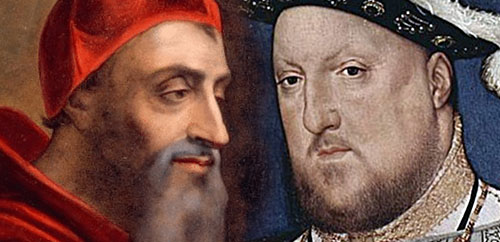
In any other century this might not have been such a big deal, after all, it was not so long ago there had been more than one Pope (some times as many as three). As far as Roman Catholic unity went, it was also not long since that the troops of the Holy Roman Emperor Charles V sacked Rome and imprisoned the then current Pope Clement VII. But Henry’s new Church of England (and its Irish equivalent, the Church of Ireland) could never quite extirpate the old loyalties to Rome, the fault line amid the population widened as the doctrinal differences evolved between the adherents to Roman Catholic Church and those who identified themselves as Protestant. All this because Henry wanted to shag a girl he wasn’t married to…
Clement VII or Henry VIII, you choose (Hint: what ever you choose the other one is going to kill you)
Three hundred year after the break from Rome, there was not much point in trying to make the case who had the better moral argument to survive. Both sides had gained the upper hand politically at various occasions, at which point they would persecute without mercy whoever happened to be the underdog. By the beginning of the nineteenth century, this was the situation in Ireland: The population was roughly three quarters Roman Catholic with the remainder being adherents of the Church of Ireland or Scots Presbyterian. However, members of the Church of Ireland had the monopoly on political and economic power. When Ireland was formally absorbed by Great Britain into the United Kingdom and its native parliament abolished in the year 1800, this signalled, paradoxically, the beginning of the end of this era of unrestrained power (and the abuse thereof) exercised by the Church of Ireland on behalf of its followers, during what was self-explicably described as the Protestant Ascendancy. Over this period Catholics (and Presbyterians too) were denied the franchise and just about every other conceivable human right. But the pendulum of power was swinging slowly in the other direction: during the nineteenth century the Church of Ireland was slowly stripped of its secular power: Tithes were scaled back and finally abolished, eventually the Church was abandoned by the state and disestablished towards the later half of that century. By 1845 Protestants in Ireland, although they then still had total control over the law of the land, ownership of the same, and all the civil apparatus of government, must have seen that their days of unfettered control slipping as Catholics slowly regained their right to vote, own property, educate their people, and be employed by the very government itself.
So who were these Protestants? They were concentrated mostly in the north of Ireland, which contained the few counties where they were (and still are) a majority. They were immigrants from Scotland and England, but many families had lived in Ireland for generations, some dating back to the Norman invasion. Some Anglo-Irish families could be indistinguishable from the native Irish in language and custom. It’s foolish to talk about pure Irish, or pure anyone. I know nearly half of my own ancestors originated from the far north of Scotland and had been there for uncounted centuries: They are Scots. Yet according to science nearly half of my DNA indicates an original homeland in Ireland. There were certainly many Protestants who were native Irish, but the fact remained that the Catholic religion remained a majority in the country if for no other reason than as a reaction to British rule.
Wrong choice.
The Protestants did themselves no historical favours. When in 1798 Ireland erupted into full rebellion against the British Crown and the Irish parliament in Dublin, the revolt was violently suppressed. Because the majority of the rebels were Catholic even as the United Irishmen themselves had Protestant leaders, zealots could choose to present it as a sectarian conflict and did. One of the set-piece battles took place in the town of Carlow on 25 May 1798, where prior to the bloodbath, relations between the Catholic and Protestant inhabitants of Carlow had been characterised as “friendly”. Without a single casualty on their side, the British Army killed about 500 civilians and rebels (No distinction was made). Another 150 were summarily executed in the aftermath. Wading though the blood were such characters as the Reverend Robert Rochford, known as the ‘slashing parson’.
“In a very short space of time, Orangeism, Protestantism and oppression became synonymous concepts in the minds of the Catholic population.”
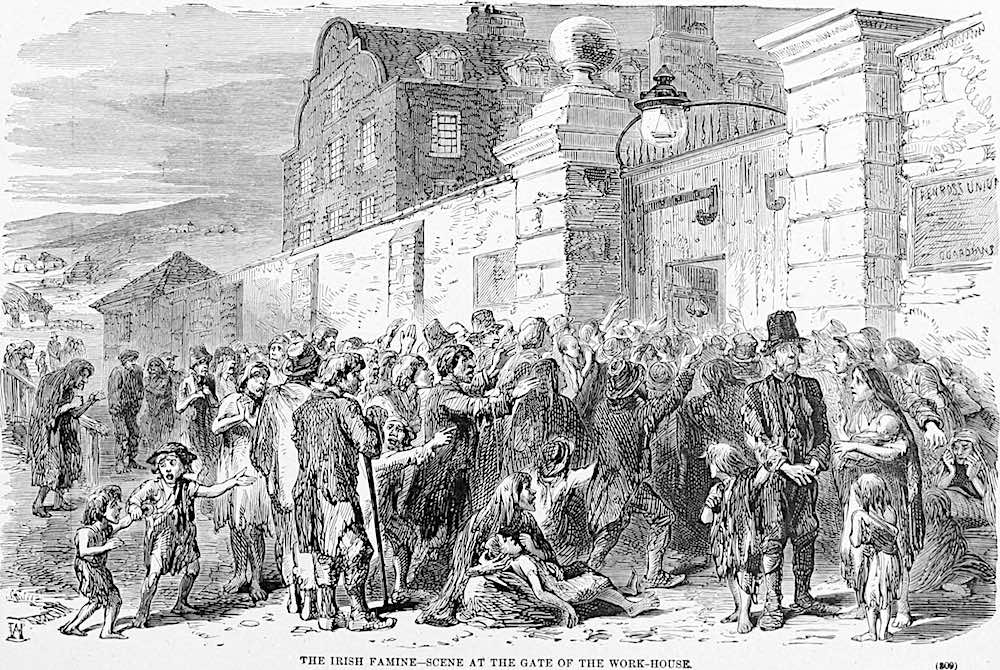
In 1845, when the great famine began, the end (however remote) may have been in sight for Protestant domination of (most of) Ireland, but direct rule from London had brought with it new institutions such as the Poor Laws, and the Workhouse—run exclusively by Protestants. Most Catholics would rather have starved than enter the Workhouse, and that was the point. Being poor, without a home, or starving was practically a criminal offence and workhouses were the gaols. During the peak of the famine the workhouses became concentration camps for those evicted from their homes for being unable to pay their rents due to the failure of the harvest; for those who could not afford to pay for what food there was, as the Laissez-faire policies of the Government saw food shipped out of the country because that was where the profit was. But Laissez-faire ideology stretched only so far: for fear it might hurt the bottom line of the local magnates and land owners, imports of food to Ireland were barred by the government. Mediocre food and poor accommodation in the workhouse bred the inevitable result: disease.
When the food ran out there was no choice left. [Wikmedia commons]
In Carlow, the poorhouse building has been long demolished, but on the site of the burial ground where Mary Anne Astley lies, there is a monument to the over three thousand men, women and children buried there who were “victims of poverty, famine, cholera and injustice” (according to the inscription). If you were Roman Catholic in Ireland, you were given no good reason to love your Protestant neighbour; he was probably your landlord or on the board of governors for that local poorhouse. But here was a twist: the late Mary Anne, her brother and his sweetheart too; all three were Protestants, all members of the Church of Ireland. Both Chapman and Astley are names of English origin, but how long their families had been in Ireland cannot be known. In 1848, none of them had a family. Ultimately, a Protestant could starve to death in the workhouse just as well as a Catholic, so how did George Astley and Mary Chapman survive?
In Australia.
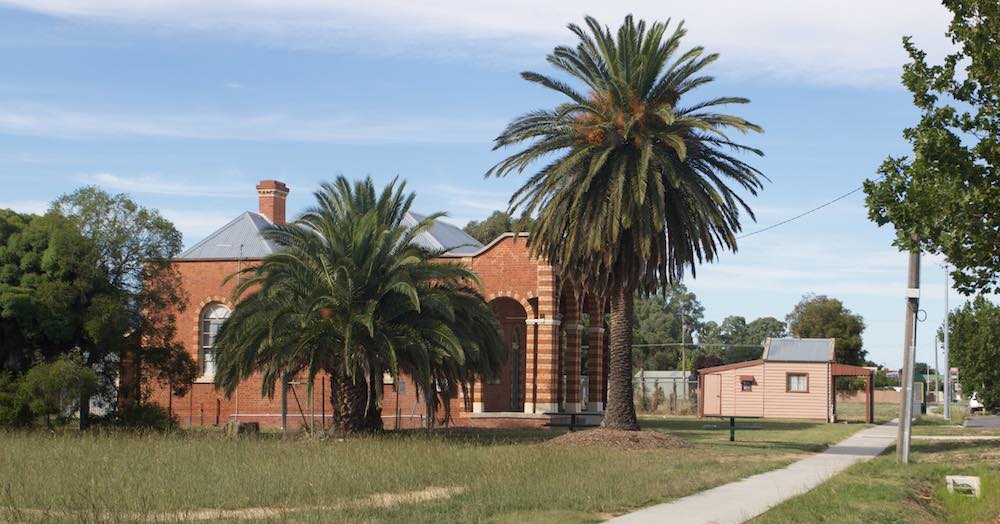
The former shire office for Huntly in 2017. It is now the offices of the local history society.
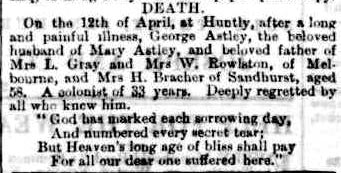
Huntly is a small town in rural Victoria several kilometres north of the mining metropolis of Bendigo. Huntly was also a mining region in its own right back during the gold rushes of the late nineteenth century. It was here that George Astley and Mary Chapman made their final life together. George was a local government contractor, which meant that he must have been able to turn his hand to just about anything. They were married for thirty years until George’s death in 1885 at the age of only 58. Mary outlived him by nine years and they were finally re-united at the White Hills Cemetery outside Bendigo. This is quite a puzzle as George had been involved with a Cemetery Board for Huntly. Why were the couple not laid to rest there? The site of their grave at White Hills has been lost, but that is a rant for another article.
The couple were both deeply invested in the civic life of the Huntly community; the meeting about the above-mentioned local cemetery was but one example. George was on the local School committee, and involved in local government politics, but it was as parishioners and members of the board of the local Church of England parish that they and their family were most committed (It is worth observing that the local school was an Anglican-run institution at the time of his membership on its board). Their strong connection with this church is documented in the numerous mentions of family names in the contemporary newspapers in connection with High Church business, often concerning quite absurd personal disputes that thankfully, they seemed to remain on the periphery of.
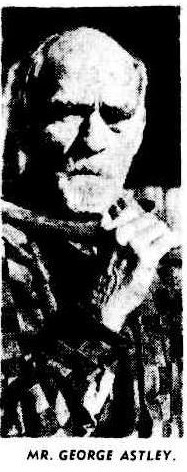
George Alexander Astley in 1957. He lived to the age of 93.
One of their sons, George Alexander, and a daughter, Rebecca Edith, were both recorded being awarded prizes at the anniversary celebrations for the Church of England Sunday School during 1879. It is thanks to this son, one of seven out of ten children George and Mary had together who lived to adulthood, that we have some clue as to how his parents survived Ireland, and indeed met in the first place.
According to a letter written by George, preserved in the archives of the Huntly Districts Historical Society (without whose kind and generous cooperation this article could never have been composed), his parents met at school back in Ireland and there became lovers. That is their son’s own word for their relationship.
Which school?
A gazetteer for Carlow in the year 1839 describes the following:—
“A Parochial School is aided by an annual donation from the Rector of £10. There are two National Schools and an Infant School — a Ladies’ Association, for bettering the condition of the Female Peasantry — a Protestant Orphan Society, where the children are clothed, dieted, lodged, and educated — a Cloathing [sic] Fund Society, and a Fever Hospital. The District Lunatic Asylum for the counties of Carlow, Kildare, Wexford, Kilkenny, and the County of the City of Kilkenny, is situated in this Town, and was built in 1831 at an expence of £22,552, 10s. 4d.;- it is under excellent regulations, and is calculated to accommodate 104 Lunatics.”
One day it may be possible to investigate the records of these institutions located in Ireland, but for the moment only the calculation of probabilities says that this is where they met, and where they obtained their rudimentary education—for it is a documented fact that while George Astley and Mary Chapman could both read, neither could write. Maybe that was sufficient to ensure their survival. They could read about the opportunities to get out Ireland, about schemes of sponsored immigration to such places as North America, or the distant colonies of Australia. That was a chance denied to most Irish Catholics. All the Carlow institutions mentioned in the gazetteer above had one thing in common; they were restricted in access to the Protestant minority, desperate to maintain their separate identity within an overwhelmingly Catholic majority—a majority who day by day they were giving more reasons to hate their guts.
George and Mary would get out of Ireland, but they were not yet married and the transit to the other side of the world would test their commitment to each other as much as anything they may have endured in Ireland, in the workhouse or beyond. When they set sail, they would never see Ireland again. But would their love survive the oceans?
A few days ago the early warning systems of the islands of Hawaii announced that a intercontinental ballistic missile was heading their way and it was not a drill. Forty-eight hours ago, black ash floated down on the suburbs of Perth. The air not only felt hot, it smelt it. The mid-afternoon light dimmed to a dark orange. The forests around Mundaring were on fire. Twenty-four hours ago the rains began. These were ex-cyclonic rains, they started and did not subside. Twice a summer’s month rainfall fell in a few hours…
… This morning I did some business with my computer. Today was to be one of my research days and I noticed that a small update was required for my laptop. While the download took place I got ready to go into the library, when I returned about ten minutes later the re-start took place and my lap-top was dead—utterly destroyed.
All my research notes, photographs, records, databases of the past decade were on that computer and all were gone— at least until my mirror backup system finishes its work in about seven hours time. In practice, I’ve probably lost about two weeks, (probably less) of emails and photographs. Only the photographs really mattered. I had taken a hundred or so of family photos over the holiday period, now only a dozen or so— either printed out, or shared on social media— survive. At the end of the day, only I know there were many other images that once existed. All anyone else will ever know is a possibly fading piece of paper or the caprice of the magnanimity of a social media company to continue to maintain someone else’s memories.
On the weekend (before the world ended) I watched a documentary called “Stories We Tell” by Canadian activist/actor/director Sarah Polley. The subject matter resonated with me for reasons that will become very clear to anyone when they see this film. I highly recommend that they do. That it concerns the director’s search for her biological father and the effect this has on the rest of her family doesn’t really do justice to the scope of this work. The approach she has taken in this work is uncompromisingly critiqued in the very documentary itself so I don’t think I need to say any more here, except to say, I don’t think I could be so unflinchingly honest about certain aspects of my family story. With both she, her parents and biological father being either professional actors and/or Canadian cultural celebrities it should have been no surprise that there was so much archival visual material to call on. Yet I was continually amazed that at key moments in the story there seemed to be the exact bit of 8mm film that matched what the script was describing, including footage from her mother’s funeral and family parties that showed exactly the key moments in the family’s history. Could they really have been that fortunate?
Only towards the end of the film does a bit of un-commented on business show the reconstruction of these key moments by a film crew aided by lookalike actors, including the director’s sister in a blond wig who looked more like their mother than their mother did. This footage might be described as “fake” yet it blends in so seamlessly with existing material, except in the more obvious moments, how would anyone tell? Abruptly, my viewing ended about (I guess) five minutes before the end as my broadband internet connection failed again… It was that sort of weekend. But it got me thinking—If it had failed five minutes earlier, would I have even known that much of the supposed archival footage in this film was not authentic? And if I did not, what difference would that have made?
I’m writing this in the Battye Library in the centre of Perth. All around me are the records of the fragments of history, not only relating to me, but of the entire state of Western Australia. In case of a fire, flood, nuclear missile strike, power failure or hard-drive crash, how much of our shared heritage would be unknowably gone?
There is currently no known authentic likeness that exists of James Dyson.
He was a prominent man of his time— merchant, land owner, Perth City Councillor—he was present at certain key events in the history of the city: He was definitely present at the opening of the Perth Town Hall, he was most likely present at the opening of the Perth Railway Station, The Wesleyan Church, Royal visit, parades… All these events were photographed, but there is no currently identified photograph of James Dyson. Even of his many, many children (with one notable exception that possibly explains the rule), no images appear to have survived.
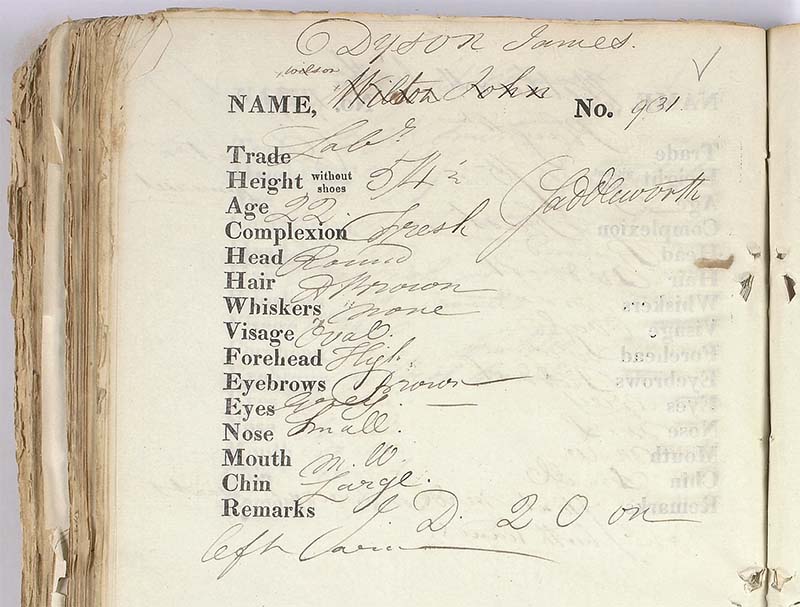
The veracity of the sole written description that comes down to us of his appearance depends whether you accept (as I do) that he was a Van Diemen’s Land convict, in which case we have this documentation:
CON18/1/15
Now, it is possible to feed these details into an identikit program to generate an impression of what Prisoner 901 looked like. Best of all, there is such a program exactly for Australian Convict records, and when you run that program, you get this:—
(The only parameter I had to change was the eye colour that the program kept trying to make brown rather than the stated grey.) Try it for yourself!
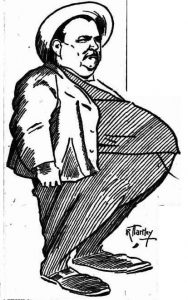
Although he was a bit shorter than today’s average, a number of his sons were noted for their height… and width. (Given that the family were involved in both the butchering and baking trades, it’s a fair bet that improved diet had much to do with this).
Always classy: Drewy Dyson
Going to the extreme (as always) was Andrew Dyson. Drewy achieved his greatest fame at the end of the nineteenth century for being the fattest man in Western Australia. He is (I guess, inevitably) the only child of James for who original likenesses exists*, and being Drewy, they exist in excess: many photographs, written descriptions and even cartoons.
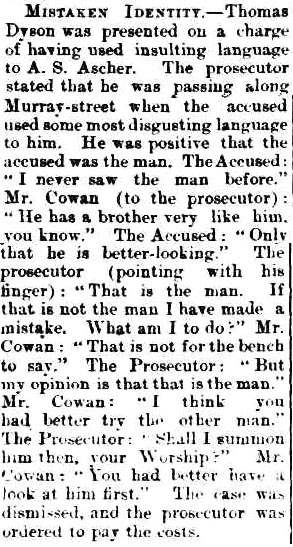
Drewy Dyson also provides us with a very good idea of what his elder brother Thomas looked like. One day in May 1897 Thomas Dyson was hauled into Court to face Mr. Cowan, the Police Magistrate:—
The Inquirer & Commercial News (Perth, WA : 1855 – 1901) Friday 14 May 1897 p3
Traces of James might be seen in a scattering of images of his grandchildren. George Henry “Harry” Dyson (left) was Thomas’s eldest son and clearly shows shows the family similarity to his famous uncle if not also his grandfather.
Ellen Christina Edwards is sometimes considered to be James Dyson’s daughter although in all probability she actually was the daughter of Jane Devling (Dyson’s second wife) and her first husband Richard Edwards.
This image of one of her own daughters is interesting to compare how much of Jane and how much of James there might be in the many children they did have together. While we might have some sort of image for James now, for his wives we have less than nothing.
Including Ellen, Dyson had twenty-two children, nine of who would go on to produce offspring of their own — of those nine there would be only one surviving grandchild from the children of his first wife. (This happens to be the branch of the tree that I am descended from). Recently the existence of some earlier family photos of my Dyson family have become known to me and some of the blanks of a visual map that ties me to this family were filled in, but there is still so much missing. The appearance of Joseph Dyson, James’s eldest son remains a complete mystery to me.
What do you see when you see a family photo?
About ten years ago I started researching my own family history. As a graphic designer, it was perhaps inevitable that I would start by collecting and restoring family photos… Isn’t there a saying: “When your only tool is a hammer, every solution starts resembling a nail”?
Scanning and cleaning up the old photo albums was to make connections with how grandparents looked like their grandchildren, children like their parents… or not, as was my case. Then my siblings started families of their own, and in the faces of my beautiful nieces and nephews I saw the their parents, and grandparents, and back through the generations as far as the visual record stretched. What I didn’t see is me. When I looked in a mirror I didn’t see family, only a stranger stared back.
For until that time the only family I had ever known was my adoptive family.
To be utterly clear, they are and always will be my family. And 100% of the time me being adopted has been a non-issue. It had never been a secret; just a matter of fact— like the sky being blue, or that pineapple on a pizza is an abomination. —But there was something missing that until I found it I could not define.
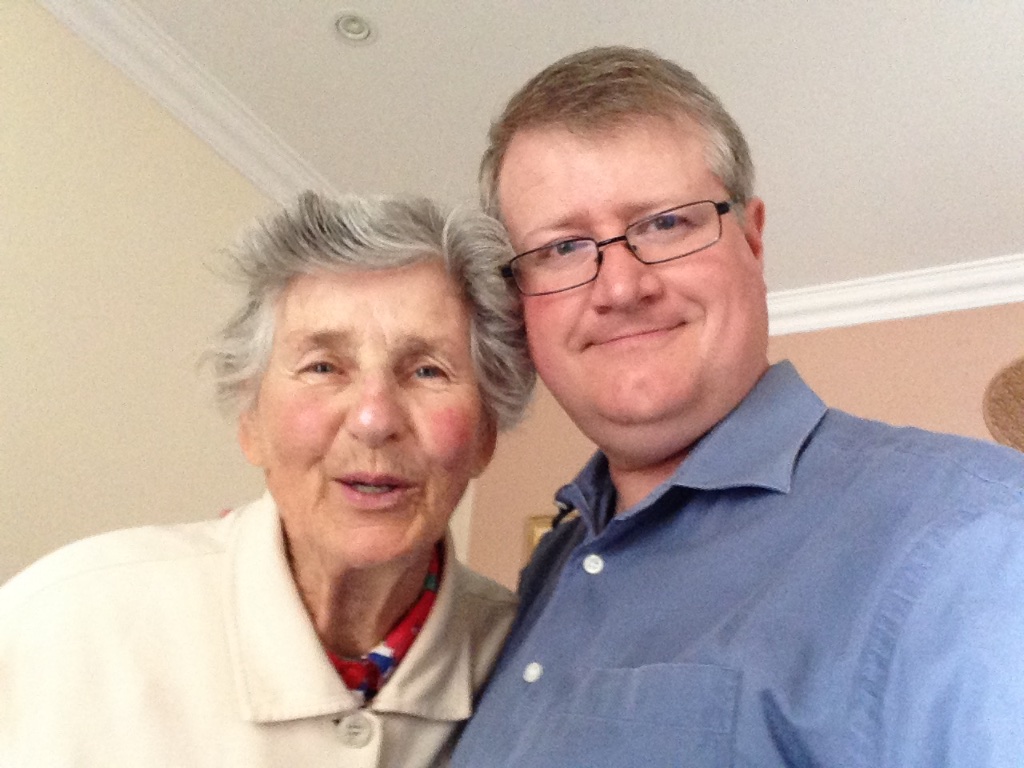
The Dysons are part of my biological family. My maternal grandmother was born a Dyson. In 2009 we finally made contact. In 2017 she was 88 years young.
My grandmother and me, 2017.
There is no one reason why I began my family history search, or why I continue with it—I refuse to differentiate between my adoptive and biological family trees — They are both integral to who I am, and that is possibly one of the answers, I feel a sense of completeness in myself that I had never felt before—that and the ability to channel the inner bastard that I know now to be integral to my heritage.
When I look in the mirror I no longer see a stranger.
Now where the hell is that photo of James Dyson I know must exist?
Television and photo-plays have theme tunes. Nation-states have theme tunes which they call National Anthems. For most of Australia’s past two centuries, the national theme tune has been “God Save the [Queen/King]” (which does say quite a lot about the mentality of those who made that choice). Outside show-business identities and fictional characters, real people tend not have their own personal theme tune which plays whenever they make an entrance in to a room. (The President of the United States’s personal theme music pretty much confirms my previous observation.)
Thus, it is pretty damn special that I can now confirm that James Dyson (1810-1888) convict, entrepreneur, ratbag and most glorious ancestor of them all, also had his very own theme tune that the band struck up when he rose to his feet.
A theme tune isn’t like a personal favourite song,— the recipient doesn’t have to like it— whether Old Man Dyson appreciated his choice we can never know, but if he did understand the full significance of what was assigned to him, I would like to think he would have smiled, if only ironically. Then, as now, and probably throughout all of musical history, the smash-hits and ear-worms of contemporary musical culture were adopted and championed by those who assigned a meaning and significance to the music exactly opposite to that intended by the musician creator.
So it was or could have been for Dyson’s very own theme tune “A Grand Old English Gentleman,” delivered by the ensemble of the “Free” Templar Band on the occasion of the thirty-ninth anniversary dinner of the foundation of the “Sons of Australia Benefit Society”.
Mr. M. STOKES proposed the next toast, that of the Treasurer of the Society, Mr. Jas. Dyson, speaking in eulogistic terms of that officer’s services. The toast was enthusiastically received, the Band playing “The Fine Old English Gentleman.”
Mr. DYSON, in responding, thanked the meeting for the hearty manner in which they had disposed of the toast of his health.
I would guess that is was only the melody of the chorus line “Like a fine old English gentleman, All of the olden time.” that was played by the band, that would have been enough to get the idea across. As with any assembly of nineteenth-century men in self-congratulatory mode, it is impossible to tell whether they were mocking or deadly serious in their appreciation of what was, by 1877, already a hoary old chestnut, although, in its original form, it had only been composed back in 1835;
I’ll sing you an old ballad That was made by an old pate, Of a poor old English Gentleman Who had an old estate, He kept a brave old mansion At a bountiful old rate With a good old porter to relieve The old poor at his gate Like a fine old English gentleman, All of the olden time.
In 1835, James Dyson had been a year in Van Diemen’s Land, and a convict for twice that time. It may have been a longer time before that when he had last known the protection of a family home in the old country of Lancashire. The family James Dyson left behind certainly had no “brave old mansion“, and it was not until 1861 when his older brother Andrew became master of the decrepit manor house, Birchen Bower, complete with ghost story, legend of buried gold, and Chartists drilling in the neighbouring fields, that the Lancashire Dysons had substantial property. James Dyson had been a land owner at least since 1848 when he bought a lot on the corner of Murray and King Street in the city Perth. He also owned a swamp. If Dyson though about this at all at that time, he had a reason to smile.
A song has to get really popular first before it can be successfully parodied, so “A Fine Old English Gentleman” had been parodied many times indeed— even by 1877. The most famous example was penned as early as 1841 by no less than the most famous English author of the nineteenth century, Charles Dickens. The melody, on the other hand, was nicked about a decade later by Sir Arthur Sullivan, the respectable half of the Gilbert and Sullivan musical team, and used in their production of the “Mikado” (1885) in the opening of the number “Behold the Lord High Executioner”—
Understanding where this motif comes from adds another layer to the comedy and demonstrates that W. S. Gilbert was not the only subversive one of the pair.
Then there were the straight re-writes of the lyrics to the same tune, Here is one from a Queensland newspaper of 1899, by an anonymous someone with no sense of humour whatsoever:
[…] Now surely this is better far Than all the new parade Of theatres and fancy balls, ‘At home’ and masquerade : And much more economical, For all his bills were paid. Then leave your new vagaries quite, And take up the old trade Of a fine old English gentleman All of the olden time.
The piss was asking to be taken, and us Australians did it as early as 1860 in a version entitled “The Fine Old Border Squatter“.
But here is the final twist, the song lives on today, stripped of it original lyrics, and according to the performers of this latest 20th century iteration:—
The original, a bourgeois pop song of the eighteenth century, gives a sycophantic picture of a rich old port-wine and roast-beef character, lolling on his estate and being kind to the poor at Christmas time. The present version gives the old song the ‘alienation’ treatment, by substituting a lower class hero, firmly non-conforming in habits. The Tinkers say: it was taught to us by John Howarth’s stepfather when we were barely of drinking age, and we’ve since heard it in many a pub: in fact, it’s quite a favourite taproom song in Oldham.
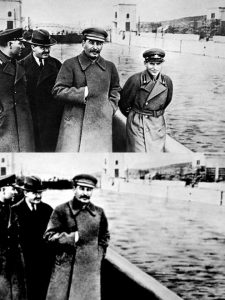
My pet peeve is the way certain of my ancestors have been air-brushed out of history just as blatantly as a Soviet apparatchik on one of Stalin’s bad days…
Dyson, the Perth marine-store dealer of Falstaffian brawn, is connected with the Groperopolis Wesleyan Church. Leastways his father built it. Old man Dyson, the yarn rues, had to wait a deuce of a time for his money.
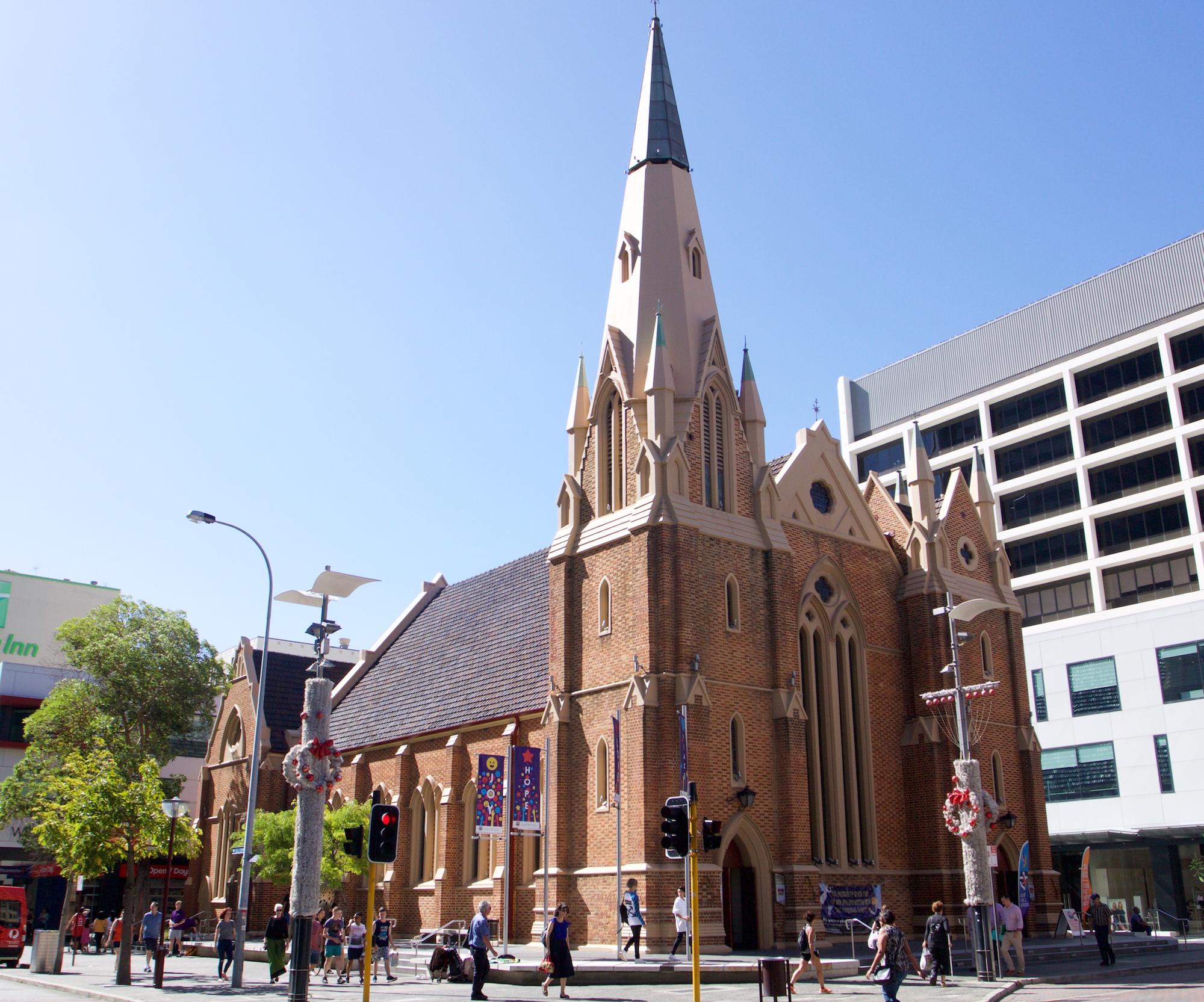
This Dyson, is of course, Drewy, and the church his father James was supposed to have built is the Wesleyan Church on the corner of Hay and William Street. Completed in 1870, it is one of the earliest surviving buildings in Perth.
Wesley Church this very day, Perth, Western Australia
Aged nine in 1867, Drewy claimed to have worked on the build himself:—
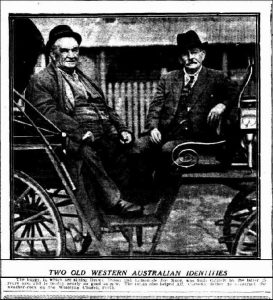
“Drewey Dyson’s dad built the present Wesleyan Church. […] Anno Domini 1867, when Dyson, sen, was building the present Wesleyan Church, at the corner of Hay and William-street, the present Drewey Dyson, of West Perth, was billy-boy on the job, and used to make the tea at midday, run messages, and generally make himself useful in a small-boy way.”
Sunday Times (Perth, WA : 1902 – 1954) Sunday 2 July 1922 p7
Then there was the famous article and photograph of Drewy and “Lemonade Joe” Moor from 1922 which mentioned how the two assisted a Mr Carson to build the weather-cock on the Church steeple.
That seemed to be enough evidence:— James Dyson had built the Wesley Church, where his son Joseph would later be a Sunday School teacher and another son would be convicted of throwing eggs at the parishioners…
… Then I read all the official Wesley Church histories I could find… There have been quite a few over the years, mostly by pastors past and present, and the tale they tell is of progress ever upwards (but never quite explaining the utter irrelevance of their movement by the later half of the twentieth century and beyond). The most recent of these, however, was not written by a cleric, so was refreshingly open about some of the less than saintly shenanigans surrounding the institution. In Thea Shipley’s Full Circle: A History of Wesley Church Perth, published in 2003, there was a whole chapter devoted to the construction of the church building. Because I felt I could trust this author not to sugar-coat the history, and because there was absolutely no mention of any of the Dysons in any of the earlier histories either, I was forced to the conclusion that James Dyson’s role in the construction of the church was yet another Drewy Dyson fantasy. Benjamin Mason, Dyson’s rival in the timber trade was definitely recorded as having provided timber, and William Buggins, a well known builder of the time (and also connected to Joseph Dyson’s in-laws’ family) was mentioned to have overseen construction, that clinched it for me.
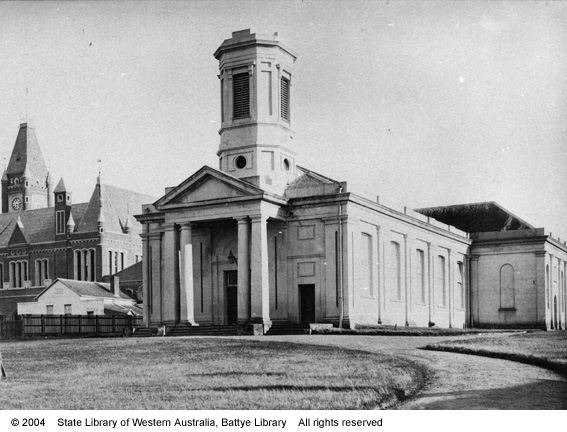
The front of the original St George’s Cathedral in the late 1860’s
It was not impossible that Drewy had miss-remembered which church his old dad had worked on. Construction on the first St George’s Church commenced a few years before James Dyson arrived in the colony. By March 1842, progress was still crawling as the iron roof ordered from England failed to arrive. As was noted in a later history:—
“It was then decided to make a wooden roof locally and the sawyers in the Colony combined to raise the price of timber for the purpose.”
[T. G. Heydon, “The Early Church in Western Australia”, The Western Australian Historical Society (Inc) Journal and proceedings Vol II. Part XI p1]
James Dyson was on the ground by now, and this sounds exactly what I would have expected him to do…
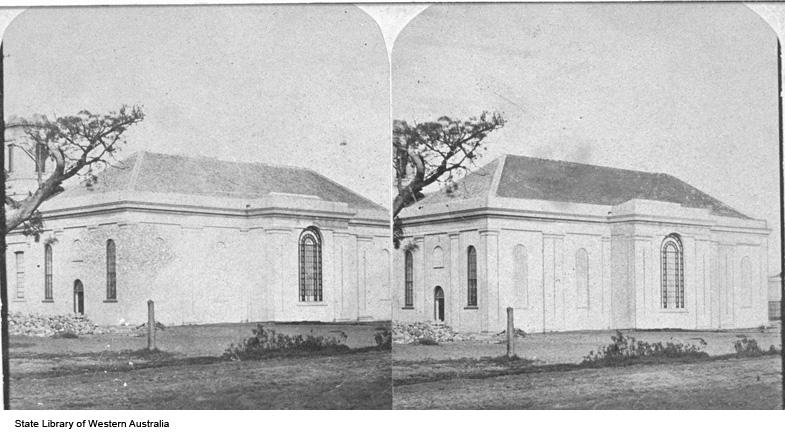
Even if he did not contribute to this initial phase, he was certainly involved in a later extension to the church in 1862. (It is important to note that this is not the same Cathedral building that stands today, which dates to the last years of the nineteenth century)
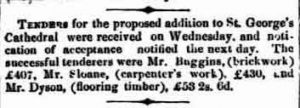
The Inquirer & Commercial News (Perth, WA : 1855 – 1901) Wednesday 2 July 1862 p2
Also involved in this extension is the same Mr Buggins previously referred to. Given that both he and Dyson are mentioned together for this project and Buggins alone is mentioned in the Wesleyan histories, it begins to look like Drewy’s memories might have been at fault.
Stereographic view of the back of St George’s Cathedral, for which James Dyson provided timber flooring.
The work on the original St George’s Church was famously slow and ill-funded and the story that Dyson did not get paid for a very long time rang true for his involvement with that project. On the other hand, the Wesley Church of 1870 (the second of its name), was begun in 1867 and was largely funded by the Shenton family, in particular, their patriarch, George Shenton (senior). When Shenton died suddenly and unexpectedly at sea in 1870, shortly before the building was opened, the outstanding sums were allegedly paid out by his family as a tribute his memory. This was the same Shenton Dyson bought his swamp from, and whose son, who would have paid the final bills for the church, would buy it back from Dyson some years later. Shenton senior had gifted to Dyson a family bible on the occasion of his (eventual) marriage to Mrs Jane Edwards. Given this history, it did not sound right to me that the Shentons would not pay their bills on time.
Here my investigations might have ended with the the conclusion that:—No, James Dyson didn’t build the Wesleyan Church, but his kids might have watched with interest, given that the family only lived a few houses down on Murray Street…
Then the trail led me to William Traylen, Methodist Pastor in Western Australia. He arrived in the colony only days after the death of Shenton, and was one of the first speakers from the pulpit of the newly consecrated church. He was involved in the temperance movement, and his name had arisen in conjunction with Joseph Dyson’s activities in the same sphere as was mentioned in the article concerning the mystery of Dyson’s Hotel. While researching further, I learned he kept a diary, some of which survived and has been published.
I tracked down this book (compiled by one of his ancestors), and found something that none of the official histories of the Wesley Church, Perth, had deigned to share with us*— It was a reproduction of an 1867 ledger during the construction phase of the church, and it revealed what the public record had tried so hard to obscure—
*(I do not include Thea Shipley in this complaint. Her manuscript was published posthumously and who knows what was cut out, or never written.)
Buggins, Mason, and James Dyson — all together on the ledger — all paid by the building committee of the Wesleyan Church. Dyson supplied both Bricks AND Timber and was paid £672, 7s and 10d. Yes, he built the Wesley Church; No, Drewy was not lying… for a change.
Today was a good day….
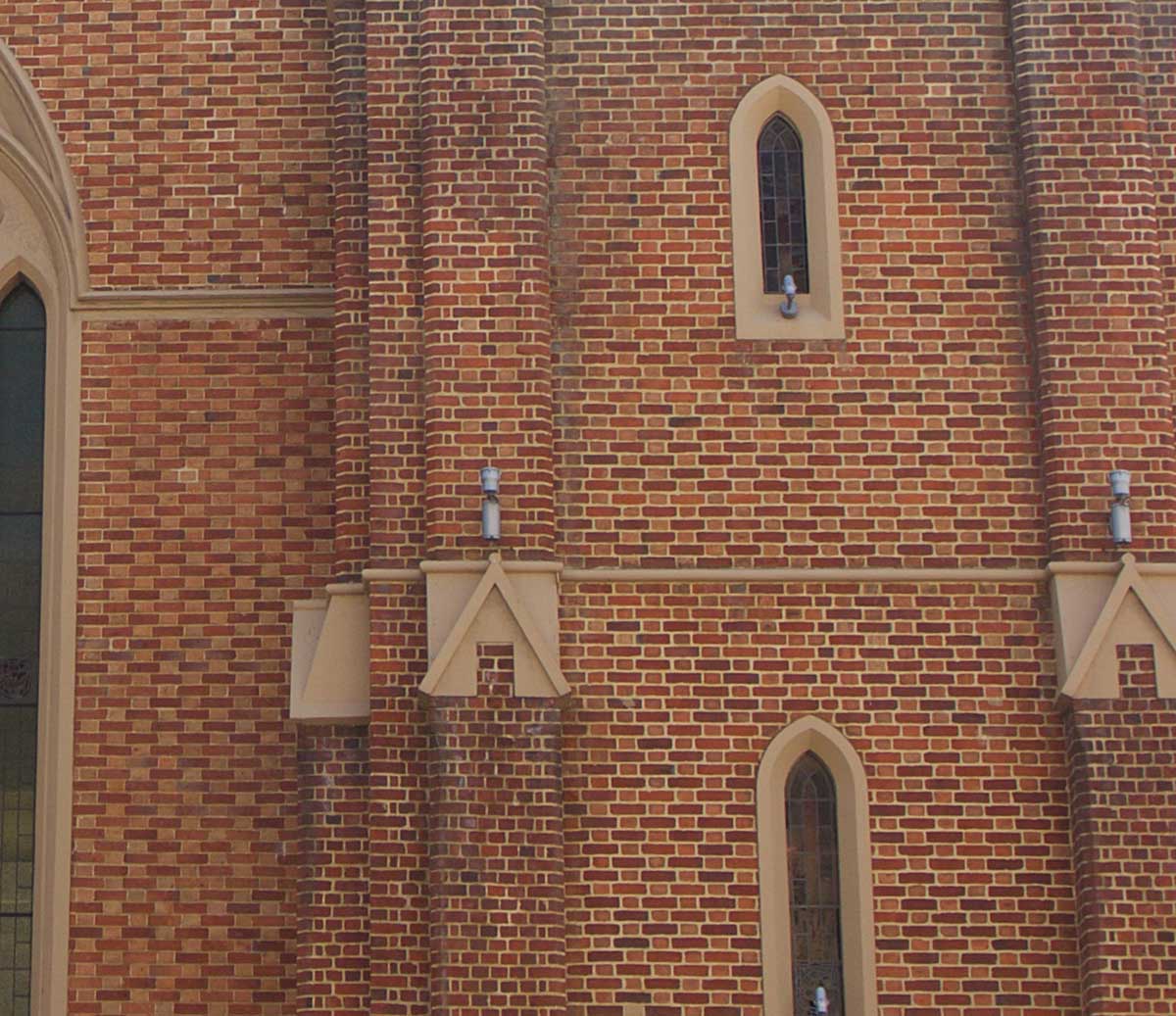
…So here are some more of my great-great-great-great grandfather’s bricks:








 …continued.