Author: Alan Thompson

  • Literally —ing the Patriarchy: Introducing Jane.

    Literally —ing the Patriarchy: Introducing Jane.

    It should be clear by now that I have no problem mocking my ancestors— when they are bullies, pompous, arrogant, do monumentally stupid things, or are just so completely and utterly full of themselves it is all too easy. Of course, most of whom I have written about so far have been blokes. That’s because the blokes loved talking about themselves (and other blokes) to the exclusion of all else. Their life’s details were recounted by yet more blokes with very fixed ideas about what was worth recording and what was not. Now every single one of these blokes had a mother. A goodly proportion of them also had wives and daughters. You might not realise that from the surviving records.
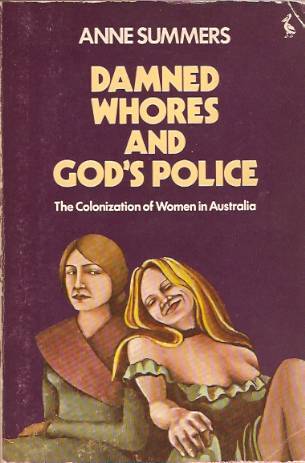
    I’m afraid to say I haven’t read this book, but the title alone pretty much sums up how my female ancestors are presented in the historiography.

    And here’s something even more shocking for you to process;  ALL of your ancestors both male AND female engaged in the act of sexual intercourse, and what’s even more horrifying, some of them actually enjoyed the experience and voluntarily repeated the process more than once.  You can go take a cold shower now.

    Mary Chapman, Margaret Gunn, Sarah Coe, Sophia Borghart, Frances Hoffingham, Mary Ann Spencer. These are all women in my direct ancestry going back eight generations and are part of an even longer list for which there appears to be no information on at all apart from their names. In the surviving records they they have no friends, back story, loves and losses other than as appendages to their respective spouses.

    The name of James Dyson’s own biological mother in Lancashire is not known, but she did indubitably give birth to him at some time around 1810, presumably she knew his father. Even the actual spouse of his reputed father, Hannah (nee Binns) is only a name, existing in the records solely as the the daughter of a father, wife of a (philandering) husband, and mother to (most) of his children.

    Of James Dyson’s first wife Frances (or Fanny), no two documents can even agree on the same family name.  What is confirmed is that he exchanged her in for a newer, younger model, the still married Mrs Richard Edwards (junior). Her maiden name was Jane Develing.

    Now I am in a slightly tricky position when writing about Jane. I am a descendent of Frances, Dyson’s first wife. I also happen to be male. If I adopt my usual snarky tone with Jane’s story, am I opening myself up to accusations that I denying my family connection with her out of some (utterly-unearned) sense of genetic moral superiority? I might even be accused of blaming Jane for the ultimate fall from social grace of her husband and by extension the rest of his family. I could be blaming Jane for the crime of being a woman, and that would be bullshit. I could go in the other direction and say that Jane was a victim for being a woman in a man’s world, but while that argument might be made, but it also denigrates Jane’s character as someone who most definitely made her own choices in life.

    Jane Develing is mentioned in two major works of Western Australian history, and in this regard she is well up on both her husband James and her most famous son Drewy. These two examples bookend her life with her second husband so they are well worth surveying:

    “The Bride Ships” by Rica Erickson (1992, Hesperian Press) starts with the arrival of Jane’s ship, the Mary in Fremantle on 25 October 1849.  Jane is described as “The most notorious of the servant girls […] evidently a person of some spirit…” (p11). The book explains the circumstances whereby young women were sent to the Western Australian colony for use as servants, or wives. Jane’s own origins are not explored, but it does describe her successful prosecution of a fellow shipmate on the voyage for assault after they had arrived in Western Australia. He was one of the “Parkhurst Boys”, juvenile delinquents assembled from Parkhurst Prison on the Isle of Wight. Unmarried Jane was heavily pregnant at the time of the assault.  The book then baldly records that she married a widower named Richard Edwards, then another widower called James Dyson, who later became a Perth City Councillor. The bit where the former and future husbands brawled in the street wasn’t mentioned.

    The late Dr Rica Erickson was a wonderful historian. I wish Jane had been the subject of a whole chapter rather than a paragraph as I’m sure then we would all know a great deal more about Jane Develing and the Dysons than we do at present.
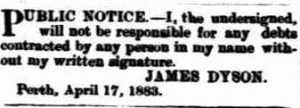
    Divorce 1880’s style.
    The Inquirer & Commercial News (Perth, WA : 1855 – 1901) Wednesday 18 April 1883 p5
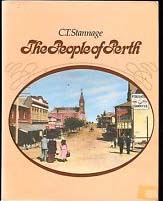
    “The People of Perth” by C.T. Stannage (1979, Perth City Council) is an official history of the city commissioned by the council itself. Despite this, Stannage pulls no punches and the starchier councillors must have wondered what the hell they had just paid for. He does not not shy away from the seamier side of life that I am sure his sponsors would have preferred he had just glossed over. He takes up Jane’s story a little time after she had separated from her second husband. He uses Jane as a case study for women deserted by their spouses.

    “… One such was Jane Dyson who, with her young daughter Anna, found employment with the wealthy butcher John Liddelow at his establishment on the corner of Barrack and Murray Streets […] Over a four month period Jane stole from Liddelow goods and cash to the value of £58. […] Jane was sentenced to imprisonment for five years. On her release she became one of Perth’s best known madams with a popular establishment in Stirling Street. The fate of her daughter Anna is only to be guessed at.”

    (Stannage p118-119)

    The late Tom Stannage is pushing an agenda of social inequality with this story, but Mrs Jane Dyson is no Fantine from Les Misérables and Anna (actually Hannah) was no Cosette. In 1884 Hannah was twenty-eight, with a nine year old daughter also named Hannah. She had been divorced from her husband since 1877. In the appeal for clemency that Jane sent to the governor in 1885, Detective Police Inspector Lawrence raised a couple of salient points —

    This petitioner previous to her conviction had been living apart from her husband for some considerable time— Cohabiting with an ex-convict named John Smith — and has done absolutely nothing, since leaving her husband and towards providing for the young children she mentions. — […]

    The sum of £32. 10 — (part of the money stolen) was found in her box, when arrested, which she was Keeping for the purpose of paying her daughters passage from the neighbouring Colonies, in Conjunction with whom She intended opening a brothel in this City.

    SRO; Consignment No. 527 ; Item No. 1885/1505 ; Item Title : “Prisoner Jane Dyson – Petition to His Excellency The Administrator”

    Mrs Jane Dyson was first and foremost, a survivor. She paid the males in her life— indeed the entire system she was forced to exist within— exactly same respect it, and they, afforded her: precisely none. I admire her for that. I also believe my admiration would have been absolutely irrelevant to her. When she died in 1901 her son Drewy gave her a fine headstone in the same plot with her late husband James and his first wife Fanny. But in her will, she left all her possessions to her surviving daughters. Jane had the last word.
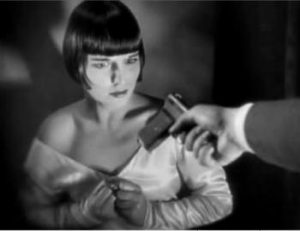
    The actress Louise Brooks in the 1929 German film “Pandora’s Box”. A particular gentleman has ruined himself in pursuit of this young lady. In response he suggests that she might like to shoot herself for his lack of judgement.
  • Kill the Joke (AKA: “You had to be there”)

    Kill the Joke (AKA: “You had to be there”)

    “Finally, a loud, long-continued whistling was heard from the bush where now is Leederville. Later it sounded from about West Perth, and owing to a temporary break in the line the engine remained there some time, occasionally whistling to let the waiting crowd know it would be soon coming along.

    “There you are!” roared Drewy Dyson, who had been one of the most consistent pessimists; “it’s lost in the bush. Listen to it coo-ee-ing” ! ! !”

    Sunday Times (Perth, WA : 1902 – 1954) Sunday 20 December 1914 page 8

    Nothing kills a joke like having to explain it…

    The actual event in 1881. I call bullshit. [SLWA]
    Eastern Districts Chronicle (York, WA : 1877 – 1927) Friday 15 April 1881, p2

    The story of Drewy Dyson and the locomotive engine lost in the bush is undoubtedly utter fantasy. Its also the most re-published story of Drewy, retold at least five times in the pages of the Sunday Times between 1914 and 1932. The signs of the pen of Dyson’s old friend “Dryblower” Murphy is all over this tale, set thirty-three years before it was first presented. At the time of the the rail line’s formal opening in March 1881, Drewy was most likely not even in Perth. He was then aged twenty-three, newly married, and wreaking havoc in the inland town of York, where he had recently completed his apprenticeship. He was about to start up his first business venture on his own account.

    The Inquirer & Commercial News (Perth, WA : 1855 – 1901) Wednesday 26 November 1879 p3

    There was, of course an actual Dyson connection with the new railway (You knew there had to be, didn’t you?) The contractor who built the original Perth station building was a Mr Thomas Smith. No less than two of Smith’s sons were married to sisters of Drewy. John Thomas Smith was a carpenter, and was married to Drewy’s half-sister Ellen (from his mother’s first marriage). His full sister Hannah had been married to Charles Henry Smith. They had separated messily back in 1877. C. H. Smith was an undertaker by trade. Many years later Drewy would be an undertaker by notoriety…

    I guess its not impossible Drewy was present on a trip in from the country. This idea is supported in the second telling of the tale:

    LOST.
    The recent alterations at the Subiaco railway crossing recalled the story of the opening of the line from Fremantle to Perth, and subsequently on to Guildford.

    The local cockies, and other inhabitants had but a vague idea of how a line and locomotives, worked, and spent much rime[sic] arguing the point, very few going down the line to see how it was getting on.

    One section reckoned from what they’d seen in pictures the engine would choke itself with coal-dust, while another group estimated that no rails such as they saw could hold iron wheels on (they were used to deep bush ruts and calculated accordingly). A third section who mostly lived up at where now is Chidlow’s Well, Northam and elsewhere, and had never seen a yard of line laid, hung on to the theory that the engine and a train couldn’t possibly dodge the trees and would get bushed!

    When the eventful day arrived when the little locomotive and a few box carriages were to dash in from Fremantle at a breakneck speed of about 7¼ miles per hour, the fences, sheds, gravel heaps, and trees in the vicinity of what is now the Perth Central Station, was cocky-clustered in dense masses of fully fifty. The majority had come into Perth the night before per. bullock dray, brumby, and other means, and were impatient to behold Puffing Billy.

    About midday the train reached what now is West Perth, having started out of Fremantle early in the morning, a few rail-jumps and other troubles having delayed it. As a sign of joy as it left West Perth, and as a signal of success, the engine emitted several furious blasts.
    The cockies listened to the toots for a few moments.
    “There you are!” grunted Drewy Dyson. “I knew she’d get lost. Listen to her coo-eeing in the bush! ! !”

    Sunday Times (Perth, WA : 1902 – 1954) Sunday 10 October 1915 page 8s

    On the third telling, the cast of characters expands and the fictional origin of the tale becomes a little clearer. Horace Stirling and father join the narrative and the owner and editor of the Perth Inquirer paper and the Daily News couldn’t represent a fact straight if it ran over them.

    LOST.
    And old picture of Perth that has just drifted in recalls a very early day happening.
    The faded photograph shows the Turning of the First Sod of the Perth-Fremantle railway, and is a splendid memorial of bygone days.

    The picture shows a collection of cottages, gardens, etc, where now is the busy Central Station and Wellington, Beaufort, Roe and William streets, the Pinjarra Volunteer Cavalry and an assemblage of the populace and civic dignitaries being seen.

    During the time the railway was being pushed into Perth no engine or carriage was in the State, the line being gauged by a construction truck pushed along as the line proceeded.

    “How will this locomotive, as you call it, find its way through the thick trees down around Karrakatta,” demanded half the natives of Perth, that portion of the country between here and Fremantle being densely wooded.

    “The line will bring it along,” explained Horace Stirling, a young man then who had in Melbourne, Adelaide and Sydney seen any amount of iron horses.

    The populace, however, regarded the small rails as fences, and could not see how they would keep the engine and carriages IN, as if they were fences.

    “Is there any chance of her getting lost in the scrub, Mr. Stirling?” asked Drewey Dyson of the dad of Horace S.

    Stirling senior explained again the mode of laying the rails and the general procedure thereof.

    One day they clanged the old town fire bell to let the people know that the first train would arrive in Perth on the following day.

    A huge crowd” of several hundreds assembled to welcome in the first engine and a couple of carriages containing the then Governor and Administrator—Broome.

    “At exactly noon a faint whistle was heard.

    The train had reached where now is Leederville.

    Ten minutes later another heart-rending shriek emanated from a bit further along, where now is West Perth.

    It stayed there a while, to receive the congratulations of the ancestors of Pat Hughes and a few others, and then, amid a salvo of escaping whistle steam, it essayed to again move along.

    West Perth was then all scrub and trees, and the huge crowd of 250 in Perth listened in wondering incredulity.

    “There you are!” bellowed young Drewey Dyson, as he heard the short, shrieking whistle, “I said she’d get lost. I can hear her coo-eeing in the bush!”

    Sunday Times (Perth, WA : 1902 – 1954) Sunday 6 June 1920 p 4S

    The story survived even Drewy’s own demise in 1927, while at the same time elaborating and entrenching his part in the tale. Version 4:

    “LOST!”
    Apropos of a story elsewhere, and also as the Town Hall last week held souvenir photos and sketches of the opening of the Perth-Fremantle railway, a story.
    In the year 1881, when the line from Fremantle to Perth was at last completed, a public holiday was proclaimed to mark the coming of the Iron Horse.
    The rails had been laid right from the Port to the metropolis, a small gauge truck, pulled by a horse, being used to get the rail paralleled correctly.
    The grades had all been made correctly, bridges built, cuttings and embankments made, and all was ready for the steam locomotive and its two trucks and a carriage load of distinguished citizens, officials, visitors, etc
    Where now is the Central Station had gathered (for those days) a huge crowd, the fences, sheds, trees, poles, etc, being fully occupied.
    Never having seen a real steam locomotive and a train, the indigenous Gropers, always used to horse teams, argued long and loud as to how it could keep from getting tangled up in the trees, the mystery of the flanged wheel not being then known to the younger inhabitants thereabouts.
    “How long is a train?” asked several of the local youths.
    They were told an average train would be about 100ft. or 150ft long.
    Those who had never seen a train, but had seen drays, waggons, etc., with two to twelve horses in line, scoffed in scorn.
    “Bet you it gets tangled up in the scrub!” said one.

    “Bet you it gets bushed down near Butler’s Swamp” (now Claremont), said another (history made it the late Drewey Dyson who was so cocksure of the train’s failure).

    Eventually the train puffed out of Fremantle, over the bridge, past Butler’s Swamp, up the grade where now is West Leederville, and finally ran down the long grade into where is situated the West Perth station.

    As it entered the last lap of its journey to Perth, the engine, with its vehicles behind, still shrouded by the then thick scrub, set up a series of whistle blasts, long and short, regular and irregular, drawn out and staccato.

    The crowd at Perth could see nothing of the exhaust steam, the day being hot, but it could clearly hear the whistling.
    “There you are!” excitedly yelled Drewey Dyson, “what did I tell you? She’s lost. Hear her coo-ee-ing away down there in the scrub!”

    Sunday Times (Perth, WA : 1902 – 1954) Sunday 22 September 1929 p6S

    By 1932, Drewy Dyson was just a memory, once a participant, now just the reputed story teller. Every version of the story was slightly different, so like a colonial Rashomon, I reproduce all the versions I have found so far, here for you… Version 5:

    COO-EE.
    The story of Mrs. Agnes Reeve concerning how she kept the Stirling street railway crossing gates 40 years ago, near where now is this office, recalls the opening of the line from Fremantle to Perth. The late Drewey Dyson and the also demised Horace Stirling both revelled in telling the story.

    When, the line was being laid, a gauge truck being used to get the proper width of the rails, the natives of Perth, who had never seen a railway train, wondered how the same could possibly dodge through the trees. When told a train of engine and carriages would be approximately 150 feet long, and as they had had acquaintance only with horse-drawn waggons, they wondered how such a line of vehicles would get along in and out the gum trees and scrub.

    The day arrived, and a thousand-odd men; women, and children were assembled where now is the central station, and the horseshoe bridge.

    Those who had seen a train in England endeavored to tell those who hadn’t something of the wonders of the iron horse, but it was in vain.

    How was she to get through the trees and scrub?

    “I’ll bet she gets lorst comin’ along’ by Butler’s Swamp,” said one, “Butler’s Swamp” now being Claremont.

    “I beleeve you’re right. Bill,” said another. “But we’ll see—an’ ‘ear.”

    By and by a long, plaintive whistle was heard away down where now is West Perth.

    It was repeated.

    And repeated again.

    It was the loco. engine whistling or trying to whistle “Cock-a-doodle-doo!”

    “There you are!” excitedly yelled one of the bystanders. “There you are! She’s lorst! You can hear her coo-eeing in the bush!”

    Sunday Times (Perth, WA : 1902 – 1954) Sunday 10 July 1932 p 4S

    Boom Boom!

  • Steam Powered Luddites

    Steam Powered Luddites

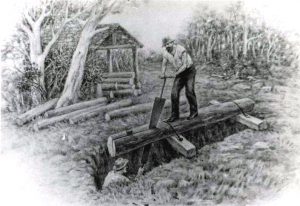
    James Dyson had built something of an empire in Western Australia on the back of supplying timber sourced the old fashioned way—by hand. Pity the other pit-sawyer though, who had to stand in that pit when the logs were being sliced into planks, and pity also the poor sap (pun intended) whose on-the-job-training did not include lessons where not to stand when the tree fell.

    Dyson’s business portfolio included more than just being a timber merchant, so his decline from being one of the largest employers in the colony to near penury cannot be attributed solely to competition in the timber trade, but one of his sons shooting a business rival’s son in the head would not have been conducive to any sort of cooperation when Benjamin Mason (father of the wounded party) together with his partner Francis Bird took the next logical step and introduced steam-powered machinery into the timber cutting process.

    The “convict fence” in the Canning River off Riverton in 2012.
    The Inquirer and Commercial News, 2 September 1868, p. 2

    Bird & Mason’s business was conducted on a scale that Dyson’s business model might have been unable to complete with. They also employed  many convicts. In 1864, they built a new mill at a place called Bickley Brook in the Darling Scarp east of Perth. Steam power was used to run a circular saw. On horse-drawn railway tracks, cut timber was carted to a landing site on the Canning River and sent down in barges to Perth and Fremantle. The traces of the posts that made up the path for the horses that dragged the barges across the shallow waters can still be seen today.

    Although Mason and Bird’s enterprise was not to survive the test of time, even better resourced companies would arise to carry on what they had started. But Dyson while was unwilling or unable to make the transition to the mechanised future of timber processing, other members of his family might not have been not so reticent.

    Back in the “Old” Country…

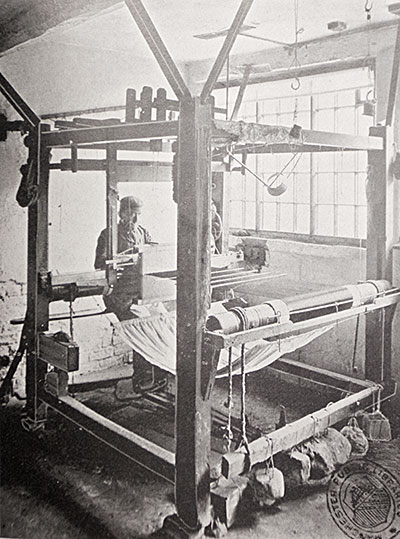
    A Lancashire Hand Loom Weaver.
    The Morning Post (Lancashire), 21 November 1870 p7

    Dyson’s father, Joseph, had been a cotton-spinning machine seller. That put him on the cutting edge of technology for the late eighteenth and beginning of the nineteenth century. His other sons who were not juvenile delinquents: Andrew, William and Joseph, all were involved in the spinning and weaving processes for cotton that was increasingly being centralised in powered mills, rather than in private homes and tenements such as their father had serviced. Bower Mill in Hollinwood, near Oldham, was initially an unpowered factory; it had been built for rope making, and that process was by hand. But during the same period of the 1860’s when James Dyson’s hand timber sawing business was at its peak, his brothers converted the ancient building to process cotton using coal fired steam engines.  Across the road from the mill was a Colliery, a seam of coal even ran underneath the mill itself. It should have been a match made in heaven, but instead subsidence in the mining tunnels caused severe damage to the floor of the factory. Not to worry though. After the inevitable protracted legal tussle, the two surviving brothers Andrew and Joseph won a frankly gianormous sum of money in compensation.

    Back to us Luddites.

    The Perth Gazette and Western Australian Journal (WA : 1833 – 1847) Sat 29 Aug 1835 Page 555

    The Swan River Colony that James Dyson found himself in what was possibly the most isolated British settlement in the world at that time (prepares to be bombarded with other examples). News from home was six months away at best (Home being defined as the British Isles in this case). The nearest neighbouring colonies were weeks away by sail, or more. Technological progress took some time to filter through to what was essentially an agrarian economy, but you’d be daft to think they weren’t aware of progress happening elsewhere. When steam ships eventually regularly paid visits to the western third of the Australian continent, they would bypass Perth entirely and call in at Albany on the far south coast for coaling. The coal they required in vast quantities had to be imported to the colony. King George’s Sound and Princess Royal Harbour were simply more sheltered locations to complete this laborious work then storm swept Gage Roads.

    The Perth Gazette and West Australian Times (WA : 1864 – 1874) Fri 25 Nov 1870 Page 2 (P.S. This is actually satire, y’know!)

    The Government imported a steam dredge at vast expense  in 1869 to reclaim land on the Perth foreshore and to deepen the river estuary. Like the other much derided plan of the time—The volunteers wanted a troop of mounted rifles, but their C.O. wanted them to be mounted artillery, the dredge was the subject of active derision.

    The Steam Dredge “Black Swan”

    Eventually the dredge did fulfil it’s promise, but the joke is still on us. After all the resources expended in reclaiming the foreshore for the public, a more recent government decided that this very same foreshore should have a large hole dug into it so rich people could pay a lot of money to stay in buildings around it. The pointless inlet that was created was about as popular as the dredging machine that had first filled it in, nearly 150 years ago.

    By 1871, even as his businesses were gradually running down, more and more of James Dyson’s attention may have been on his civic duties. He was on the council of the Perth City and the Perth Road Boards respectively. That year the members of the road board went to inspect a new timber cutting machine. I would be interesting to have heard Dyson’s reaction.

    The Perth Gazette and West Australian Times (WA : 1864 – 1874) Friday 10 November 1871 p3

    During his time on the City Council, both the electric telegraph and the first steam powered fire engine was delivered to the city.

    Dyson’s sons, you would imagine, would have been more in tune with new technology. You would mostly be wrong. Horse power was their limit. Their father had been born into the white heat of the cutting edge of the industrial revolution, which might have been why Thomas, Andrew, John and possibly Matthew were apprenticed as blacksmiths, but only Andrew and Thomas did any manufacturing. They had been born and grown up into a poor, rural and insular corner of the British Empire, where (essentially) a slave labour force rather than ingenuity was what got things done. Thomas had the most success mass producing furniture, but he went to Victoria. (Maybe shooting your father’s business rival’s son hadn’t turned out to be such a bad career move after all) Andrew built coaches (when he wasn’t on the bottle or behind bars) John ended up digging coal.

    Truth (Perth, WA : 1903 – 1931), Saturday 12 December 1914, page 7

    Andrew Drewy Dyson for all his many flaws, was no simpleton. He understood marketing. He was praised for his craftsmanship, (which was considerable when he stayed away from the bottle).  So when the first steam locomotive came to town in 1880, take this tale of the country yokel with a massive grain of salt, after all, Drewy probably wasn’t even there…

    THE RAILWAY.
    A week-end contemporary which specialises in reminiscences of Old Sydney should stick to yarns of Chowder, Clontarf, Surry Hills, the Argyle Cut, and other haunts of Noo South pushdom.

    Recently it printed, a picture of a railway locomotive in the Perth-yards, attached to some seated trucks, and labelled it “The First Railway Engine Used in WA” The letterpress goes on to say it ran on the Fremantle-Guildford line, and was the pioneer of all such traction.

    As a matter of fact, there was a well-equipped State-owned railway line between Geraldton and Northampton long before the Fremantle-Perth Guildford line was thought of, it being used for the cartage of passengers and base metals.

    When the Perth-to-Fremantle line was nearing completion a popular query amongst the younger of the local population was as to how the engine and carriages would dodge the trees en route.

    The elders explained, but the juvenile native-born, were a bit sceptical.

    The day arrived when the first Puffing Billy was to arrive in Perth from the Port, and the population of the capital gathered in expectant, half-doubtful multitudes where now is the Central Station.

    After a long wait some of the crowd voiced the opinion that the train wouldn’t be able to find its way up to Perth, and made bets of kangaroo skins, logs of sandalwood, etc., that black trackers would have to be sent out to bring it in.

    Finally, a loud, long-continued whistling was heard from the bush where now is Leederville. Later it sounded from about West Perth, and owing to a temporary break in the line the engine remained there some time, occasionally whistling to let the waiting crowd know it would be soon coming along.

    “There you are!” roared Drewy Dyson, who had been one of the most consistent pessimists; “it’s lost in the bush. Listen to it coo-ee-ing” ! ! !

    Sunday Times (Perth, WA : 1902 – 1954) Sunday 20 December 1914 page 8

    …continued.

  • Timber!

    Timber!

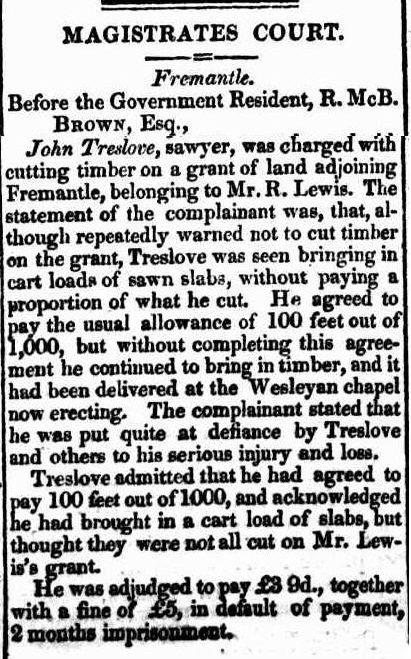
    Timber was the business of James Dyson from his earliest years in Western Australia. A year after his arrival in 1841 he was working as a labourer. Of the few people from this time we know for sure that he associated with, Stephen Hyde was a carpenter, and his next door neighbour in Perth for the next ten years.  By 1845 James was describing himself as a sawyer, and the earliest mention of him in the newspapers of the Swan River Colony was as the successful bidder for a government contract to supply timber boards for a building on Rottnest Island.

    The Perth Gazette and Western Australian Journal (WA : 1833 – 1847) Sat 15 Jul 1843 Page 4
    The Perth Gazette and Western Australian Journal (WA : 1833 – 1847) Sat 14 Nov 1840 Page 2

    Neither of these articles from the period mention Dyson but they do illustrate an important point. It was not possible to just wander out and collect timber, particularly not from unoccupied crown land. To be a sawyer, you needed either money, or a patron. (Apropos to nothing, Peter Brown (or Broun) and Robert McBride Brown were brothers.)

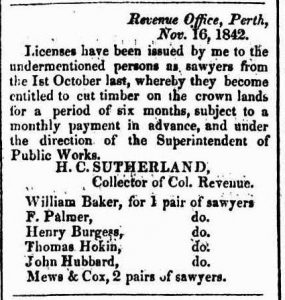
    If Dyson was working as a sawyer prior to 1843, he must have (in conjunction with someone else) been employed by or worked with, one or more of the following gentlemen:

    The Perth Gazette and Western Australian Journal (WA : 1833 – 1847) Saturday 26 November 1842 p3

    After this date, the regulations changed, and most frustratingly, names of licensees were no longer published in the papers. We can know, however, how the work was done by James, at least in the beginning:

    A generic illustration of pit sawyers at work. [http://www.nationaltrusttas.org.au]

    Shortly after his arrival he commenced business as a pitsawyer — a laborious occupation, but of a most lucrative nature in days previous to the application of steam machinery. After about nearly twenty years he established himself in town as timber merchant and general dealer, and in those days was amongst the largest employers of labor in the colony.

    The Daily News (Perth, WA : 1882 – 1950) Saturday 23 June 1888 p 3

    From 1850, two equally momentous events transformed the Western Australia; on the 25th October 1849, Dyson’s future second wife Jane Develing arrived in the Colony on the Mary. On 1 June 1850 the ship Scindian landed the first large scale cohort of convicts to Western Australia. These prisoners were initially occupied building their own gaol in Fremantle, but Dyson would eventually employ one of these men: Thomas Hart was a burglar, but his professed trade was as a mason. In what capacity Dyson employed him I have not yet uncovered.

    The Perth Gazette and Independent Journal of Politics and News (WA : 1848 – 1864) Friday 11 April 1851 p4s

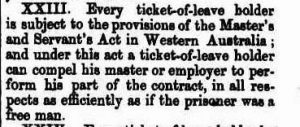
    From later ships, a convict would usually be granted probation very soon after he arrived in the form of a ticket-of-leave. They were by no means free, but they were no more a slave labour force than any other employee in the colony at the time.

    The Perth Gazette and Independent Journal of Politics and News (WA : 1848 – 1864) Friday 18 July 1851 p2

    A convict depôt was established under the shadow of Mount Eliza near where the Swan Brewery buildings now stand. This place was also adjacent to a stone quarry that recalcitrant or unemployed convicts could be assigned to. (In later years after transportation had ceased, this depôt would become the old men’s home.) The men’s skills were advertised for prospective employers. From the attached list, Dyson would choose Henry Rugg, brickmaker and Thomas Molineux, Miner. Dyson was involved at various times with brick making in Perth, but once again it is by no means certain that this was what these men were employed for by him.

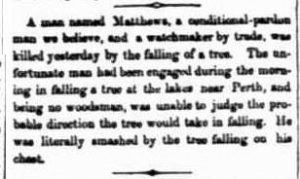
    Thomas Matthews was serving a ten years for theft and had arrived on the convict ship William Jardine on 4th August 1852. His trade was watchmaker, but he was employed by Dyson as a sawyer on 28th April 1855. It was not a great choice for either…

    The Inquirer and Commercial News (Perth, WA : 1855 – 1901) Wed 10 Oct 1855 Page 2

    Matthews was working near Lake Monger, north of town, which does give a clue about where Dyson was operating and what sort of timber he might have been collecting at the time. Tuart was a valued hardwood for general construction work and sheoak was used for roofing shingles.

    An example of a shingle roof.

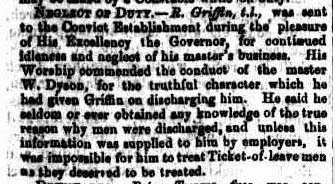
    Convicts, as a rule, do not write testimonials to their masters’ treatment of them, so we only hear anything about them when something goes wrong. Richard Griffin was a housebreaker who arrived on the Lord Raglan, 1 June 1856.  Dyson most definitely did employ him as a sawyer from 14 May 1860. Under a month later he was returned to the depôt, and thence to the police court:

    The Perth Gazette and Independent Journal of Politics and News (WA : 1848 – 1864) Friday 8 June 1860 p3

    This is a rare example of a Dyson being complimented by a magistrate. William was James Dyson’s third son and was born free, but he was in turn complimented by father for his action? Remember, James Dyson had once been a convict himself, in Van Diemen’s Land. He had never been granted either ticket-of-leave or conditional-pardon status and had served out the full seven years of his sentence. If you look at his record, you could see it was far from spotless. This was a man that understood exactly what it entailed to be accused and convicted of “Idleness & neglect of duty”. His attitude seems to be, “I know what you are thinking, because I thought it myself, once. I didn’t get away with it then, and I’ll be d—ed if I let you get away with it now.” This impression is reinforced by a later recollection of Drewy Dyson, of his father.

    Drewy’s father was a man who held very strong opinions on the jury system of trying criminals and suspected criminals, and more than once in his time when in a panel has been the cause of pulling up a barrister and even a judge during the course of various cases. Old Man Dyson was exceedingly well-versed in law and not bush-law at that, and could quote off hand chapters from British authorities that would not be possible to any but those possessing a wonderfully retentive memory. As a boy Drewy received many strong lessons in common humanity and equity from his father, the latter taking him on more than one occasion to see condemned men being brought chained through the streets of Perth in an open cart, just as they were taken to Tyburn in London in days long gone by.

    Sunday Times (Perth, WA : 1902 – 1954), Sunday 24 April 1927, page 14

    So it was that Drewy Dyson’s older brother probably came to regret messing about with that gun in the wetlands north of town in the year 1867.

    The Inquirer & Commercial News (Perth, WA : 1855 – 1901) Wednesday 24 July 1867 p2

    Thomas might have preferred prison. He was exiled from Perth, not to return for nearly twenty years. He served an apprenticeship in Geelong, Victoria, but eventually, out of all Dyson’s many children, he would end up with the greatest success in business. Young Benjamin Mason was the son of Benjamin Mason, senior. The Mason family of Perth were another clan of storekeepers, publicans, carpenters and general entrepreneurs very similar to the Dysons in many respects. One can’t help but fear that having your son shoot your near neighbour’s son in the head must have put a crimp in the personal relations between the two families and may have thwarted any potential business cooperation. This is especially unfortunate as Ben Mason’s name, in conjunction with that of his parter Francis Bird, will be forever linked with the next stage of development of the timber industry in Western Australia. It was part of an evolution Dyson was not able to or was unwilling to adapt to.

    …continued.
  • The Little Boy Lost: Enter Drewy.

    The Little Boy Lost: Enter Drewy.

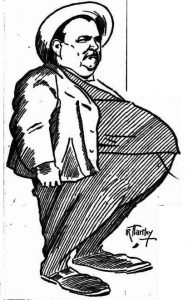
    He was a monster. That has to be made plain from the start. He could be very funny, he was creative and he was intelligent. He loved animals. He probably loved his family, but he also hurt them. He hurt them a lot. He also hurt many of the animals he loved as well, and he also hurt himself. He could laugh at himself. Others laughed at him too, a lot. He would have been fun to know personally but he humiliated those who had no choice but to share his name. He was the meanest drunk Western Australia has possibly ever known (and I realise that is a bold claim to make) and he was the fattest Western Australian of the nineteenth century. He was Andrew “Drewy” Dyson.

    Sunday Times (Perth, WA : 1902 – 1954) Sunday 22 December 1907 p 1S

    He was born in Perth on 30 October 1858. His father was the colonial entrepreneur James Dyson. His mother was Mrs Jane Edwards. There were still a few more years to go before Jane’s first husband could be declared legally dead and the two could finally marry, so rather than face any needless embarrassment— as with the previous two children they had already had together— Andrew Dyson’s birth was not  formally registered.

    The colony that Andrew was born into was not the same place his parents had arrived into, eight and seventeen years before, respectively. It was a far more dangerous place, for one. Half the population was under legal curfew at night, the other half huddled behind locked or bolted doors in a de-facto state of curfew in terror of any curfew-breakers from the other half. Western Australia was now a Convict settlement, and a rough and rowdy place to live in and bring up children. On a positive note, those same convicts had made Andrew Dyson’s father quite rich, and soon he might completely paper over his own chequered past with a thin veneer of promissory notes.

    Labour shortages back when James Dyson arrived in 1841 had enabled him to fill a niche as a timber cutter and he must have had at least one other confederate to assist him in that enterprise. (Pit sawing requires at least two people) But that same shortage of labour must have at the same time limited how much Dyson could grow his business, which now included contracts for wood used to construct public buildings. That all changed with the arrival of the convicts in 1850. Usually paroled as soon as they stepped ashore, these men were available for hire almost straight away, and Dyson was soon one of the biggest employers of labour in the colony. So when someone was referred to as working for James Dyson, odds-on that person would be a ticket-of-leave convict.

    Young Andrew Dyson first burst in to public prominence when he was nine in October 1867. He was travelling with a party of his father’s men deep into the Canning district south and east of Perth. They followed the rough dirt track that was then the Albany road to a location some way past what is now known as Armadale. It was there that the carter had some unspecified work to do about 100 metres away from the track. For some further unspecified reason Andrew tagged along with him accompanied only by his dog. The carter sent Drewy back to wait by the cart, or so it was reported, however the boy never reached that destination.

    Lost, 1907, Frederick McCUBBIN [National Gallery of Victoria]

    It is one of the greatest tropes of Australian culture — the child lost in the bush. For parents who came from a very different landscape in the northern hemisphere where the deep dark forest was a fairytale nightmare from the distant past, here it was for real. It scared the living shit out of them, being in it. Even more gut wrenching was the thought of their children out in it, alone and helpless, and there was nothing they could do. People would rather have thought the mother done it than a “dingo took my baby”…

    The news would have shuddered through the populace — everyone would have known. Children died of diseases like dysentery every day. That was sad, but it did not make it into the paper. A child lost in the bush did.

    The Perth Gazette and West Australian Times (WA : 1864-1874) Friday 4 October 1867 page 2

    Dyson rode out to join in the search personally. His mind must have jumped back to all the children he had lost: His first daughter Hannah, aged only seven months; his eldest son George in a cart accident aged 16; Samuel, barely a year old from whooping cough two years before. Then just a few months ago, there was that regrettable affair with Thomas, his second eldest child with Jane. Thomas was thirteen, but he had disgraced himself so he had been sent far away to Melbourne to serve an apprenticeship there; it must have felt like he had died too.

    James Dyson reached Narrogin on the Albany road on the 8 October 1867.  It was not the town of that name about 150km from Perth along the route, but the other settlement called Narrogin that was only about 50km from home on the Albany road. If you are confused you were not alone. Some of the papers mixed them up too. This might be why the closer of the two to Perth changed their name to Armadale. The Narrogin Inn that Dyson would have passed through is still there, but not in any form that he would recognise.

    The Inquirer & Commercial News (Perth, WA : 1855 – 1901) Wednesday 8 November 1865 p 3

    Dyson, that day, carried with him the hopes and best wishes of all his peers, hoping for the best, but expecting the worse. Dyson skated on thin ice sometimes in regards to authority, but no-one could doubt he loved his children. Right now, right then, everyone was on his side, everyone was riding with him that day. Andrew had been missing now for six days.

    As anyone knows who have taken the Albany Highway from Perth to Albany even today, the road twists and rises past Armadale, climbing into the Darling scarp. Even today, tall dense timber hugs the sides of the road, you would think, wandering in there, you would never come out again. But some distance past the Narrogin Inn, that was where Dyson encountered a man on a horse with a young boy and his dog. Andrew had been found, safe and sound. The paper tells the story:

    LOST IN THE BUSH.— An unfortunate case of being lost in the bush occurred last week. A lad of about nine years of age, the son of Mr. J. Dyson, of Perth, accompanied a carter with a team of his father’s to the Canning, and when about 26 miles from Perth, the carter occupied himself in some work off the road, and sent the boy back to the cart, some 150 yards distant. He lost his way while attempting to reach it ; and was unable, from the nature of the country, to recover himself. In his rambles he discovered a horse track, which he followed some miles, but night closed on him, and he lay down in the hollow of a tree till morning with his dog, which had faithfully kept by him the whole time. On waking in the morning, he continued on the track he abandoned the night before, which soon led him to the house of a man named Hesketh, who conducted him over to the residence of Mr. T. Buckingham, whose kindness and hospitality are highly commendable. Mr. Buckingham, as soon as possible, sent the child on the road towards Perth, in charge of one of his servants, who were met near Narrogin by the child’s father, by whom he was brought to his home.

    The Inquirer & Commercial News, Wednesday 9 October 1867 p2

    For James, from this moment, everything started going right in his life, and his good fortune continued for the most extended period he would ever experience. The previous year he missed out on a spot in the Perth City Council by only a few votes. That December he was finally elected as a Councillor for the West Ward, a position he would hold continuously for eight years. Once again, I have no hard evidence for this; but I believe the good will for his son’s safe recovery might have pushed him over the line.

    Drewy was not named in his first media appearance, but there is not doubt that it was he.  But one question remained unanswered; did his father hug him, or did he get a cuff around the ear? This was Drewy’s first mention in the papers, but it would be far from being his last, and the next time around his family would be wishing they would keep his name out of print.

    Further research

    Who was Hesketh (who “rescued” Drewy)? He was not Joseph Hesketh, the former convict, who was already dead…
    Did Drewy encounter “Moondyne” Joe Johns on the lam?

  • Know your Guv’nor

    Know your Guv’nor

    A sarcastic guide to the gubernatorial incumbents of Western Australia during the 19th Century.

    Government House, Perth. [SLWA]

    Before responsible (howls of derisive laughter) government was granted to the colony in 1890, the direct representatives of the houses of Hanover and Saxe Coburg Gotha had the final word in (well) governing said territory. Its a bit difficult to remember who was in power at what time so here’s a concise-ish list.

    1. Ralph Darling

    December 1826 — 30 December 1828

    “Huh?” I hear you ask, “But wasn’t he the tyrant and general bastard in charge of New South Wales at this time?” Yes, but he also sent a small garrison of soldiers and prisoners to found a settlement at King George’s Sound. Today it is known as Albany.

    2. Captain James Stirling

    30 December 1828 — 12 August 1832

    The Swan River Colony’s first leader and founder of Perth and Fremantle, but as with everything else concerning this shambolic enterprise, he was not officially appointed Lieutenant Governor until some years into his reign. Realizing he had not done enough schmoozing back in London, when the going got tough, he was on a boat back to England as soon as he could convince it’s master that they really should move. Captain Dance was worried that his wife was not well enough sail.

    The iconic 1929 image of the founding of Perth painted by someone who wasn’t there. Mrs Dance is wielding the axe. She looks okay to me. Stirling detested her husband. Captain Dance did seem to be a bit of a plonker. Also… the soldiers were probably wearing bear-skin hats (see below)

    He left in charge his second…

    3. Captain Frederick Chidgey Irwin

    12 August 1832 — 14 Sep 1833

    He was Captain of the 63rd Regiment. His men hated him. When he fell off his horse on parade they all sniggered. When he was relieved as acting-lieutenant governor by the next ranking officer to step off the boat, the colonists burned him in effigy. He then hopped on that same boat back to Britain, but he would be return with his bible-bashing ways before too long. His successor was…

    4. Captain Richard Daniell

    14 Sep 1833 — 11 May 1834


    A contemporary portrait of Beete.
    H.M. Ommanney Field Book No. 7 [SRO]

    The Captain of the 21st Fusiliers  who replaced the 63rd regiment was described as a “rum sort” by a contemporary. Whether that was code for him being pickled I’m not sure, but when he was indisposed, he was replaced for a time by…

    5. Captain Picton Beete

    11 May 1834 — 24 May 1834

    Also of the 21st. What a glorious name!

    6. Captain Richard Daniell (again)

    24 May 1834 — 19 Aug 1834

    but only until the prodigal son returned three months later…

    7. Captain Sir James Stirling (is back)

    19 Aug 1834 — 3 Jan 1839

    …armed with a knighthood and a promotion to full Governorship, he swiftly supervised the massacre of an entire family of troublesome Noongars at a place called Pinjarrah, ensuring peace for his settlers, while the other Noongar families expended their energies fighting amongst themselves to claim the spoils. The rampant rapacity of Stirlings’ favoured coterie of sycophants made little impression on Stirling as he retreated to contemplate the vast real-estate holdings he had personally amassed.

    8. Mr John Hutt

    3 Jan 1839 — 27 Jan 1846

    There must have been some severe sleepless nights for some over their interests when the first civilian governor took over. No one seemed to have known what to make of Mr Hutt. An isolated figure, he seemed to have got things done without at any time ever being strongly loved or hated.

    9. Lieutenant-Colonel Andrew Clarke

    27 Jan 1846 — 12 Feb 1847

    Was more to the old elite’s tastes, but then he had the bad form to snuff it barely a year into his tenure. That meant…


    10. Lieutenant-Colonel Frederick Chidley Irwin

    12 Feb 1847 — 12 Aug 1848

    Was back for the second and final time. He wasn’t any more popular… or competent… the second time round. His one positive legacy was the first program of universal state-funded schooling, but that was only because he hated the Catholics who were doing too well without government support.


    11. Captain Charles Fitzgerald

    12 Aug 1848 — 23 Jul 1855

    He was a no-nonsense bastard who had no time for any of that touchy-feely human rights nonsense. He was there to transform the free settlement into a penal colony and that’s what he did. Certain members of the gentry gave his young second wife the cold shoulder then wondered why they in turn were no longer in the Government’s favour. For some reason I like him.


    12. Arthur Edward Kennedy

    23 Jul 1855 — 20 Feb 1862

    Kennedy was hated by the colony at large and blew an awful lot of money on a new Government house but he could get away with it because the money was actually there for a change. Money from Britain to look after convicts kept flowing in.


    13. Brevet Lieutenant-Colonel John Bruce

    20 Feb 1862 — 28 Feb 1862

    “Brevet” indicates that it is a temporary rank. Bruce was commandant of the Pensioner Guard. He had a house on St George’s Terrace next to the WA Bank. Fascinating, I know.

    14. John Stephen Hampton

    28 Feb 1862 — 2 Nov 1868

    Not a nice man by all accounts. He doesn’t look anything like Sir James Stirling (right) in old age, does he? If you think he does, move to Tasmania. On arriving he decided he didn’t like the look of the new Government House begun by his predecessor and spent an even greater vast sum in changing it. He was a former controller of convicts in Van Diemen’s Land and had been evicted from there for bad behaviour.

    15. Lieutenant-Colonel John Bruce

    2 Nov 1868 — 30 Sep 1869

    Hampton left in a huff and Brucie was back in the driving seat. Even though he was only a fill-in, he felt it appropriate to oppose responsible government for his colony. Lovely.

    16. Frederick Aloysius Weld

    30 Sep 1869 — 4 Jan 1875

    The man with the silliest facial hair in all of Western Australian history and I realise that that is saying something. Weld arrived with the introduction of semi-representational government into the Colony and a great deal of good will. How “semi?” Well, no matter how large the number you multiply by zero is, you still get zero. That’s how much influence the newly elected members of the Legislative Council had over the appointed members and the new Governor. Zero. Suddenly Weld was not as popular any more, also his family were  everywhere.

    17. Lieutenant Colonel Edward D Harvest

    4 Jan 1875 — 11 Jan 1875

    If you’ve ever wondered why Harvest Terrace (where the WA Parliament House is situated) was so named, wonder no more.

    18. William Cleaver Francis Robinson

    11 Jan 1875 — 7 Sep 1877

    Robinson was a popular governor, which was lucky because they kept re-appointing him to Western Australia. His older brother Hercules was governor of New South Wales. This is absolute true.

    19. Lieutenant-Colonel Edward D Harvest (again)

    7 Sep 1877 — 12 Nov 1877

    Harvest Terrace in West Perth is where the WA parliament building now lies. Harvest Road in North Fremantle is of even more vital importance to my own personal story, and I promise I will get to that part of the story one day…

    20. Major-General Sir Harry St. George Ord

    12 Nov 1877 — 10 Apr 1880

    After being a governor he retired to be a scientist.

    He had a river named after him?

    21. Sir William Cleaver Francis Robinson (again)

    10 Apr 1880 — 14 Feb 1883

    Did they ever name any landmarks after this guy? If not, why not? Some far less well regarded successors had towns named after him. Please don’t tell me Cleaverville in the Pilbara was named in his honour?


    22. Henry Thomas Wrenfordsley

    14 Feb 1883 — 2 Jun 1883

    A Supreme court judge fill in.

    23. Sir Frederick Napier Broome

    2 Jun 1883 — 21 Dec 1889

    A humane man, it is told. He supported the obtaining of responsible government for the colony and worked for it, but because he made some powerful enemies in the colonial aristocracy he was represented as all that was wrong with gubernatorial rule.


    24. Sir Malcolm Fraser

    21 Dec 1889— 20 Oct 1890

    The Colonial Secretary finally gets the top job! Not to be confused with the Australian Prime Minister of the same name from nearly a century later.

    25. Sir William Cleaver Francis Robinson (yet again)

    20 Oct 1890 — 18 Mar 1895

    It was his last term at the job, but he did get to hand over decision making power to an elected assembly at long last. I’m trying to work out whether he liked us or hated us? So Western Australia exchanged the representative of a far distant monarch for a local aristocracy headed by the Forrest dynasty. Federation could not come soon enough.


    26. Sir Alexander Campbell Onslow

    18 Mar 1895 — 23 Dec 1895

    He was the Chief Justice of the Supreme Court in Western Australia and was perpetually ill. He seems to have specialised in pissing off every Governor he was involved with and took slight at every offence. But he was an ally of the Forrest clan and by this stage they ran the colony— , so he was a safe fill-in until the next blue-blood came along.

    27. Lieutenant-Colonel Sir Gerard Smith

    23 Dec 1895 — 30 Jun 1900

    Federation is just around the corner as we bid the 19th Century (and any real relevance of the post of governor) adieu.

  • Secret Squirrel Business

    Secret Squirrel Business

    It seems like there was nothing the average man in Australia during the nineteenth and twentieth centuries enjoyed more than belonging to a secret society. Of course it’s no fun at all if no-one can know that you belong to an exclusive brotherhood*, so you have to make sure that everyone has got the memo by flaunting your membership of that organisation (you are not able to discuss publicly) in the most ostentatious manner you can manage. Street parades in uniform were best; inviting the press along to your celebratory dinners and having the whole thing published in meticulous detail the next day was even better. Of course the display of esoteric symbols and talismans on every conceivable public surface where ever you could manage it was obligatory, you just could never explain what they meant… because that was a secret.

    The Mechanic’s Institute (left) next to Perth’s first Masonic Hall (centre)  in about 1868. The Town Hall (right) is being erected in the background.

    The Freemasons are probably the most famous of this ilk, and were the most prestigious and exclusive club, as you needed to invited to join by your similarly elite peers. It was not for the everyday hoi-poli. Your Governor of the Colony (so long as he wasn’t a Catholic), Bishop, Judge or Top Civil Servant were all likely to be masons. For a secret society, they loved owning prominent buildings in the very heart of town, dressing up for the funerals of their brethren, and denying that being a mason had any influence on their day jobs.

    But if you were not an elite, there were still mysterious and baroque organisations you could become a member of (if organised religion was too inclusive for your tastes). If you wanted to piss off the Catholics you could join the Loyal Order of Orangemen. If you hated people who drank alcohol, you could join the Good Templars, or the Rechabites (among others). Many publicans in the early days of Perth were foundation members of temperance societies.

    Good Templars being inconspicuous in Newcastle (Toodyay) circa 1875 [SLWA]

    *The Good Templars were somewhat unique in that they allowed women into their ranks. This was an excellent strategy as it allowed their members to bask in the warm glow of the strong disapproval of other such institutions as the Catholic Church.

    The original Weld Club house on St George’s terrace.

    Strictly boys only was the Weld club (for those who found the Freemasons too egalitarian). But if you were not a member of the ruling elite—only a humble mechanic or even a middling shop-keeper, then there were the friendly societies just for you.

    In the days before social security for a average worker, sickness meant ruin, and death meant poverty (or worse) for any dependent unlucky enough to survive you. Charity from the parish was even less of an option than back in Britain, as there pretty much was not a parish. The Colonial Government did establish the workhouse system here; to be destitute was practically a criminal offence. Friendly societies were first and foremost an early system of life or health insurance for their low-income members. The benefits received could and did vary widely. For a few pence a week, contributors or their families might receive paid medical attention, income protection when unable to work, funerals paid for, or even a pension for the widow.

    Back in England, originating from Lancashire, the best known and globally dispersed organisation of this type was the Manchester Unity Order of Oddfellows. This evolution from an even older organisation sprung up in James Dyson’s home town the very year of his birth (1810). The MUOOF or IOOF(as it was often abbreviated) combined the practical matter of regularly collecting the subs from its members with the very social activity of weekly or monthly meetings in the local public-house. Once the legal technicalities were overcome (establishing that this was not a seditious gathering plotting the overthrow of his Majesty’s Government), lodges would spread across the Anglophone world. Eventually it would reach Western Australia:—

    The opening ceremony in connection with the new Oddfellows’ Hall, Hutt-street, took place last evening. A full description of the hall, the foundation stone of which was laid on the 24th of July, 1895, has already appeared in our columns, and it is only necessary to say that the building is a very commodious one of two stories, admirably suited for the purposes for which it has been erected. If any defect might be mentioned, it is the fact that the dividing floor between the upper and lower halls is hardly sufficiently packed to deaden the sound, which penetrates from one hall to another, so that the two cannot be used at the one time with any comfort by those who have engaged them.

    The ceremony consisted of a torchlight procession, which left the Town Hall for the Oddfellows’ Hall, headed by the City Brass Band, in which about 200 members of the lodges marched in their regalia. Bro. F. Bowra, P.G.M., acted as Marshal, and amongst the heralds were Bro. W. Lawrence (bearing a measure of corn), Bro. Arnold (Bearing a vase of flowers), and Bro. G. Wallace (bearing a goblet of water).

    The West Australian (Perth, WA : 1879 – 1954) Wed 22 Apr 1896 Page 5

    The Oddfellows had been a presence in Western Australia for many years, but predating their formal establishment in 1870 by over thirty years, all the way back to the time of Governor Hutt, in fact— a home grown version of a friendly society on the Oddfellow’s model was created for the Colony. On the first anniversary of its birth, what would one day become the Western Australian Newspaper editorialised:—

    A union society, under the denomination “Sons of Australia” — not a very appropriate title, considering the ages of the members,— has been established at Perth, and the anniversary meeting took place at Dobbins Hotel yesterday. The Rev. J. B. Wittenoom, at the solicitation of the members, performed divine Service in the afternoon, and delivered a lecture on the occasion.

    The Perth Gazette and Western Australian Journal, 20 January 1838 p10

    If you think this is oddly snarky, you have to bear in mind that a year ago, in another publication was written:

    A friendly Society called the “Son[s] of Australia” has been formed since January last. The object of the Society is to provide by contribution for the maintenance or assistance of the Members thereof in sickness, old age and other infirmities. The Rules of the Society have been duly enrolled before W. H. Mackie Esquire, and a Bench of Magistrates pursuant to act of Parliament 59th Geo. III. and are now in the course of being printed at the “Guardian” Office. The Trustees are Messrs W. Nairn, W. Rogers Senr. and J. Tompson, Mr Charles Foulkes Secretary. The objects of this Society are highly laudable, and it is the most useful institution ever formed in the Colony. A considerable sum has been already subscribed towards the formation of a permanent fund, and we earnestly hope the Society will flourish.

    Swan River Guardian (WA : 1836 – 1838) Thursday 16 November 1837 p250

    And so it all becomes clear. The editors of the two newspapers in town at that time were mortal enemies. For Charles MacFaull, editor of the Gazette, anyone who ran a newspaper who wasn’t him was a mortal enemy. For William Nairne Clarke of the Swan River Guardian it was much simpler: anyone who wasn’t him was a mortal enemy. They were naturally going to oppose anything the other didn’t oppose.

    This was only a few years before before James Dyson arrived in the colony of Western Australia, but fast forward to the time of his death fifty-one years later, and it becomes clear that his involvement with the Sons of Australia Benefit Society was one of the defining activities of his life:

    The Daily News (Perth, WA : 1882 – 1950) Saturday 23 June 1888 p 3

    The Society survived James Dyson’s death, but it would not survive the custodianship of his son, Joseph the Elder. Only a year after the opening of that Oddfellow’s Hall in 1895, the Sons of Australia Benefit Society was finally wound up.

    Last night the members of the Sons of Australia Benefit Society assembled at Jacoby’s Bohemian-hall, for the purpose of receiving their first dividend out of the sale of the city property formerly owned by that society, situated at the corner of Barrack and Goderich streets, which was recently purchased by Messrs. W. B. Wood, A. E. Cockram, and J. Carmichael, for £11,000. The scheme of dividing the assets of this old established institution, which was founded in the year 1837 by the late Mr. G. F. Stone, father of his Honor Mr. Justice Stone, whose inaugural efforts were supported by Messrs. Crane and others, is based upon a payment of £150 to the old and £115 to the younger members, who comprise a total of 83, all told. The first dividend amounts to £90 per member, one of whom has been an inmate of the Perth Invalid Depôt for several years past.

    The Daily News (Perth, WA : 1882 – 1950) Friday 22 May 1896 p2

    Now here is where the story really starts to get interesting…

  • Rottnest Island #1: It’s a start

    Rottnest Island #1: It’s a start

    Rottnest Island, 2013
    Digression time: This is an actual sandgroper. They are very rare, I doubt most “true blue” Westralians have actually seen one, much less know what they actually are… that’s another trope I detest: the name Westralia. It’s Western Australia, thank you! Fortunately this obnoxious moniker had mostly died out in the early 20th Century.

    One of the more annoying legends I had to endure when I grew up was how integral Rottnest Island was to the hearts and minds of all true Western Australians. Located only a few kilometres off the coast from Fremantle and easily visible from the continental shore, it was the mythical holiday island of the state. Tradition was, as far as I could tell, you weren’t a true-blue sandgroper unless you’d been conceived there in a boozy, sandy orgy of debauchery, preferably during the school holidays.

    Now, one of the only certainties, perhaps the only certainty I had about my own identity, was that I 100% belonged to Western Australia. I resented bitterly the implication that because I had never been to that place, I was somehow less of a citizen. As a result, even when I was old enough to have made the trip over there myself, I shunned the place. I had no desire to visit until comparatively recently when I finally began to learn more about the island and it’s history, and to my surprise and initial dismay— how it was intricately bound to my personal story — whether I wanted it to be or not.

    The first thing you are going to see when you approach Perth and Fremantle from the seawards is Rottnest island. So before it was a holiday mecca, it was (proceeding backwards in time) a military base during WWII, concentration camp during WWI, then for most of the time of the British occupation of Western Australia in the 19th century, a prison of last resort for the colony’s aboriginal population. There were a number of phases to it’s use as a prison, some less horrible than others, but depending on your skin colour, Wajemup was an island of dread.

    The entrance to the Quod: 2013. See that timber there?…

    I first learned that my Armstrong ancestors had much to do with Rottnest during these early days as an aboriginal prison. Francis Fraser Armstrong has been depicted as the hero versus the villain that was gaoler Henry Vincent, but of course things were never that cut and dried. The Armstrongs left their mark on the island in many place names and a sandwich.

    My family the BLT

    One hundred years or so later, Rottnest then featured in the tale of my adoptive great-grandfather. He might well have owed his later success in business to his employers who narrowly avoided being interned on the island during the First World War for the crime of not being born British. They were forced to divest their Western Australian assets (some of which Arthur Turton acquired). But there was another story from the next decade that Turton never related to his grandchildren, and remained hidden until we uncovered it (finding it printed in just about every newspaper in the country at the time)… It was not a scandalous story, just an embarrassing one… for him. He was shipwrecked off the island and he couldn’t swim. Obviously he survived and went on to be Mayor of North Fremantle, but that is a story for another day.

    Finally, there had to be a Dyson connection… so there was, and it is an important one for both James Dyson and the history of Rottnest island. Now we must back-track to the early days of Rottnest as an Aboriginal gaol, and the establishment’s second (and ostensibly more competent) superintendent Henry Vincent. Vincent had a reputation for sadism and brutality that no number of official investigations and formal inquiries could ever quite dispel. The whole island was a designated prison, but while the prisoners enjoyed (at this stage in history) the liberty of the island for much of the time, they were expected to return to the establishment barracks in the evening.

    Plans for the Native Establishment dated 1842

    Constructed in 1842 mostly from materials and timber on the island by the prisoners themselves under Vincent’s supervision, by 1845, when the whole island was gazetted as a prison, an extension must have been required. Local supplies were maybe no longer available so timber needed to be purchased from the mainland. The government put the matter out to tender:

    The Perth Gazette and Western Australian Journal (WA : 1833 – 1847) Saturday 22 March 1845 p2

    And the successful tender was from…

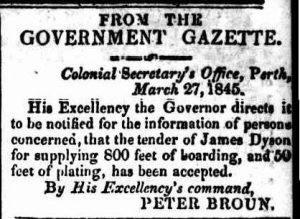
    The Perth Gazette and Western Australian Journal (WA : 1833-1847) Saturday 29 March 1845 page 3

    So James Dyson provided timber for an extension to the first Native Establishment building on Rottnest Island. It’s a not-very-interesting historical footnote in Western Australian terms, but a vital moment in the Dyson family’s history, for this is the first mention in public of James Dyson in Western Australia. Only a labourer in 1842, now he was a sawyer and a successful independent contractor after only four years in the colony.

    If the plan of the prison from 1842 does not look much like the current structure on the island, now known as the “Quod,” there is a reason for that and it’s not due to the 1845 extensions. Henry Vincent once again would be supporting Dyson and his family in their livelihood, just as his legendary clashes with Francis Fraser Armstrong were about to reach their peak. For next year, he (or another warder) burnt most of the settlement down, including the establishment:

    A fire took place at Rottnest a day or two since, when a stack of hay, containing about fifty tons, recently sold to the Commissariat at the rate of £4 per ton, was destroyed, together with the gaol and some other buildings. It appears that some native prisoners had escaped, and hid themselves in the bush. Mr Vincent, in order to dislodge them, set fire to the bush, the wind then blowing from the direction of the houses, but it eventually shifted, and carried the flames towards the buildings which caught fire, and were ultimately consumed. Mr Barlee and Mr Brown left Fremantle for Rottnest yesterday morning, to inquire into the matter, and, until the result is made known, we must only conjecture that there might possibly be some justification for the conduct of Mr Vincent, in resorting to so novel a method for securing escaped prisoners. The loss to the Colony is about £500.

    The Inquirer & Commercial News (Perth, WA : 1855 – 1901) Wednesday 13 February 1856 p2
    The Inquirer & Commercial News (Perth, WA : 1855–1901) Wednesday 19 November 1862 page 2

    In 1862 a new gaol building was finally commissioned. Lo and behold, Dyson once again successfully tendered to supply timber for the replacement.  Vincent was gone, but if it was possible, the future regime was even crueller. The Quod was a prison, pure and brutal. Armstrong returned to the island once more, late in his life, to witness the execution of an uncomprehending aboriginal prisoner. If James Dyson ever visited Rottnest Island, even if just to deliver his timber, the records do not tell.

    The Quod is a ten sided prison — like the Roundhouse on steroids : 2013.
  • Leetown to Auchterarder

    Leetown to Auchterarder

    Star (Ballarat, Vic. : 1855 – 1864), Wednesday 16 March 1859, page 2

    When certain members of the Dyson clan chose to deny their Lancashire heritage of robbery and mayhem, they liked to pretend their antecedents came from Scotland (As you do.) But much as some might prefer a purer lineage of cattle rustlers and street brawlers, adulterers and colourful racing identities, there is some authenticity to the professed Scottish identity of the children of Joseph Dyson (junior). Jessie, his wife, was the daughter of a Vandemonian draper named James Strutt.

    Unaccompanied and single, Jessie’s mother arrived in Australia on an immigrant ship from Liverpool when she was aged about 21. She made landfall at Melbourne on 15 March 1859. Her ship was named Monica. She had no apparent family in Australia, so some commission agent would have made a profit from bringing her out. Her name was Annie B. Brough, and on the immigration document she was listed as a domestic servant. She came from Perthshire in Scotland.

    The Argus (Melbourne, Vic. : 1848-1954) Saturday 25 January 1868 page 4

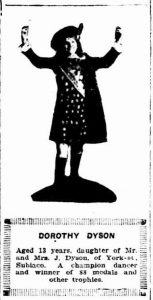
    What she did for the next nine years in Australia, I don’t know, but then she married Strutt who was a good nine years her junior. Ironic then, that she out-lived him after a fifteen further years of marriage. Her long widowhood concluded with her life in January 1901, expiring in the house of her son-in-law in Perth, Western Australia. She passed on not just DNA but a cultural heritage to her children, and they to her children’s children. That was the culture of the Scottish Highlands of Perthshire (co-incidentally the adopted name of the city in which she expired). Her granddaughter Miss Dorothy Dyson (among others) was a famed Scottish Dancer. (She danced Scottish dances, not that she was actually Scottish herself.)

    Sunday Times (Perth, WA : 1902 – 1954) Sunday 23 November 1924 p30

    Tracing Annie’s life back to Perthshire, you arrive in the hamlet of Leetown, in the Carse of Gowrie. A carse is a stretch of low-lying extremely fertile country, this one being on the north shore of the Firth of Tay.

    In the Carse of Gowrie, 2015
    Leetown. Visited in 2015

    Annie, or Ann, was the daughter of John Brough, Esq. The “Esquire” part of his name implies he was something a bit more than your common Agricultural Labourer, which is what he was designated as during the Census of 1841. The census (to be fair, I’ve only sighted a transcription) also gets his age wrong by about three decades. The 1851 Census is probably closer to the mark, giving his age as eighty-four. In 1851, he is described as “formerly a carrier” and to have been born in St Madoes, which is another village in the Carse. He would have been seventy-two years of age when he fathered Annie by his second wife Janet (Jessie) Blair; who was herself nearly thirty years his junior. By his first wife he had grown sons, who presumably would have inherited any property he possessed. His second wife also pre-deceased him.

    At the time of his death, aged ninety-three, Annie was one of two young daughters from his second marriage who remained single, presumably to look after the old goat in his dotage. She had just arrived in Australia by the time he died on 17 November 1859, which makes me all the more curious over what the relationship between the two actually was like. Annie had an even younger sister Margaret who went into service as a housekeeper when she was old enough. Their only surviving sibling was an older sister called Mary who married a man named Boyd. She named one of her daughters Ann Strutt Boyd (born 1871), so there can be no doubt she remained in contact with her sister in Australia.

    On the 1851 census Annie was listed as being born in Errol, another village in the Carse. Annie’s baptism record is missing, so the accuracy of this can not be confirmed.  Leetown is tiny; barely a row of houses. There is no store or services. The precise location where the Broughs lived I could not tell.

    St Madoes is a short walk from Leetown, which is where her father was born and where the nearest church is situate.

    St Madoes 2015

    There are any number surviving gravestones that attest to the presence of the Brough family in St Madoes over the centuries, however I could not immediately identify any direct relatives of Annie.

    Probably an ancestor, but I don’t know how.

    The presence of this line of Broughs in St Madoes dates back to James Brough (or Brugh) 1694-1787,  Annie’s great-grandfather. He was married in St Madoes to a local girl, and most of his children were born here. But this James was born in the town of Auchterarder.

    Auchterarder in 2015

    St Madoes is about 6km east of the city of Perth (the Scottish original, not the Western Australian one). Roughly 20km to the south-west of Perth is where Auchterarder lies. Auchterarder services the Gleneagles golf course, which is apparently very famous (If golf meant anything to me at all I’d be excited, but it doesn’t so I’m not). Auchterarder was known as the the “town of 100 drawbridges“, the reason why is no longer so obvious, but once, the extremely long main street (which gave the place its alternative title of the “The Lang Toun“) had deep drainage ditches on either side. The bridges that crossed the ditches to the front doors of the houses were the 100 drawbridges…

    the main street of the Lang Toun towards the Toun Hall: 2015
    Behind the Toun Hall: 2015

    The reasons why there be “drawbridges” no more, and why James Brough left the town might be one and the same. Judging by the remains in the old church yard behind the town hall, the Broughs, or Bruchs, were once notable identities in town.

    By 1715, Queen Anne, last of the Scottish Stuart monarchs, had been dead a  year and the Scottish parliament was extinct for nearly ten. Rule was from London, and there the throne was sat upon by a German called George. What occurred next is characterised as a rebellion,  but in the Scottish context is better described as a civil war. On the government side was the Duke of Argyll. For the rebels was the Earl of Mar; ostensibly fighting for Scottish independence and the return of a Scottish King.

    On 15 November 1715 the battle of Sheriffmuir ended inconclusively, but the Jacobite rebels advance had been halted despite their numerical superiority. They withdrew through Perthshire, occupying Auchterarder and then Perth. In the height of freezing winter they burn Auchterarder and the surrounding district to the ground. The occupants starved, froze, or in the case of James Bruch, moved to St Madoes. Was this how the “noble” Jacobite cause of which the songs were sung was actually fought?

  • CSI Halifax

    CSI Halifax

    18 June 1833. Halifax, Yorkshire.

    A heinous crime had been committed the previous evening, Mr Robertshaw had been viciously attacked and robbed in the street that night. That Tuesday morning the wheels of early nineteenth century justice began to turn. A suspicious character was apprehended that very morning. He was from across the border in Lancashire, Winterbottom was his name. By useful coincidence there happened to be an officer from the constabulary of that particular county;  Mr Heyward from Oldham, present in Halifax that very day.

    The scene of the crime: Halifax in 2015
    Yorkshire Gazette 13 July 1833 p3

    Heyward had been on the trail of villains from his own jurisdiction, so he eagerly secured an interview with Winterbottom, wherever the Halifax authorities were holding him.  He immediately identified Winterbottom as one of those he sought, and Winterbottom instantly recognised he. This Javert, this Lestrade of Oldham swiftly secured a confession and the names of his accomplices. Heywood hastened away back across the border into Lancashire to apprehend those suspects. By Thursday evening, he had all four in custody.

    They were examined before Christopher Rawson, Esq., back in Hallifax on Friday, in a process described as exhaustive. The prisoners were committed to stand trial at the assizes to be held in a few weeks time and ordered to be sent to York Castle until that date.

    The ordered Place of Remand: York Castle in 2015

    Enough of the debtor’s prison remains in York to get a very clear idea of what the holding conditions of the prisoners was like. However there is no record of James Dyson or any of the other accused being present at the relevant period in the Gaol facilities’ database. They may not have been transferred to York at all, and may instead have been held at Bradford, which was where their trial was eventually held on 3 July 1833.

    The place of judgement: Bradford in 2015.

    The four young men were charged with stealing from the person. They were:

    James Dyson
    James Schofield
    James Butler
    Thomas Jackson

    The Jurors were:

    Joseph Cox of Bradford, Draper
    John Collier of Bingley, Farmer
    Robert Ellis of Bradford, Grocer
    Benjamin Ellis of Gunessal, Farmer
    Jonathan Foster of Clayton, Farmer
    Thomas Farnell of Bingley, Spirit Merchant
    John Hutchen of Clayton, Manufacturer
    Johm Hainsworth of Adele cum Ecculs Cow, Miller
    John Mawson of Rawden, Clothier
    Robert Nunns of Hasfull, Joiner
    James Peekover of Munton, Shopkeeper.

    But wait, is there not a name missing from the charge sheet? Hold on, here is the list of witnesses called:

    Thomas Robertshaw
    Henry Naylor
    Joseph Winterbottom
    George Hulley
    William Heywood.

    Obviously a deal was done with Winterbottom to deliver up his accomplices, presumably he was forgiven not only this crime, but whatever crime Heywood had been chasing him for to begin with.

    Court documents that should have been for this trial but weren’t. Kew, 2015

    Somewhere in an archive in Bradford, there may be the complete trial notes for Dyson, Schofield, Butler and Jackson. The search for these records lead me on a fruitless search through the archives of Britain in late 2015. It culminated in the National Archives in Kew, London, on my last day in England, was when I discovered that these particular trial notes were back in Yorkshire— where I had started the search. Its only on TV that you can fly back and find what you have missed…

    Possibly the Hulk Justitia: The original image was engraved by Cooke after Prout as ‘Convict Hulk off Deptford’ in Cooke’s Views in London and its Vicinity completed in 1834.