Could the situation have got any more tragic for the Dyson family in the November of 1859? This is the family of James Dyson, the timber merchant of Perth, Western Australia we are talking about here, so yes it had been (and would be again).
Since the death of Dyson’s first wife, the family had actually been doing fairly well. Convicts had arrived in the Colony during 1850 and cut labourer’s wages by 60%, It was hard at first, but Dyson was now an employer himself, and by utilising both free and ticket-of-leave workers, he was soon to be counted among the largest employers of labour in the colony.
He was on the cusp of eligibility (through his growing real-estate holdings) to be selected as a juror, and hence, eligible to stand for public office. Having £150 in assets was the measure of tangible respectability for a man who was was yet to marry his future second wife, although they already had seven children together (including two from her previous marriage and three from his). They were counting down the days until her first husband could be declared legally dead. Dyson clashed in court with the Perth Town Trust over the right to collect timber on the Trust’s land, but soon he would be eligible not only to vote for councillors to that body, but be a councillor himself.
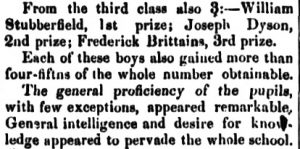
Awards day: Inquirer (Perth, WA : 1840 – 1855) Wednesday 28 December 1853 page 3
He had three sons on the cusp of manhood. William, the youngest surviving child by his first marriage was then twelve, and might have been a bit of a concern. He did not seem to have the academic nous of the next, Joseph, then fourteen, who was one of the first students to attend the state-run Perth Boy’s school in St George’s Terrace (when it was opened in 1854).
Perth Boys School in 1861 photographed by Alfred Hawes Stone (SLWA) Joseph Dyson would have been among the first students to use this building. Other buildings including the courthouse were used before this.
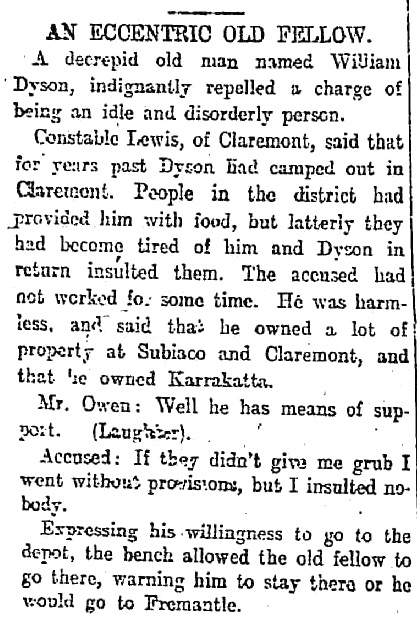
This is speculation based on the abject lack of any future positive mark William has left to posterity. There is a mention in 1887 that he may not have been able to hold his liquor (thus marking him out as a true Dyson), then there are a number of traffic offences (involving horses). One of these includes a fine for mistreating a horse, which leaves me unable to summon any affection for him whatsoever. William’s ending was sad. He did not seem able to function outside the family umbrella, so by the beginning of the 20th Century when the family of James Dyson had well and truly disintegrated, he was reduced to the situation of being a mad old bastard ranting about the extent of his family’s fortune back in the good old days.
The Daily News (Perth, WA : 1882 – 1950) Saturday 19 March 1904 p8
The “Fremantle” they threatened him with was, of course, the insane asylum. The Old Men’s Depôt had not long been moved from it’s uncomfortably public location at the foot of Mt Eliza to a less confronting locale conveniently situated in Claremont. William was only 54 years old at the time. He lived the rest of his life in the Claremont Retreat, later known as Sunset Hospital, where he died, totally forgotten, in June 1915. He was buried in an unmarked grave in the cemetery at Karrakatta. He had outlived all his immediate family.
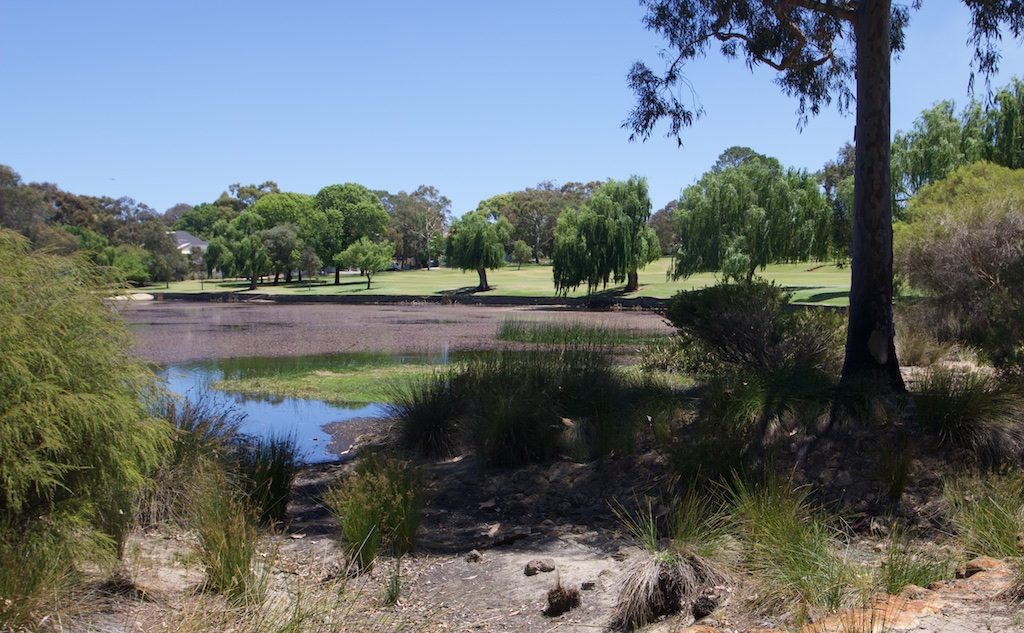
The Dysons had famously owned property in the Subiaco-Claremont area. In 1858 James purchased a wetland lake from George Shenton, senior. Apart from being one of the most influential merchants and financiers in the Colony, Shenton was also the chairman of the Perth Town Trust, yet despite that, seemed to hold Dyson in some high regard. Many years later, Dyson was compelled to sell the lake back to Shenton’s son, George, junior. The area around the lake was a significant camping ground for the Noongar inhabitants near Perth. Their name for the wetland area was Julabup, but from the time of Dyson’s possession of a British title deed, it became known as Dyson’s Swamp.
There are no records of Dyson’s interactions with the aboriginal custodians of his property, so I remain cautiously hopeful relations were good. Julabup is now formally returned to its original label as Lake Julabup after a long stretch when it was known as Shenton Lake. But it will always be Dyson’s Swamp to me.
Lake Julubup in 2016
Dyson had been expanding from his original business as a timber cutter, to being a building contractor, market gardener, baker, butcher, brick-maker and general dealer. Not that he personally did any of these things—that was what convicts and family members were for. Dyson’s swamp was a key asset. The Perth city herd of cattle was marshalled just outside the north of the city. In theory the abbatoirs were supposed to be on the eastern edge of town, by the Claise Brook—In practice, butchers plied their trade wherever they had their premises. Dyson’s Perth city dwelling and butchery was on the corner of William and King Streets. This was the first Dyson’s Corner. Dyson’s swamp was a convenient watering area for the herd near the town, as such, it was quite a lucrative piece of real estate. No doubt it was also a useful source of timber that he could legally exploit. His eldest son might well have been carting timber on the bullock cart when James Dyson’s world fell apart.
George Dyson might not have had the formal education of his younger brother, but he was described as sharp, active and industrious when aged nearly sixteen. It is not hard to imagine that he was his father’s pride and joy. Two months after his death, his desolate father was drinking himself into insensibility. It was a uniquely nineteenth century traffic accident. The bullocks pulling the cart had swerved suddenly and crushed the young lad between the wheels of the cart and a tree. He died a short time later. The accident certainly took place on the path to Dyson’s Swamp.
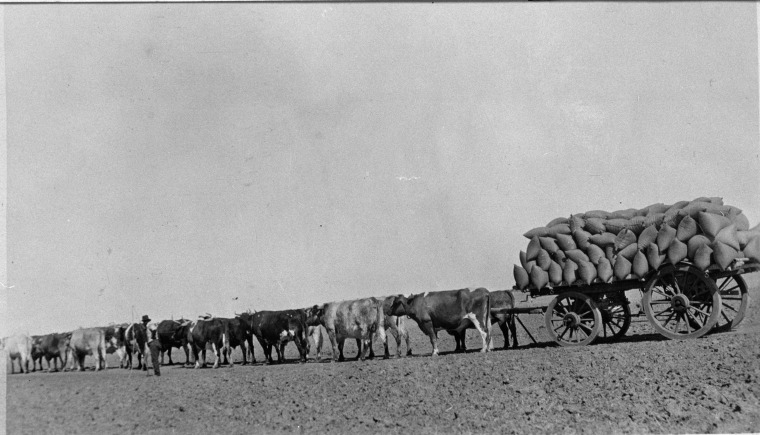
An example of a bullock team from about three quarters of a century later in the south west of Western Australia. [SLWA]
The grave site of George Dyson is lost. If George had lived, the fortunes of the Dyson clan might have been very different. But George was gone. His place as James’s heir was inherited, somewhat awkwardly, by James Dyson’s second son. This is where Joseph Dyson the Elder’s story really begins.
*These children in their turn, had surviving offspring.
The source of this material was a transcription from the Dyson family bible made in the mid 1990’s. I have never seen the original. I wonder who looks after it today?
Searching for James Dyson’s first wife and finding instead the Children’s Friend Society.
A little after a year since he arrived in the Swan River Colony, James Dyson, a labourer in the town of Perth, married for the first time that we know of. Civil registration of Births, Marriages and Deaths only begin in the Colony of Western Australia in 1841, so from this record—which is also the first tangible, formal document with James Dyson’s name on it in Western Australia—we know that the ceremony, witnessed by Stephen and Hannah Bridget Hyde (the couple’s neighbours in Perth for the next decade), took place on 25 October 1842.
There are no known images of James Dyson and Fanny, but if a painting did turn up, we can safely assume it would not look like this.…or this.
Dyson was lying about his age—he was at least eight years older than the twenty-three years that was stated on that certificate. Of his bride, we are forced accept her age at the time of marriage (twenty-two) is nearly accurate for we have so little else to go on with. She signed with a mark (x) which strongly implies she was illiterate. Her name was written down for her as Fanny Hoffington. She gave birth to four children with Dyson before her own death. There is no official death certificate yet located, or any mention of the event in any of the local newspapers. Her marriage, the birth of her children and her place of burial represents the extent of the official knowledge we have about her, and even that is riddled with contradictions.
Her pre-marriage name is described differently on every single source record that mentions her:
Marriage: Fanny Hoffington Birth of son George: Fanny Skeffington Birth of son Joseph: Fanny Hoffingham Birth of son William: Fanny Hovenden Birth of daughter Hannah: Fanny unknown (If they couldn’t work out her maiden name when she was alive, what chance do the rest of us have?)
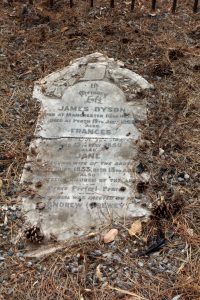
We have her tomb stone, but can we trust it?
Her headstone in the old East Perth Cemetery gives her name as Frances, and confirms she was the wife of James Dyson, giving the date of her death. However this headstone was completed in 1901, a good half century after her demise.
The secondary source for Fanny Dyson’s existence comes from a transcription of a family bible made in the mid 1990’s. I have not seen the original and I don’t know where it is now located, or if it survives at all.
This transcription reads:
Married 1st: 10.9.1842 Frances Overton HOFFINGHAM Died Perth, 12.5.1850, buried East Perth Cemetery.
It adds yet another possible family name to the mix. So where did this Frances/Fanny Overton Hoffingham/Hoffington/Skeffington/Hovenden aka unknown come from?
Having raised this question rhetorically, I still don’t have a satisfactory answer, but in researching the problem I came across a solution that could fit but is so outrageously improbable that it just couldn’t be true… One solid bit of written evidence… or a DNA test… could swiftly demolish this house of cards, but such is the hand I’ve been dealt. (If you think I am overcooking my metaphors, you haven’t sniffed nothing yet…)
There is no record of how Fanny (as I shall now call her—great-great-great-great grandmother being too much of a mouthful) arrived in the Swan River Colony. Records for servants, labourers, wives and children arriving were seldom made. If she had been a convict, there would have been some record. The ruling culture was unapologetically sexist, classist and would have felt no shame in any other *ist you would like to pin to them. Such was their overwhelming sense of superiority, any who did not measure up to their own self-image of importance, quite simply was not worth mentioning. Thus, arrival notices such as published in the Shipping news obscures the identities of an extensive swathe of population who may have been in the young colony. Steerage passengers on boats were not named.
This should not divert attention away from the fact that the population of the twelve-year old colony was still pathetic.
By 1841, the Colony’s pitiful non-aboriginal population of under four-thousand men women and children was not just stagnant, it was contracting. workers were in critically short supply. The first colonists had bought out a labour force that they bound to themselves by contract. While under contract, it was illegal for a servant to leave a master’s employ. But after a decade, these contracts had mostly expired (or were about to), and those workers were then free to either work for themselves, or get the hell out of colony as soon as they were able, away from bosses far too much in love with themselves. Young female domestic servants were in especially short supply. They had a tendency to swiftly and inconveniently give birth to children, or get married— often both (but not necessarily in that order.)
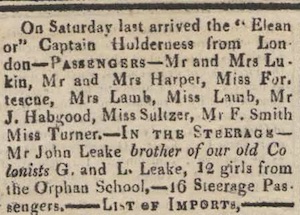
I suspected there had to be some scheme to at least attempt to replenish the work force and add to the stock of peons (much later on, convicts would be brought in, but not until 1850). If Frances was not an unrecorded child, or the domestic servant of some named immigrant, she might have arrived through some such scheme. Then I found the following article in a newspaper of the year 1837:—
Swan River Guardian (WA : 1836 – 1838) Thursday 28 December 1837 p274
The date was about right. Might Fanny have be one of these girls from the Orphan School?
I draw your attention to an inestimable book by Geoff Blackburn called The Children’s Friend Society: Juvenile Emigrants to Western Australia, South Africa and Canada 1834-1842.
From it, I learned about the Children’s Friend Society, the first in a long tradition of sending to Western Australia, child migrants as a virtual slave labour force (useful until they got too old or their indentures expired). As always, the road to hell was paved with good intentions. However, the seventy-three children who were dispatched to the Swan River Colony (only seventy-two actually arrived) had a much kinder time of it than their brethren sent to Canada or the colonies at South Africa. The great majority of those sent were boys, which makes it much easier to account for the female immigrants.
A Captain Edward Pelham Brenton founded the society in 1830, fired by the same evangelistic religious impulse of the era that motivated little Wilberforce to push through the laws in Britain abolishing slavery. Immigration was not part of the original plan: it was initially a scheme for training orphans for employment. Not just orphans, but all “the neglected and destitute children that infest the streets of the Metropolis” (p16)… but when jobs could not be found for their parents let alone their children, the Empire’s colonies beckoned.
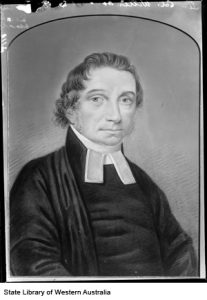
By 1841, the society was defunct. Brenton was dead, metaphorically and literally from a broken heart. Allegations of mistreatment of young people sent, in particular, to the colony at Cape Town—sealed the scheme’s fate—the court of public opinion in Britain passed its judgement. But in Western Australia, perpetually out of synch with the spirit of the times, the society’s agent in the colony continued writing to request more fodder orphans be sent, even after the head office in London was closed. This hapless agent was the Colony’s colonial chaplain, John Burdett Wittenoom.
John Burdett Wittenoom. SLWA
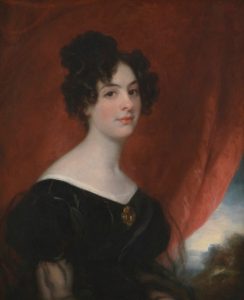
Wittenoom, who under no circumstances could ever be accused of being an evangelical, did have one redeeming characteristic in the exercise of his pastoral duties: He seemed to genuinely care for the welfare of the children that passed through his charge. The record shows that he followed their progress and checked up on them long after he had any official requirement to do so. His passion was children’s education (and perhaps music). He might have been the first to admit that he would have much rather have remained the master of a college back in London than take the job of token government religious leader in an obscure colony on the far side of the world. He would have had little enthusiasm for the religious drive of the disturbingly young wife of the Governor of that Colony, Ellen Stirling, but in the Children’s Friend Society they did share a common interest. She was acting matron for some of the Society’s charges on the ship that brought her and her husband back to Western Australia in 1834. Although, like her soon-to-be monarch, Victoria, she was barely older than the young women she had guardianship of.
Lady Ellen Stirling. National Portrait Gallery of Australia.
The ‘orphans’ were supposed to be teenagers before they were dispatched to the colonies, and before that time, they needed to be housed and trained back in England. The young Princess Victoria was also a supporter of the society. In her honour, The Royal Victoria Asylum for Girls at Chiswick to the west of London was named. This was the Orphan School of that newspaper article.
It is a bizarre quirk of this culture how these girls were guarded; age or experience counted for nothing. Being, or having been married, was all. This is Jane Austen territory. That Lady Ellen Stirling was only twenty, and perpetually pregnant, somehow made her a suitable guardian for other younger women. While she did have her newly-knighted husband present on that voyage, (though you wonder how useful Sir James Stirling would have been in the situation) that was not the case for the matron sent out on the “Eleanor” to look out for those twelve girls in 1836. She was a young widow of thirty with four very young children of her own. They accompanied their mother to Western Australia, and they were likewise sponsored by the Society for their passage to the Colony. Wittenoom would also keep an eye out for their well being.
Now for the big reveal:— All the orphan girls are accounted for and none are named Fanny or Frances. Anticlimactic, yes? Their Matron, in short order, remarried to a man in the colony named Edwin Knott, and the former Mrs Sarah Massingham took his name. The youngest of her four children to the late John Massingham was born in 1833 and was only aged four in 1837. In 1842 she was nine, so even allowing for the greatest elasticity in birth-dates for both parties involved, she could not have been the wife of James Dyson even though she indeed was called Frances (or Fanny) Massingham. She married a young labourer called John Wansbrough out in the Beverly district in 1856 but died in childbirth later that same year.
Massingham — Hoffingham… We are talking illiteracy here, so it might have worked… and it still might! The eldest of Mrs Knott’s children was also a daughter. In 1842, Emma Massingham was aged about fourteen. Now Dyson was in actuality aged over thirty years, so, if these two did indeed hook-up (to use an anachronistic term), it is quite a repellent concept to my thinking and would have been pushing things even by the standards of those days. They would have had, although, as a rôle model, the by now former Governor of the Colony who was thirty when he married his wife of sixteen. Wittenoom would not have approved of the match, I am sure, so that could be why Emma might have assumed the name of her younger sister and the couple both lied about their age to the registrar. They were not married in any Church service Wittenoom presided over. Then the deed was done.
Not very convincing, is it?
This is all pure supposition of course, and a long bow is drawn to even more ludicrous levels of tension when you discover after the first Mrs Dyson’s reputed death in 1850, four months after the death of her last baby, leaving three young boys aged between six and two, Emma Massingham wedded a man named John Henry Gregory in 1851. The Gregorys had ten children over the course of a marriage that lasted sixty three years. They both died only a few months apart, the year the Great War began in 1914.
Of course, maybe Fanny Dyson never died, and she left her husband, as James Dyson’s next wife would leave her first husband*. Remember, we do not have her formal record of death even though she was allegedly interred in Perth’s only official burial ground and deaths were supposed to be recorded. How could James have ever been persuaded to go along with such an outrageous scheme? But Dyson had secrets, many secrets, including one big one he would not have wanted coming to light just as the first convict ships were arriving in Western Australia. There was leverage to be applied, possibly enough for him to have seen his young wife ‘dead’ as the only alternative to discovery.
This story is just that. It cannot be proven. Running a nose over the dead fish of feasibility reveals that this stinks. Yet so much in James Dyson’s history, especially when Mrs Richard Edwards, the former Miss Jane Devling and Dyson’s eventual second wife enters the narrative, is equally pungent, if not actively odourific. The difference is for the outrageous tale of Mrs Jane Dyson, we can prove that it is true.
Updates and future research directions.
Since this article was written, an even more far fetched theory concerning the identity of the first Mrs Dyson has been developed. Unlike this one, I believe it to be true!
P.S. It turns out Fanny Dyson did leave her husband, but then she died.
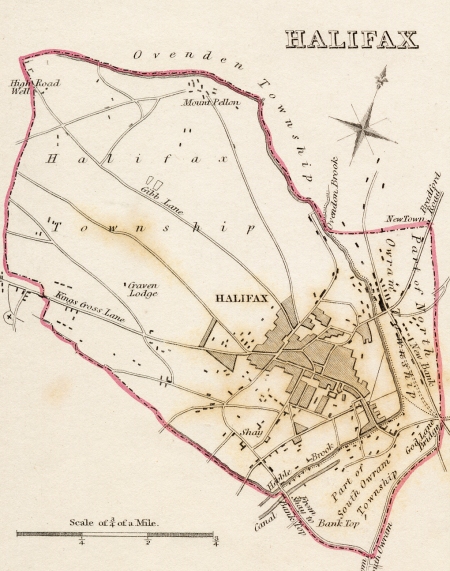
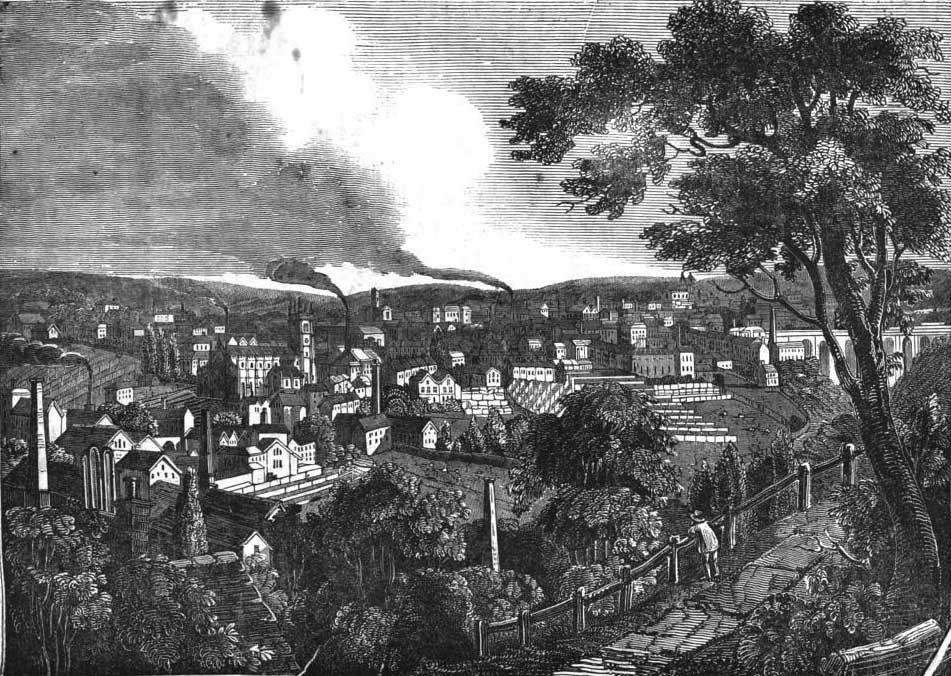
Halifax is a town in the West Riding of Yorkshire, not that far from the Lancashire border to the west. With little in the way of useful agricultural land in the district until comparatively modern times, the processing of wool, and later on, cotton, evolved into an industry that dominated the town. Messrs Buck and Kershaw established themselves in business as stuff merchants in the late eighteenth century. “Stuff” has a few different definitions, but in this case referred to worsted cloth, a material which is spun from wool. By the first third of the nineteenth century the original Mr William Buck and Mr James Kershaw were long departed, but the business lived on, running a worsted spinning mill, a warehouse in the ancient street in Halifax known as the “Woolshops” and a head office at a prime location in the very heart of town on Union street.
Halifax in 1835
Mr Thomas Robershaw was one of Messrs Buck and Kershaw’s employees in Halifax. He was a warehouse manager for the business and was thirty-six years old. It’s not clear yet whether he was married or had any family. His residence was about a mile away from his place of employment, in a locale known as Kings Cross. His journey to home was west down the Kings Cross Lane, also a major thoroughfare to the junction of paths that lead out of the district to the manufacturing and trading centres in East Lancashire. Houses for the rapidly expanding workforce sprawled outwards from the old town. Civic services were non-existent for the burgeoning population, but in the finest tradition of laissez-faire economics the private sector filled the gap with inns and beer-houses. In the whole parish there were but three policemen, and two of those were volunteer constables. What could possibly go wrong?
On the evening of Monday, 17 June 1833, for Mr Robertshaw, things finally did go wrong. First of all, he left his pocket book in the inn he visited on his way home from work. Such was how his fortune would play out that this careless or intoxicated act would soon be recast as luck. The hour was late when he departed the establishment and his home was still a mile away. While the mid-summer night may have been fine, there was also a new moon. There may have been the odd lantern outside a public house, but street lighting was a thing of the future. Mr Robertshaw walked home in the dark.
Town of Halifax, Yorkshire, from The Penny Magazine, 15 March 1834
Somewhere between the Halifax town centre and King Cross is as close as can be identified that the assault took place. There were five of them, but how much he saw we can not tell. That he was not altogether in the remote wilderness is the extreme length they went to silence him in their struggle. Soil was grabbed and stuffed in his mouth, more and more dirt to smother his cries, a suffocating pressure like he was being buried alive from the inside out. It felt like he was going to die. His chest would have pounded with terror and the useless adrenaline urged him to breathe faster for the air that would not come. Roughly, his pockets were searched. Perhaps they searched again, for they did not find what they had expected to find on the sort of man such as he, that would make such a desperate action worthwhile. Coins worth nine shillings were all that they found, and they took them. Then perhaps for spite for such a miserable haul someone took his hat. After that they let him go and fled, leaving Mr Robertshaw barely alive to spit out the choking dirt. There is not much more to say on Mr Robertshaw’s life other than that he most likely never fully recovered from this ordeal.
Eighteen days later he stood in the courthouse in the nearby town of Bradford to give evidence against four young men accused of theft from his person. The fifth member of the gang was not in the dock. He was a much older man than the others and was also their alleged ringleader. He would have stood where Mr Robertshaw had stood on the witness stand when he gave evidence against his compatriots. Maybe part of the deal was that the four were only charged with the theft and not the assault. The jury found them duly guilty. Highway robbers were still routinely sentenced to death. Instead, the four young men were sentenced to transportation for seven years and the older man walked free. How Mr Robertshaw felt about this outcome is not known. If he felt that justice had been done we cannot tell.
While the four young men were imprisoned on the hulks awaiting transportation to Australia it is recorded that they confessed their parts in this crime. None of them appealed their sentence although they had the opportunity to do so. Maybe they had realised the full enormity of their actions and that a re-examination might go that much worse for them. For on Monday, 29 July 1833, exactly one month after the attack, Mr Thomas Robertshaw, of King Cross, foreman to Messrs. Buck and Kershaw, stuff merchants, Halifax, died. He was buried the next day in the churchyard of the Holy Trinity church in Halifax by curate William Wilmott, M.A. He does not have a headstone.
Future research
The crime, the pursuit and apprehension of the gang is recorded in some detail in the regional contemporary newspapers. The preliminary documents of the trial exists which lists the jurors and witnesses against the accused.
James Dyson served seven years as a convict in Van Diemen’s Land (now Tasmania) between 1834 and 1840. He arrived in Hobart Town on the convict ship Moffat on 9 May 1834. Until 1837 he worked on the road gang in that town, Then he was transferred to northern Tasmania around the Launceston district and was assigned to various masters in the area. He was never granted a ticket-of-leave or a conditional pardon, instead his sentence was extended, and he remained in the system until 3 July 1840. He left the colony a year later for the free settlement (one without convict labour) of Western Australia.
He was not a model prisoner, although his long record of malfeasance while in bond should be seen in context over a seven year sentence. Below is an attempted translation of Dyson’s official record as a convict. It is hoped that some more flesh can be applied to these bare bones of history:—
Transcription updated 13 September 2022 Transcription updated 5 May 2023
Hobart Town
26 August 1834 P[ublic]W[orks]./ Drunk to be worked on the Roads 6 months /[ordered by] P[rincipal]. S[uperintendent of Convict Department]/
26 August 1834 [Assigned to] P[rincipal] S[Superintendent of Convict Department’s] office
9 September 1834 [Assigned to] W[harf] W[orks] Off[ice]
? July 1835 P[ublic]W[orks,] Absent from his Work, 25 lashes / [ordered by] A[lexander] Murray
24 July 1835 P[ublic] W[orks,] Disorderly Conduct in the Street, Tread Wheel for the next 6 Saturday Afternoons / [ordered by] J[osiah]. S[pode].
1 August 1835 P[ublic]W[orks,] Idleness to be confined in Barracks on Saturday & Sleep in a Solitary Cell 3 Nights / [ordered by] Alex[ander] Murray
21 September 1835 Hobart Town P.O [sentence?] ex[tende]d 71 [by 1 year?]
2 October 1835 Disorderly Conduct in Absenting himself from work on the 2nd Oct / 12 lashes/ [ordered by] A[lexander] Murray
24 August 1836 P[ublic]W[orks,] Absent from Barracks all night, 3 Months hard labour in view of the Town Surveyors Gang / [ordered by] W[illiam] Gunn
29 August 1836 [Assigned to] P[rincipal] S[Superintendent of Convict Department’s] Off[ice]
4 February 1837 Having in his possession a Woman’s cap & some Lace without giving a satisfactory account of them / Hard labour in chains 3 Months / [ordered by] P[rincipal] S[uperintendent of Convict Department] / at his trade Vide [see] Liut Governors decision 4/2/1837
7 February 1837 [Assigned to] P[rincipal] S[Superintendent of Convict Department’s] Off[ice]
Launceston
14 July 1837 [assigned to] L[aunceston]
16 September 1837D[avid] Williams / Returned to Govt his master not requiring his services [date may be in 1839]
Corra Linn, Evandale
4 December 1837 [assigned to] Morven [Evandale District]
7 December 1837 [Master is Henry] Nickolls/ Assaulting (and threatening)?? Violence to his master 6 months hard labour in the Street & ret[turned] to Government ([ordered by] R[ichard]. Wales) [to] Kings Meadows Chain Gang, after[wards to] Laun[ceston] assignable. Vide [see] Lieutenant Governor’s Decision
King’s Meadows, Launceston
16 December 1837 [assigned to] C[hief]. P[olice]. M[agistrate]. [then either ink blot or obscure word]
?1 December 1837 L[aunceston] [date obscured -either 21 or 31]
Cressy Estate
2 October 1838 N[orfolk] Plains [thank you Lenore!]
Some one or some place associated with the Cressy Estate?
5 October 1838 VDL Establishment / Incorrigible idleness and using abusive language. 26 lashes & returned to Government / [ordered by] J[ames]. C[ubbiston]. S[utherland].
Campbell Town
13 October 1838 [Assigned to] C[ampbell] t[own] of[fice]
Calstock Estate, Deloraine
20 October 1838 ? [Assignment lost off fold of page] Possibly Calstock Estate near Deloraine
Snake Banks (Powranna)
23 November 1838 [Lt Pearson] Foote/ Idleness & neglect of duty. 6 months hard labour / [magistrate] W[illiam]. M[oriarty]/ Snake Banks & Returned to his Service vide Ltd Gov Decision 23 Nov 1838
Calstock Estate, Deloraine?
23 May 1839 Theoretically the date returned to the service of Pearson Foote, RN.
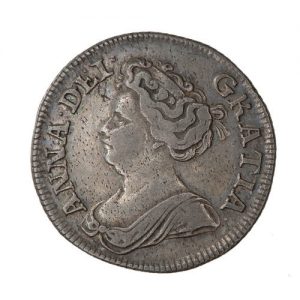
Queen Anne, just so you know. (There might be a test later)
Five minutes of searching the internet revealed no consensus on the origin of the name Dyson. Thankfully this is not what this article is about. Regardless of the original etymology or geographical location of a theoretical common ancestor, (and while it would give me no pain at all to be able to trace my ancestry all the way back to a female cattle rustler in the West Riding of Yorkshire) the earliest credible ancestor I can identify from the surviving records is that of Simeon Dyson from Crompton, near Oldham in Lancashire. His son, Ely (or Eli) was born during the reign of Queen Anne, some time before April 1701.
Bill and Madge. R White, engraver, died 1703, Public domain, via Wikimedia Commons
His son William was born about 1687, during the reign of King William III and Mary II.
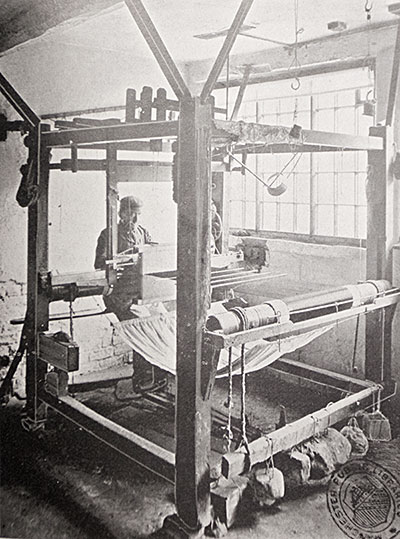
Hand Loom Weaver in Lancashire. James Dyson’s father sold machine parts.
For several generations thereafter, the descendants of Simeon were predominately cloth weavers in the hilly east of Lancashire, occasionally spilling over the county borders into Cheshire to the south, or east into Yorkshire. The weaving of wool into cloth using hand looms was a traditional cottage industry in the region, and Simeon’s listed trade as a joiner—a specialised skill in carpentry—hints at his future family’s success in manufacturing the implements of the weaving trade.
Joseph Dyson (1783-1839) was born into a very different world to that of Simeon, his great-great-grandfather. King George III had comprehensively lost the American colonies and the spinning material of choice was now cotton. Staggering technological advances in the production process transformed a rural landscape into both an industrial and urban one. During Joseph’s lifetime, the transition from water power to coal and steam would have turned the damp wet country (the moisture being ideal for the cotton spinning process) from green to black. Joseph married Hannah Binns in the Church of St Chad at Rochdale, on 19 January 1804. His father-in-law, Mr. Andrew Binns was described as a Cotton Spinner which does not really adequately reflect the reality that he was not a weaving machine operator (skilled though such operators needed to be), but was actually an owner of a mill in his home town of Mossley.
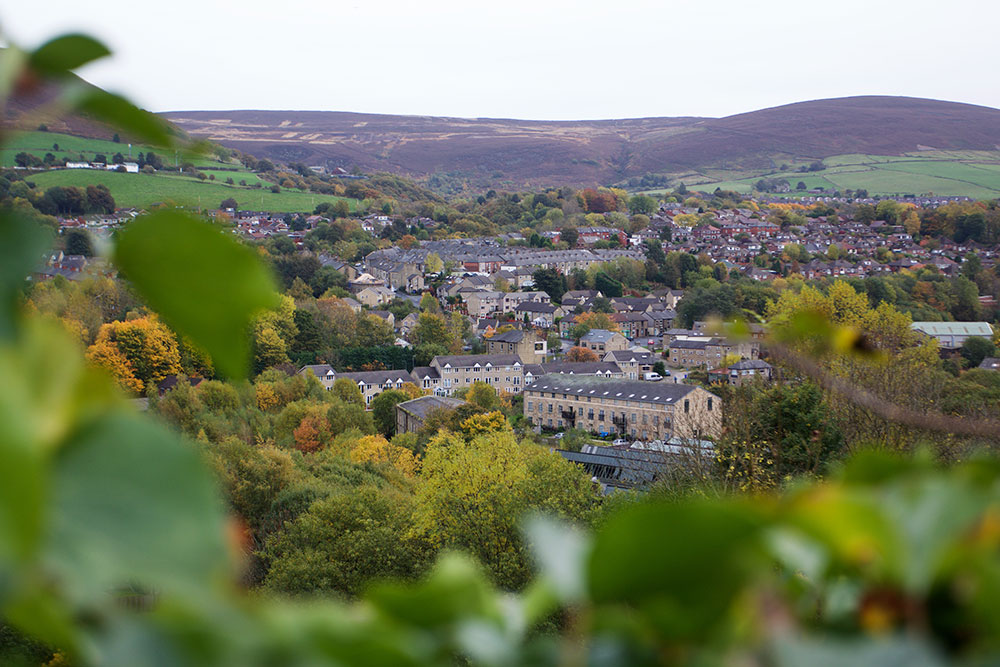
The town of Mossley lies on the border between three counties, Lancashire, Cheshire and Yorkshire in England.
Joseph seems to have had a varied career that involved quite a bit of travelling about the county. At the time of his marriage, his trade was listed as clothier, which suggests he was involved in the selling end of the cloth production cycle. By 1815 he was described as a cotton weaver, which again tends to down play his responsibilities as an overlooker—a factory floor supervisor. He made his residence on the outskirts of Oldham town, a district glorying in the name of Mumps. He owned at least six cottages on a small street that looped underneath the hill-side overlooking the main road out of town. It’s grand name of Regent Street seems somewhat overblown. Those six cottages (now long gone, as are everything else contemporary to him or his family on Regent street) probably was the heart of his cotton empire, as far as it went. The impossibly large number of occupants of this tiny street are mostly listed as cotton spinners in the 1841 England Census, which took place only a short time after his death. Dyson probably owned or sold the hand spinning machines worked by them in his cottages. His travelling work continued as a machine broker and a trader in cotton waste. When he died at home in Regent Street in 1839 he left his children an estate worth £2000… to some of his children at least.
Regent Street, Mumps, Oldham, Lancashire, England: visited October 2015. There is nothing remaining of anything even remotely associated with the Dyson family.
His sons continued in the Cotton milling trade as Spinners, Overlookers, Managers and Yarn Agents— except one.
Of his nine supposed children, three appear not to have been born to his wife, Hannah—and at least one of those may have been adopted from his unmarried sister.
All the children that survived into adulthood were mentioned in his will, witnessed shortly before he died at his home on 13 July 1839, his long-suffering (inferred by the circumstances) wife having pre-deceased him eighteen months before. All the children were mentioned, except one.
Thomas Dyson, born 1803 at Quickwood (Saddleworth) near Mossley.
Andrew Dyson, born 1806 at Mossley.
William (i), born 1808, died 1814 at Quickwood.
John, born 1815, at Bough, Mossley.
Mary, born 1822 at Mossley.
Sarah, born 1824, at Oldham
William (ii), born about 1826.
Joseph, born 1828, at Mumps.
The missing child was James Dyson. He was reputed to be born in Newton Heath, a suburb of Manchester on 15 October 1810, but no baptism record has been discovered for him. Birth certificates are still a generation away. At least two of his siblings, John and Mary, are described as illegitimate on their baptismal records. In John’s case, Joseph is the reputed father, while Mary was probably the daughter of Joseph’s unmarried sister Betty. The second William Dyson also has a missing baptism record but, like older brother James, he indubitably existed. James Dyson is not in the 1841 census that locates most his siblings living together in Regent’s street, or working with their late mother’s Binns relatives. He was either in, or about to arrive in Western Australia at that precise moment. Essentially, there is no formal record tying James Dyson to this family in Lancashire. And that’s the way (I am sure) they wanted it. Informally, however:—
James Dyson in Western Australia, outlived all but one of his siblings back in Lancashire, and at the time of his death, and until her own in 1896, sister Sarah lived in Newton Heath, Manchester — the only definitely recorded member of his family to do so. She lived in a house named “Birch-villa” on Droylsden road. It’s name might a reference to to the family’s cotton mill founded after the time of her father and run brothers Andrew and Joseph. It was known as Bower Mill and was located in Hollinwood, equidistant between Newton Heath and Oldham, near the site of an old house occupied by the family called “Birchen Bower.” The house was famous for many legends including a real life mummy and ghost story. Today there is a motorway on the site.
But what had James done to be so comprehensively written out of the family story in Lancashire? Before him, James was a family name among the Lancashire Dysons. It was demonstratively “retired” after him. He was not the last bastard to be fathered by his father so it could not be that. There remained some memory of the family’s antecedents in Lancashire by James Dyson’s Australian children, and there may have been some (long lost) line of communication back to someone in the home country.
The Daily News, 23 June 1888, p. 3
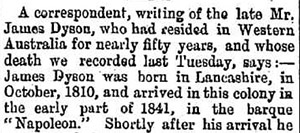
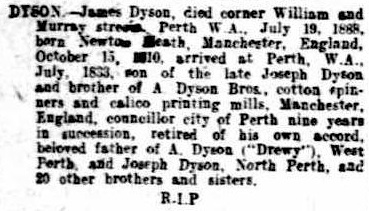
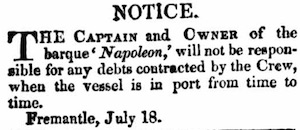
James arrived in Western Australia on the ship Napoleon in 1841, but the surviving passenger list for the January arrival at Fremantle from England does not mention him. But wait, does not the press clipping below say he arrived in July, 1833?
The West Australian (Perth, WA : 1879-1954) Tuesday 19 July 1910 page 1
The year the colonial barque Napoleon visited Western Australia was most definitely 1841— she made two visits to Fremantle in that year, one in January, and the second in July. She is not to be confused with an American whaler of the same name also in the vicinity at that time. A passenger list for the January visit contains no mention of Dyson, although the ship sailed direct from England. From the second July visit, no passenger manifest has been located and the port of origin this time was quite different.
The Napoleon sailed from Fremantle in February 1841 and arrived in March at Launceston, Van Diemen’s Land. There she underwent re-fitting to be a whaler and sailed back to Fremantle in May, arriving on the 12 July 1841.
The Perth Gazette and Western Australian Journal (WA : 1833 – 1847) Sat 7 Aug 1841 Page 1
There was a man called James Dyson then living in or around Launceston in what is now known as northern Tasmania in 1841. Furthermore, there are distinct records of a young man called James Dyson who departed from England in January 1834 for the prison colony of Van Diemen’s Land. This James Dyson did indeed depart from Lancashire in 1833, never to return.
The circumstances of his departure were no doubt a massive embarrassment to his family, and more than enough cause enough for his father to wipe him out of the family inheritance, however his ancient cattle rustling antecedents may well have nodded with approval.



 …continued.