Tag: convict

One who has been “convicted” of a crime, but in this context, one who had been convicted of a crime and then sent to the Colonies of Australia to serve out their sentence. To have a convict in the family is either the deepest shame or a badge of honour.

  • Timber!

    Timber!

    Timber was the business of James Dyson from his earliest years in Western Australia. A year after his arrival in 1841 he was working as a labourer. Of the few people from this time we know for sure that he associated with, Stephen Hyde was a carpenter, and his next door neighbour in Perth for the next ten years.  By 1845 James was describing himself as a sawyer, and the earliest mention of him in the newspapers of the Swan River Colony was as the successful bidder for a government contract to supply timber boards for a building on Rottnest Island.

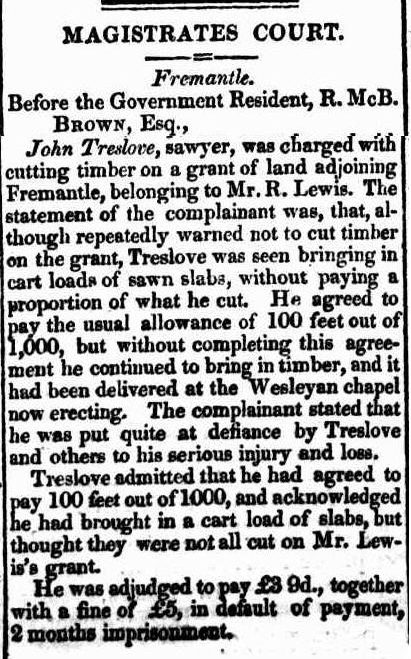
    The Perth Gazette and Western Australian Journal (WA : 1833 – 1847) Sat 15 Jul 1843 Page 4
    The Perth Gazette and Western Australian Journal (WA : 1833 – 1847) Sat 14 Nov 1840 Page 2

    Neither of these articles from the period mention Dyson but they do illustrate an important point. It was not possible to just wander out and collect timber, particularly not from unoccupied crown land. To be a sawyer, you needed either money, or a patron. (Apropos to nothing, Peter Brown (or Broun) and Robert McBride Brown were brothers.)

    If Dyson was working as a sawyer prior to 1843, he must have (in conjunction with someone else) been employed by or worked with, one or more of the following gentlemen:
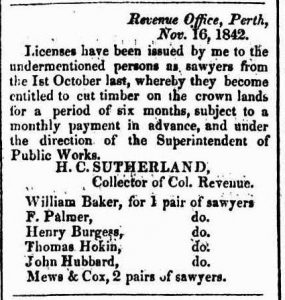
    The Perth Gazette and Western Australian Journal (WA : 1833 – 1847) Saturday 26 November 1842 p3

    After this date, the regulations changed, and most frustratingly, names of licensees were no longer published in the papers. We can know, however, how the work was done by James, at least in the beginning:
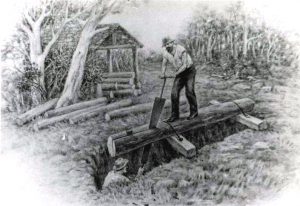
    A generic illustration of pit sawyers at work. [http://www.nationaltrusttas.org.au]

    Shortly after his arrival he commenced business as a pitsawyer — a laborious occupation, but of a most lucrative nature in days previous to the application of steam machinery. After about nearly twenty years he established himself in town as timber merchant and general dealer, and in those days was amongst the largest employers of labor in the colony.

    The Daily News (Perth, WA : 1882 – 1950) Saturday 23 June 1888 p 3

    From 1850, two equally momentous events transformed the Western Australia; on the 25th October 1849, Dyson’s future second wife Jane Develing arrived in the Colony on the Mary. On 1 June 1850 the ship Scindian landed the first large scale cohort of convicts to Western Australia. These prisoners were initially occupied building their own gaol in Fremantle, but Dyson would eventually employ one of these men: Thomas Hart was a burglar, but his professed trade was as a mason. In what capacity Dyson employed him I have not yet uncovered.
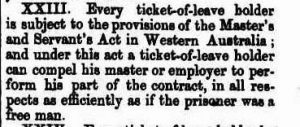
    The Perth Gazette and Independent Journal of Politics and News (WA : 1848 – 1864) Friday 11 April 1851 p4s

    From later ships, a convict would usually be granted probation very soon after he arrived in the form of a ticket-of-leave. They were by no means free, but they were no more a slave labour force than any other employee in the colony at the time.

    The Perth Gazette and Independent Journal of Politics and News (WA : 1848 – 1864) Friday 18 July 1851 p2

    A convict depôt was established under the shadow of Mount Eliza near where the Swan Brewery buildings now stand. This place was also adjacent to a stone quarry that recalcitrant or unemployed convicts could be assigned to. (In later years after transportation had ceased, this depôt would become the old men’s home.) The men’s skills were advertised for prospective employers. From the attached list, Dyson would choose Henry Rugg, brickmaker and Thomas Molineux, Miner. Dyson was involved at various times with brick making in Perth, but once again it is by no means certain that this was what these men were employed for by him.

    Thomas Matthews was serving a ten years for theft and had arrived on the convict ship William Jardine on 4th August 1852. His trade was watchmaker, but he was employed by Dyson as a sawyer on 28th April 1855. It was not a great choice for either…
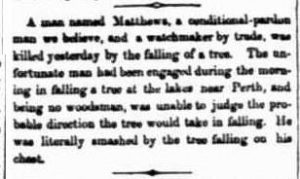
    The Inquirer and Commercial News (Perth, WA : 1855 – 1901) Wed 10 Oct 1855 Page 2

    Matthews was working near Lake Monger, north of town, which does give a clue about where Dyson was operating and what sort of timber he might have been collecting at the time. Tuart was a valued hardwood for general construction work and sheoak was used for roofing shingles.

    An example of a shingle roof.

    Convicts, as a rule, do not write testimonials to their masters’ treatment of them, so we only hear anything about them when something goes wrong. Richard Griffin was a housebreaker who arrived on the Lord Raglan, 1 June 1856.  Dyson most definitely did employ him as a sawyer from 14 May 1860. Under a month later he was returned to the depôt, and thence to the police court:
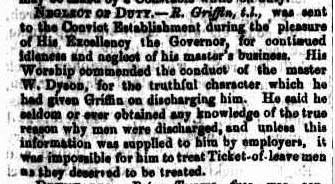
    The Perth Gazette and Independent Journal of Politics and News (WA : 1848 – 1864) Friday 8 June 1860 p3

    This is a rare example of a Dyson being complimented by a magistrate. William was James Dyson’s third son and was born free, but he was in turn complimented by father for his action? Remember, James Dyson had once been a convict himself, in Van Diemen’s Land. He had never been granted either ticket-of-leave or conditional-pardon status and had served out the full seven years of his sentence. If you look at his record, you could see it was far from spotless. This was a man that understood exactly what it entailed to be accused and convicted of “Idleness & neglect of duty”. His attitude seems to be, “I know what you are thinking, because I thought it myself, once. I didn’t get away with it then, and I’ll be d—ed if I let you get away with it now.” This impression is reinforced by a later recollection of Drewy Dyson, of his father.

    Drewy’s father was a man who held very strong opinions on the jury system of trying criminals and suspected criminals, and more than once in his time when in a panel has been the cause of pulling up a barrister and even a judge during the course of various cases. Old Man Dyson was exceedingly well-versed in law and not bush-law at that, and could quote off hand chapters from British authorities that would not be possible to any but those possessing a wonderfully retentive memory. As a boy Drewy received many strong lessons in common humanity and equity from his father, the latter taking him on more than one occasion to see condemned men being brought chained through the streets of Perth in an open cart, just as they were taken to Tyburn in London in days long gone by.

    Sunday Times (Perth, WA : 1902 – 1954), Sunday 24 April 1927, page 14

    So it was that Drewy Dyson’s older brother probably came to regret messing about with that gun in the wetlands north of town in the year 1867.

    The Inquirer & Commercial News (Perth, WA : 1855 – 1901) Wednesday 24 July 1867 p2

    Thomas might have preferred prison. He was exiled from Perth, not to return for nearly twenty years. He served an apprenticeship in Geelong, Victoria, but eventually, out of all Dyson’s many children, he would end up with the greatest success in business. Young Benjamin Mason was the son of Benjamin Mason, senior. The Mason family of Perth were another clan of storekeepers, publicans, carpenters and general entrepreneurs very similar to the Dysons in many respects. One can’t help but fear that having your son shoot your near neighbour’s son in the head must have put a crimp in the personal relations between the two families and may have thwarted any potential business cooperation. This is especially unfortunate as Ben Mason’s name, in conjunction with that of his parter Francis Bird, will be forever linked with the next stage of development of the timber industry in Western Australia. It was part of an evolution Dyson was not able to or was unwilling to adapt to.

    …continued.

  • In Old Hobart Town

    In Old Hobart Town

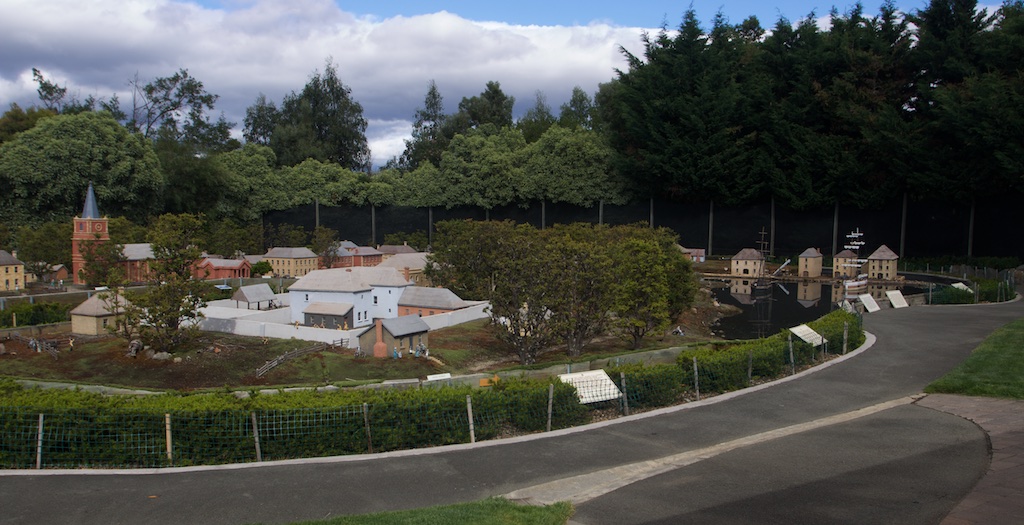
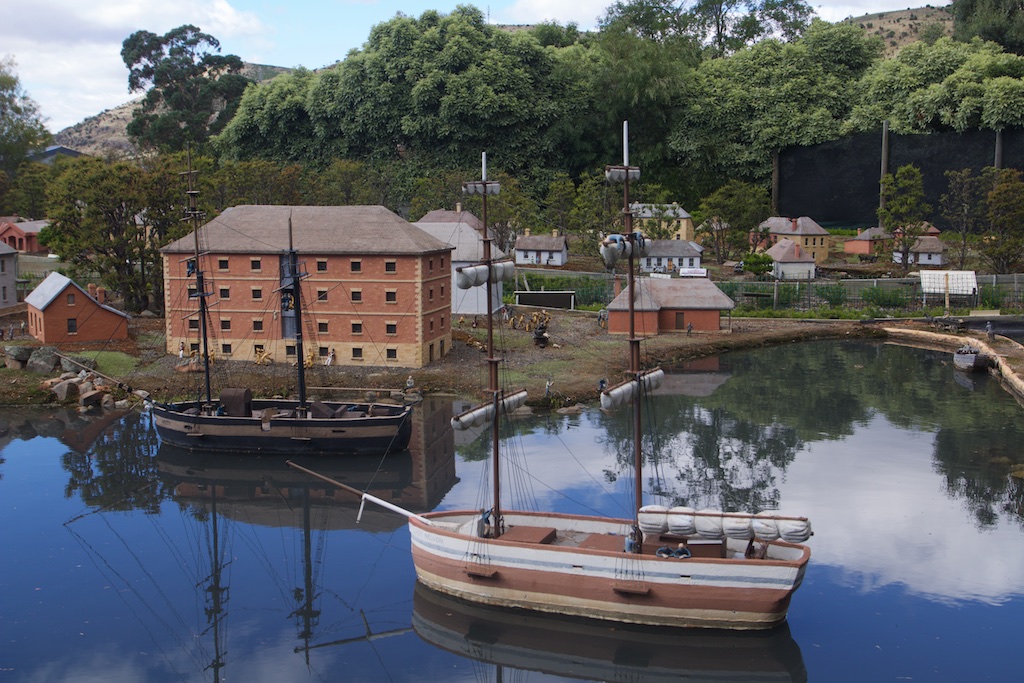
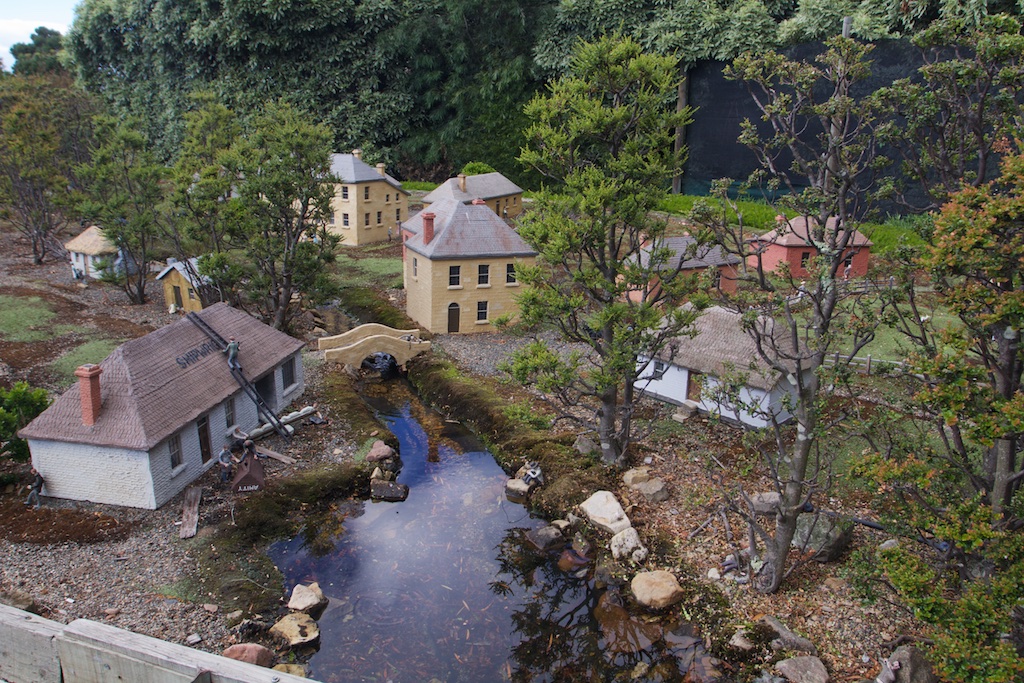
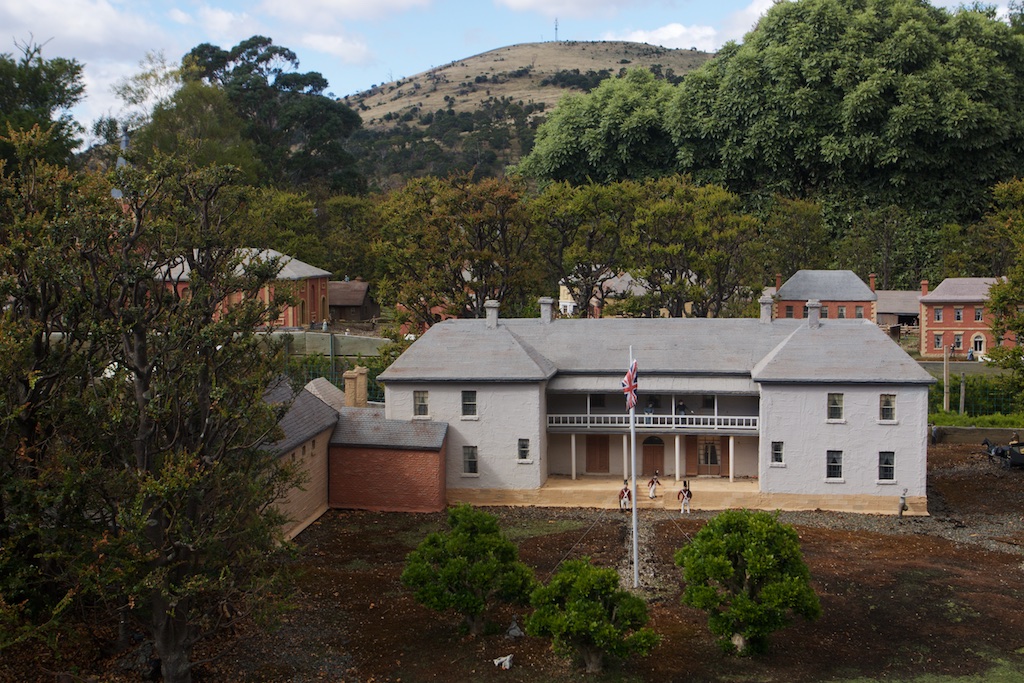
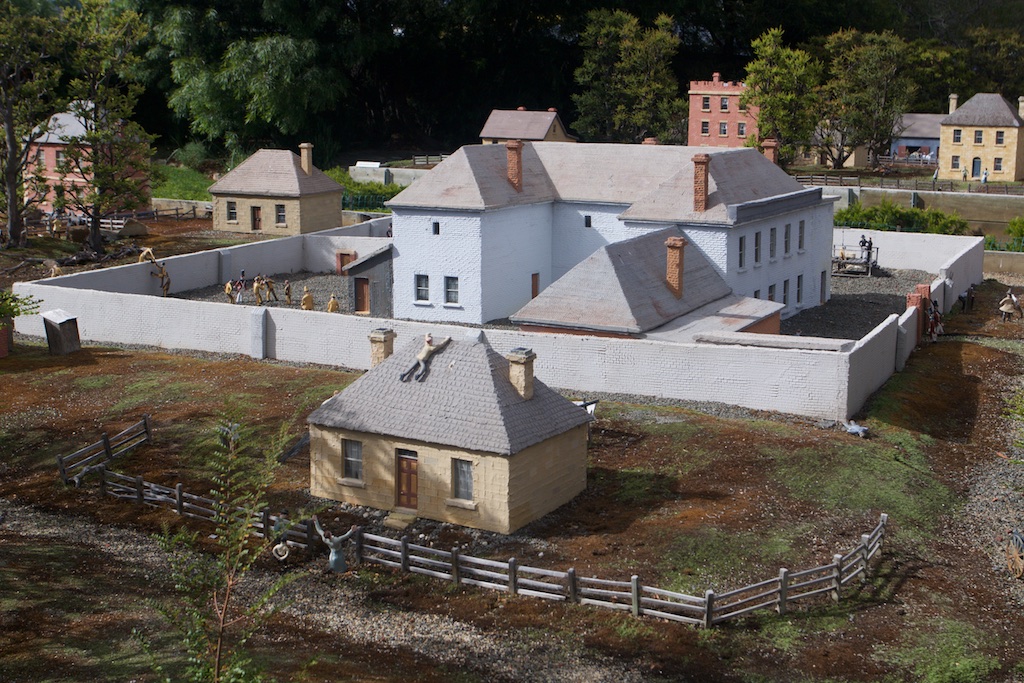
    If you want to get an idea of what the Hobart Town of 1834, the year that the convict James Dyson arrived there – was like, you are better off  travelling roughly north about 25km from the modern city to the settlement of Richmond, once a convict depôt and staging post on the road to the north. Many of the buildings there date back to the 1820’s – before Dyson’s time – but still a place he might yet recognise were he was alive today. But it is a far more modern addition to the town that is the greatest aid to re-visualising the past: The entire CBD of the early colonial town of Hobart has been recreated in a large scale diorama as a tourist attraction.

    As Perth (Western Australia) has been (although not quite to the same ruthless extent), Hobart was greatly redeveloped in the twentieth century and most of her early buildings are gone. Both settlements experienced massive foreshore reclamation projects which have utterly changed the landscape around their earliest hubs of settlement.

    The Old Hobart Town Model Village, although it is also a recreation of the 1820s period, reconstructs some of the key buildings Dyson must certainly have stepped inside, if he did not also shuffle past them in chains during his time on the road gangs. Needless to say, the Hobart Gaol is one such long vanished structure.

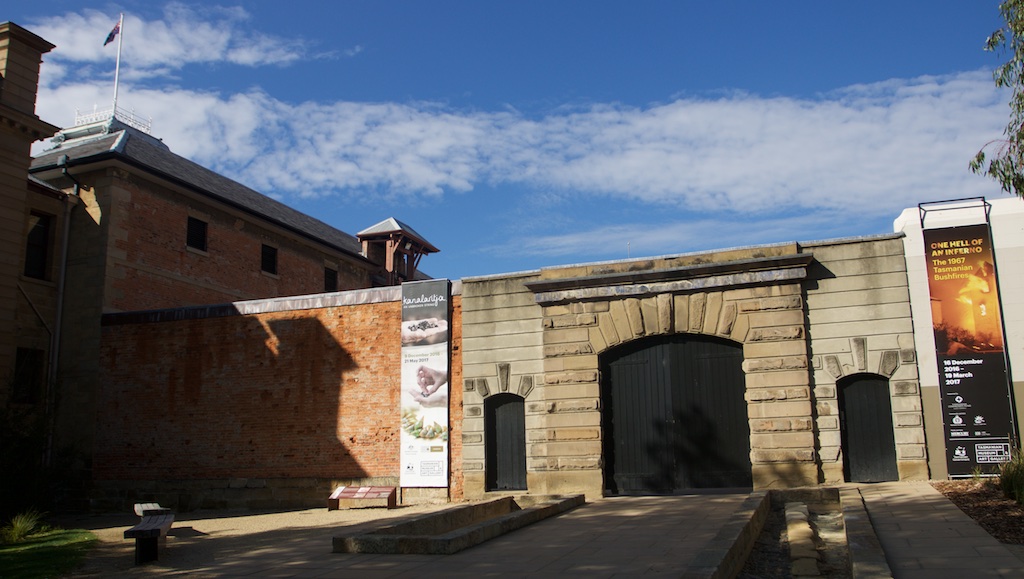
    The Commissariat complex, now part of the Tasmanian Museum and Art Gallery site, 2017.

    Back in Hobart, the State Museum and Art Gallery is housed in one of the few surviving complexes that Dyson might have seen with his own eyes. It was once the Government Commissariat stores, a Custom house and Bond warehouse. It would have been one of the first places Dyson would have seen when he was marched off his convict ship on 9 May 1834.

    Since the formation of the Colony, no vessel has ever brought out so many persons as the Moffatt. The number of convicts on board, comprising the prisoners, crew, passengers, guard, &c., is not less than 490, vis:—Convicts, 393 ; crew, 55 ; Military, 35 ; passengers, 7, not including children. She is 821 tons burthen.

    The Colonist and Van Diemen’s Land Commercial and Agricultural Advertiser (Hobart Town, Tas. : 1832 – 1834) Tuesday 13 May 1834 p3

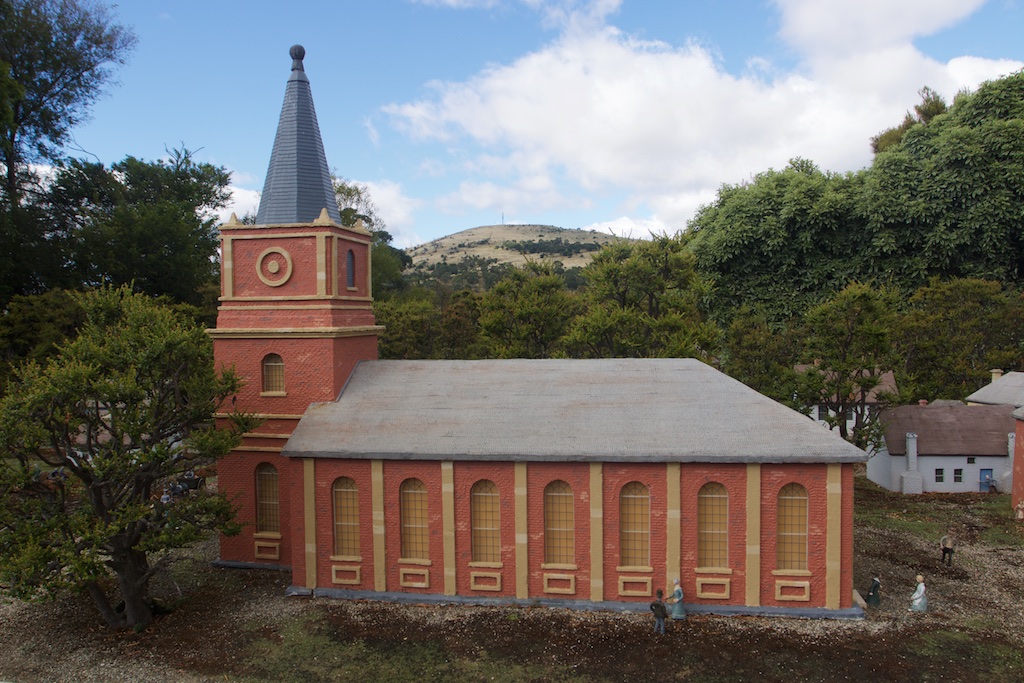
    But he would not be seeing Hobart Town at it’s best, only a few days before a violent gale had hit the town, stripping the lead from the tower gutters of St David’s Church. This original church has long since gone, except in model form.

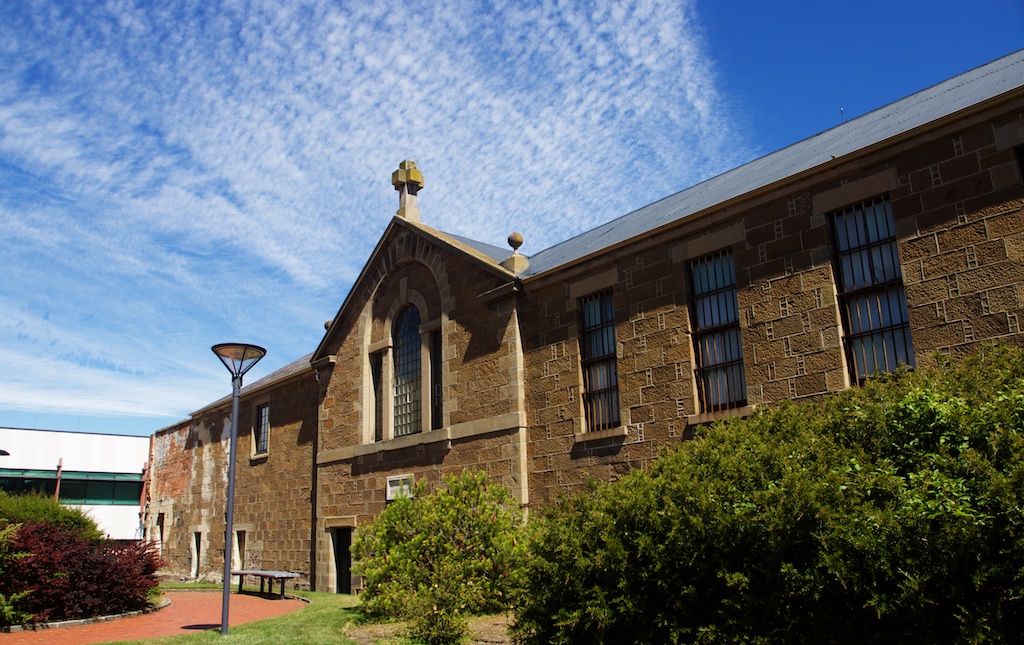
    The other significant surviving convict structure in Hobart that Dyson would have been all too familiar with would be the “Tench” or the Van Diemen’s Land Prisoners’ Barracks Penitentiary.

    Outside the “Tench” in 2017

    The surviving structure consisting of a chapel built in 1831 to service the spiritual needs of convicts housed in the adjacent gaol and barracks. These barracks must have replaced the earlier gaol as was represented in The Model Village.

    Since 1826, in whichever buildings those functions were carried out, the superintendent of the prisoner’s barracks and later, the gaol in Hobart was the one-armed Lt. William Gunn. He had lost that arm in the fight against the gang of the most notorious bushranger and runaway convict Matthew Brady, who was hanged that same year. For some unknown reason in August 1836, James Dyson did not return to the convict barracks for an entire night. Gunn ordered him to three weeks hard labour in view of the Town Surveyor’s Gang.

    I would have loved to have visited the “Tench” in Hobart during my first and only visit there in January 2017, but the museum was closed that day.

    “Such is life” …as another Australian convict once said before they hanged him.

    James Dyson’s convict record in Van Diemen’s Land

  • Van Diemen’s Land

    Van Diemen’s Land

    James Dyson served seven years as a convict in Van Diemen’s Land (now Tasmania) between 1834 and 1840. He arrived in Hobart Town on the convict ship Moffat on 9 May 1834. Until 1837 he worked on the road gang in that town, Then he was transferred to northern Tasmania around the Launceston district and was assigned to various masters in the area. He was never granted a ticket-of-leave or a conditional pardon, instead his sentence was extended, and he remained in the system until 3 July 1840. He left the colony a year later for the free settlement (one without convict labour) of Western Australia.

    He was not a model prisoner, although his long record of malfeasance while in bond should be seen in context over a seven year sentence. Below is an attempted translation of Dyson’s official record as a convict. It is hoped that some more flesh can be applied to these bare bones of history:—

    Transcription updated 13 September 2022
    Transcription updated 5 May 2023

    Hobart Town

    26 August 1834 P[ublic]W[orks]./ Drunk to be worked on the Roads 6 months /[ordered by] P[rincipal]. S[uperintendent of Convict Department]/

    26 August 1834 [Assigned to] P[rincipal] S[Superintendent of Convict Department’s] office

    9 September 1834 [Assigned to] W[harf] W[orks] Off[ice]

    ? July 1835 P[ublic]W[orks,] Absent from his Work, 25 lashes / [ordered by] A[lexander] Murray

    24 July 1835 P[ublic] W[orks,] Disorderly Conduct in the Street, Tread Wheel for the next 6 Saturday Afternoons / [ordered by] J[osiah]. S[pode].

    1 August 1835 P[ublic]W[orks,] Idleness to be confined in Barracks on Saturday & Sleep in a Solitary Cell 3 Nights / [ordered by] Alex[ander] Murray

    21 September 1835 Hobart Town P.O [sentence?] ex[tende]d 71 [by 1 year?]

    2 October 1835 Disorderly Conduct in Absenting himself from work on the 2nd Oct / 12 lashes/ [ordered by] A[lexander] Murray

    24 August 1836 P[ublic]W[orks,] Absent from Barracks all night, 3 Months hard labour in view of the Town Surveyors Gang / [ordered by] W[illiam] Gunn

    29 August 1836 [Assigned to] P[rincipal] S[Superintendent of Convict Department’s] Off[ice]

    4 February 1837 Having in his possession a Woman’s cap & some Lace without giving a satisfactory account of them / Hard labour in chains 3 Months / [ordered by] P[rincipal] S[uperintendent of Convict Department] / at his trade Vide [see] Liut Governors decision 4/2/1837

    7 February 1837 [Assigned to] P[rincipal] S[Superintendent of Convict Department’s] Off[ice]

    Launceston

    14 July 1837 [assigned to] L[aunceston]

    16 September 1837 D[avid] Williams / Returned to Govt his master not requiring his services [date may be in 1839]

    Corra Linn, Evandale

    4 December 1837 [assigned to] Morven [Evandale District]

    7 December 1837 [Master is Henry] Nickolls/ Assaulting (and threatening)?? Violence to his master 6 months hard labour in the Street & ret[turned] to Government ([ordered by] R[ichard]. Wales) [to] Kings Meadows Chain Gang, after[wards to] Laun[ceston] assignable. Vide [see] Lieutenant Governor’s Decision

    King’s Meadows, Launceston

    16 December 1837 [assigned to] C[hief]. P[olice]. M[agistrate]. [then either ink blot or obscure word]

    ?1 December 1837 L[aunceston] [date obscured -either 21 or 31]

    Cressy Estate

    2 October 1838 N[orfolk] Plains [thank you Lenore!]

    Some one or some place associated with the Cressy Estate?

    5 October 1838 VDL Establishment / Incorrigible idleness and using abusive language. 26 lashes & returned to Government / [ordered by] J[ames]. C[ubbiston]. S[utherland].

    Campbell Town

    13 October 1838 [Assigned to] C[ampbell] t[own] of[fice]

    Calstock Estate, Deloraine

    20 October 1838 ? [Assignment lost off fold of page] Possibly Calstock Estate near Deloraine

    Snake Banks (Powranna)

    23 November 1838 [Lt Pearson] Foote/ Idleness & neglect of duty. 6 months hard labour / [magistrate] W[illiam]. M[oriarty]/ Snake Banks & Returned to his Service vide Ltd Gov Decision 23 Nov 1838

    Calstock Estate, Deloraine?

    23 May 1839 Theoretically the date returned to the service of Pearson Foote, RN.

    Launceston

    ? October 1839 L[auncesto]n

    11 November 1839 G[eorge] Town off[ice] [Assigned to Samuel McKee (implied)] [thank you Ned!]

    8 January 1840 Sm Mc’Kee / Returned Depot Do [his master not requiring his services]

    3 July 1840 Free [by Servitude] Certificate No 524/1840

    Sources:

    CON-31-1-10 image 143