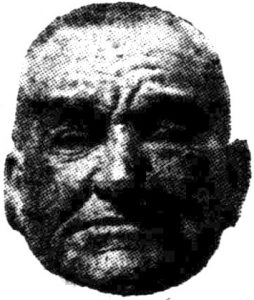
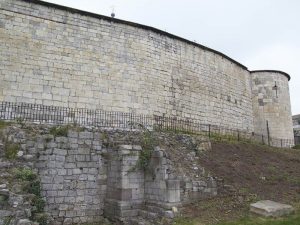
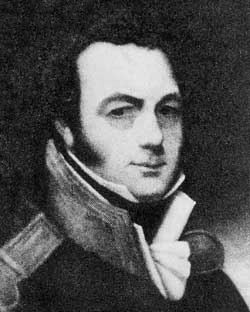
James Dyson 1810-1888. From a cabinet card circa 1860-1870. Photographer unknown. Perth or Fremantle, Western Australia. Restoration by Alan Thompson, 2019.As it was found.
The original of this image takes the form of an extremely damaged cabinet card that was nevertheless both preserved and cherished by a single family member belonging to one of the subject’s many children. I was granted permission to make a copy of this unique artifact back in 2019.
It has been shared since then only between a small number of researchers and other family members. My hope was to make it available to the wider public at the time of the completion of my book on James Dyson’s life and that of his family in Western Australia — It would have greatly assisted in the promotion of the same.
However, my restoration of this image is now beginning to appear on certain genealogy websites despite my request to those I shared it with, not to make it public for the time being.
Now the only known genuine likeness of James Dyson (1810-1888), Van Diemen’s Land Convict, early free settler to Western Australia, Perth City Councillor, builder, merchant, and general all-round ratbag has absconded, I post an official version, as it were.
Progress on Dyson’s Swamp (the book), is now postponed indefinitely until further notice.
It should be fairly common knowledge by now that Mrs Jane Dyson, before she was Mrs Edwards, was Miss Jane Develing, or Develin, Devlin or Devling… a sixteen year old orphan girl sent to the Colony of Western Australia on the first of the bride ships in 1849.
Before that, she was an inmate of the Poorhouse of St Pancras parish in London’s north. She was sent there when she was six or seven years old. Naturally, she was the ringleader of a schoolroom revolt in the poorhouse by the age of eleven. Age thirteen or fourteen, she was giving evidence at a judicial inquest into the severe discipline at St Pancras. It was called for after the suicide of a fellow inmate — who decided that being dead was preferable to another stay in the workhouse. If Charles Dickens had not already written and published “Oliver Twist” by this date, Oliver Twist would have been a girl.
After newspaper-pages of bad publicity, and questions put to management even by the Home Secretary in the mother of all parliaments — if this feisty young lady had been disliked by the guardians of the parish before — she would have been utterly loathed by them now. It was not that Jane liked them much better, but she had nowhere else to go.
The depths of their hatred might be measured by the fact that they were prepared to spend cold hard coin to make the problem go away. Not by improving conditions or governance in the Poorhouse — don’t be silly! They paid for Jane and five other girls from St Pancras to leave the country forever.
St Pancras Hospital, London, re-using some of the old workhouse buildings. 2015. Author’s photo.
But that’s another story, and one that has been told before…
Untold, has been how a six or seven year old girl ended up in the St Pancras Poorhouse to begin with. Being orphaned has been a widely considered possibility. But even so, why has it not been possible to trace her family?
We know her precise date of birth: 1 September 1833.
We know that by the night of 6 June 1841, Jane Develin, aged 7, was incarcerated in the St Pancras Workhouse system.
1841 England Census Class: HO107; Piece 681; Book: 9; Civil Parish: St Pancras; County: Middlesex; Enumeration District: St Pancras Workhouse; Folio: 33; Page: 10; Line: 19; GSU roll: 438797.
“That architectural style is early Maniac”
The thing about workhouses, or poorhouses (the terms are used interchangeably), was that even at their most exploitative they cost money to run. Various districts got together to form poor law unions to split the costs by sharing a house between them. As they were paying the bills, the various parishes got a bit particular about who they provided shelter to. They would not willingly home paupers from outside their union districts.
St Pancras Poorhouse was something of an exception to the rule. It was not part of a Union, and as the second largest poorhouse in London, it’s destitute were supposed to come solely from the parish of St Pancras itself.
GB Historical GIS / University of Portsmouth, History of St Pancras, in Camden and Middlesex | Map and description, A Vision of Britain through Time. URL: https://www.visionofbritain.org.uk/place/922 Date accessed: 27th December 2024
If Jane was an orphan, there should have been a trace of the death and burial of a relative in this parish, around about the time Jane was admitted. (There are no workhouse records surviving for the time she was admitted, they only exist after she blew the whistle on conditions inside, post 1848.)
There’s not a trace of any Develins or Develings to be found in death or burial records for the district during this time— the closest match, indeed the only match is for a burial record for a Mary Thivelin, buried in the parish burial grounds of St Pancras, by coincidence, right next to the poorhouse compound.
She was buried there on 8 February 1841. Her age at death was recorded as 35.
The chapel in 2015. Not the original building, nor was there ever likely to be a grave marker.
By this date, statutory records of births, deaths and marriages were supposed to have been kept in England. It should come as a suprise to no-one that the name Thivelin does not appear in the records for this district at this time. There is a death record for someone named Shovelin, but she was aged 25 or 26. That had to be another transcription error, didn’t it?
Yes and no. Mary Shovelin, aged 25 or 35, still maybe the most likely candidate to be Jane’s mother. She died in childbirth, as likely did the child as well. We know this because her husband was present at her death. This would make Thomas Shovelin Jane’s father.
Years ago, I asked a not-that-elderly relative what his father’s name was. He was puzzled by that question, but after a few moments of thought, replied “Pop?” (Well done Dad.) When you were six, would you necessarily have known your mother or father’s given names? Jane was 29 when she was asked that question, and the best answer she could come up with was “James Develing” as the name of her father. “James” was the name of the man she was about to marry that day. However, knowing what your daddy did when you were six is another matter entirely — when required to list his trade or profession on her marriage certificate, she put down “carpenter”. Thomas Shovelin also happens to describe himself as a carpenter on the death certificate of Jane’s potential mother.
By Survey of London, volume 35, The Theatre Royal Drury Lane and the Royal Opera House Covent Garden (1970)., Public Domain, https://commons.wikimedia.org/w/index.php?curid=101044
Here is a brief sketch of the family Jane seems to have come from.
Thomas Shovelin was born in Dublin, Ireland, about the year 1798. He was a carpenter, and there is good probability he came to England to work in the theatre district of London. Nothing is known about his wife Mary, not where she was born or where, or if, they were married. She was not his first wife. She was called Ann. Even less is known about her. She could potentialy be the mother of Jane as well as Thomas’s first two children that can be validated..
A son, George Shovelin, was born in London before 12 February 1826. He was baptised at St Clement Danes, London on that date. His parents (Thomas and Ann) were living at 140 Dury Lane in the city at the time. — The first clue as to possible theatrical connections for the family.
Another child, William Fawcett Shovelin, born about 1829, was born at sea. Which sea, under what circumstances, nothing yet is known. (Let’s for the sake of an argument, say it was on a boat.) Whether his mother was Ann or Mary is anyones’ guess. The same is true for his sister, Jane. There is still no record of birth findable for a Jane Shovelin on 1 September 1833.
George joined the British Army as soon as he turned sixteen. He enlisted in the 39th Regiment of Foot as a Private. Six year old Jane would never see him again and his Mary (his step-mother?) was dead the following year. George may have served overseas, but more research is needed to determine that. What is certain, he was no longer with the regiment when it was sent to Australia.
George was invalided out of the army by January 1853. He is on the books of the Royal Chelsea Hospital for a time. Then — and here is the second clue the family may have had something to do with the stage — he was working as a Theatrical Property Man at the time of his death, which occured at 21 Bolsover Street, Marylebone on 17 July 1858. He died of an epileptic fit. He was 31 years old. He never married.
St Pancras chapel, 2015 version.
After his wife Mary died in childbirth and he’d abandoned his daughter Jane to the St Pancras poorhouse, Thomas Shovelin disappears from the English records for most of the following next decade.
When he reappears he has married a woman thirty years his junior named Mary Ann Whitbread Green. She comes from rural Essex. There is no trace of a marriage. Their son, Thomas Charles Shovelin, was born in Notting Hill late in 1851. Then, a Daniel Shovelin was born at St Luke’s, Westminster during 1854. These boys grew up to be Hackney cab drivers, or grooms for Hackney cab drivers (The auto-mechanics of their day).
A daughter, Mary Ann Shovelin, was born in 1860 but died in 1862.
Jane’s only surviving full brother (?) William Fawcett Shovelin married a woman named Mary Ann (because of course he did.) It is his name that is recorded in the England censuses as Shoveling. He abandoned his Mary Ann to the Workhouse in Westminster, and took up with a Julia, however he was dead before his first wife expired in the workhouse in 1872.
On 7 January 1868, seventy year old Thomas Shovelin was so reduced in circumstances that he too had to be admitted to the St Pancras Poorhouse. And that was the end of him the following year.
Tracing the Shovelin family though the genealogical records has been challenging and is far from complete. Either records are missing, or the family name has been written down in hard to search for variations including Shovelin, Shoveling, Shovling, Shevlin, Shivelin, Thivelin, etc. It no longer seems to me such a jump to get from Shovelin to Develing.
Remnants of the burial ground at St Pancras, 2015. Author’s photograph
Selected Sources
Westminster, London, England, Church of England Births and Baptisms, 1813-1919 Name George Shovelin Age 0 Birth Date Abt 1826 Baptism Date 12 Feb. 1826 Baptism Place St Clement Danes, London, Westminster, England Parish as it Appears St Clement Danes Father Thomas Shovelin, Carpenter, Drury Lane. Mother Ann Shovelin City of Westminster Archives Centre; London, England; Westminster Church of England Parish Registers; Reference: STC/PR/1/17
UK, Royal Hospital Chelsea Admission Books, Registers and Papers, 1702-1980 Name Geo Shovelin Military Regiment 39th Regiment of Foot Military Pension Date 11 Jan. 1853 Residence Place 2 North London 3 yrs to 21/1/56 The National Archives; Kew, Surrey, England; WO 23: Royal Hospital Chelsea: Admission Books, Registers and Papers; Reference: WO 23/39
England Census 1861: 4 London Street, St Pancras Thomas Shovelin 58 Head, Journeyman Carpenter, b. Dublin, Ireland Mary A Shovelin 39 Wife, b. Essex, Farnham Thomas Shovelin 9 Son, b. Middlesex, London Daniel Shovelin 7 Son, b. Middlesex, London Mary A Shovelin 11mo Daughter, b. Middlesex, London Class: Rg 9; Piece: 102; Folio: 2; Page: 3; GSU roll: 542574
England Census 1861: 31 North Street, Lambeth, Surey, England William Fawcet Shovling 34 Head, House painter, b. at Sea. Mary Ann Shovling 31 Wife, b. St George Grosvenor Street George Oscar Shovling 8 Son, b. St Pancras Maryann Shovling 4 Daughter, b. St George Grosvenor Street Class: Rg 9; Piece: 351; Folio: 34; Page: 28; GSU roll: 542620
England Census 1871: 33 Maiden Lane, The Strand, London, England William Shoveling 40 Head, House Decorator, b. at Sea Julia Shoveling 28 Wife, b. Dorset. Mary Anne Shoveling 14 Daughter, b. London. The National Archives; Kew, London, England; 1871 England Census; Class: RG10; Piece: 362; Folio: 22; Page: 38; GSU roll: 824611
London, England, Workhouse Admission and Discharge Records, 1764-1921 Name Thos Shovelin Admission Age 70 Record Type Admission Birth Date abt 1798 Admission Date 7 May 1868 Admission Place St Pancras, Camden, City of London, England London Metropolitan Archives; London, England, UK; London, England, Workhouse Admission and Discharge Records, 1764-1921; Reference Number: STPBG/166
I’ve been wading through the history of the Swamp lately. That is — the actual swamp that had Dyson’s name on it — not the metaphorical entity that represents the Dyson family’s life in early colonial Australia. This is the one that is currently known as Lake Jualbup.
Dyson’s Swamp was always Jualbup. Jualbup has sometimes been Dyson’s Swamp. Jualbup was, is, and always will be Whadjuk Noongar boodjar.
Truth be told, everyone’s favourite former Vandemonian convict in Western Australia was not in direct possession of the swamp that bore his name for very long. He wasn’t even the first settler to claim ownership of it — colonial style.
According to Geoffrey Dean in One controversy after another: A chronological history of Lake Jualbup (2011), an agreement to transfer ownership of the swamp from the merchant and chemist George Shenton to James Dyson was first drawn up in the year 1858. The deal was not finalised for another thirteen years — not until the year 1871.
As late as 1965, there were still some visible traces of the Swamp as it existed from Dyson’s time. Observe the lone post in the water on the left hand side of the photograph below — this would have been part of the three-rail fence that marked the boundaries between Locations 119 and 118 — the formal designation of Dyson’s Swamp on the title deeds.
144742PD: Shenton Park Lake, 1965 Photograph by Grace Roper State Library of Western Australia
Dyson’s name was only attached to the title deed for six short years. The Shenton family reclaimed it after 1877. However, until the suburb of Shenton Park swallowed up the bush surrounding the water in the early 20th century, those who actually lived by Jualbup (both Whadjuk and European) carried on their lives as much as before.
The independent timber cutters and cow herders leasing their paddocks and huts from whoever demanded rent from them that month, included identities such as—
JAMES MCKENZIE, who described himself as a gatherer of gum and bark, was charged with being drunk on the premises of Mr. Caesar, of the Emerald Isle hotel. The constable who arrested him said he looked like ‘a wild man,’ who had never in his life been introduced to soap and water, much less a razor or a comb. The prisoner himself did no deny the charge, but submitted that there were extenuating circumstances, which the Court might take into consideration. He said he lived in the gay neighborhood of Dyson’s Swamp, and, not being used to indulge in alcoholic beverages, a few glasses of beer had overpowered him. …
He had a neighbour out by the Swamp by the name of
James Thompson (no relation).
WA Police Gazette 11 June 1879 p98
James Thompson (no relation) had a hut and a paddock somewhere near the swamp during the years 1879 and 1880. He may have been in the district long before (or after) that, but because he did not report a brown pony or a bundle of firewood to the police as stolen in any other year, he remains effectively anonymous.
(The sons of Kain proved to be innocent of this particular misdeed. Apropos to nothing, they were the sons of a pensioner guardsman who came to Western Australia with the first convict ship, the Scindian in June 1850.)
Thompson (no relation), might be the same James Thompson (also no relation) who also worked for Dyson back in 1852, before the latter could even have dreamed of owning a swamp of his own.
James Thompson, Convict number 1184, arrived in Fremantle on 30 January 1852 per the Marion, the sixth convict transport to be sent to Western Australia. He had already served four years of a ten year sentence for burglarising a house in Coventry, England, so he was granted a ticket-of-leave the day after his arrival.
Dyson employed him from 30 August 1852 for seven months until the beginning of November that same year. It is only guesswork that Thompson (no relation) was one of Dyson’s pitsawyers, or if he had been employed back then anywhere close to his master’s future swamp.
At the time, Dyson had a contract to supply timber for the new colonial hospital down the other end of Murray Street (then Howick Street). Dyson was then living on the corner of King and Murray streets on the other side of town. His marriage had just disintegrated and his first wife had herself committed to the local lunatic asylum.
Against this backdrop, when Thompson finished his time with Dyson in November, he next worked for a baker named Joseph Freeman. His new employer was also a ticket-of-leave convict, but one permitted to run his own business. The address of that business just happened to be nearly next door to the Dyson family home on King Street in Perth.
By 1855 both Thompson (no relation) and Freeman had their conditional pardons, so they were both free to leave Western Australia … almost.
£5 REWARD. WHEREAS some anonymous writer has, within the last few days, sent letters to the several Storekeepers of Perth, setting forth that I, Joseph Freeman, Baker, of Dalton’s Terrace, Perth, was about surreptitiously to leave the colony for Melbourne, which slander has had a tendency to do me some degree of harm; I hereby offer the above reward of five pounds to any person who shall render such authentic information as will unmask the cowardly informant with a view to his prosecution; and I here also give notice, that all persons indebted to me, do forthwith settle their accounts; and to request that all persons to whom I may be indebted may furnish to me their accounts on or before the 20th of July next, that they may be examined and liquidated. JOSEPH FREEMAN, BAKER, PERTH.
Both made their way (eventually) to South Australia, which was about as far as it was safe for them to travel as the colony of Victoria had enacted some hideous laws about expirees attempting to enter that jurisdiction.
According to the laws of Victoria, any person once convicted of a transportable offence, and found residing in Victoria within three years of the full expiration of his sentence, is liable to penal servitude on the roads, either in or out of irons, for the space of three years. If, after undergoing this sentence, he remains in Victoria three months longer, he is liable to a repetition of the former sentence; and so on, as long as he lives. All property found upon him is confiscated. Any constable who “suspects” that a person resident in Victoria was sentenced to transportation, and had not, three years previously, completed his term, may apprehend him without warrant, and the burden of exculpatory proof is made to rest upon the person apprehended.
This debate in South Australia about how to treat former prisoners was ignited by the arrival of James Thompson (no relation) and others into their polity. He had been arrested for wandering the streets of Adelaide very early in the morning with no good excuse.
ADELAIDE: TUESDAY, APRIL 22. [Before Mr. C. Mann, Stipendiary Magistrate.] “CONDITIONAL-PARDON” MAN.— James Thompson was charged with wandering about the streets at 1 o’clock in the morning, and not giving a satisfactory account of himself. Sergeant Badman deposed that he stopped the man and his companion in Light-square, and on his refusing to give a proper account of himself, he brought him to the Station-house, as he had watched him ever since his arrival from Swan River, about seven weeks ago, and observed him under suspicious circumstances several times. On searching defendant a conditional pardon was found upon him. There were no fewer than 20 or 30 of them about the streets, and doing nothing (as far as could be ascertained) for a subsistence. The prisoner’s wife said they brought a good deal of money with them, and she had taken in washing, and her husband was going to work that very morning. She then pleaded for him, and hoped His Worship would look over the matter, as it was the first time. His Worship said he had a duty to perform. He must commit the prisoner for a week; for though it was the first time that he had been brought before the Court, the police had watched his motions for the last few weeks, and the course now pursued was necessary for the protection of the public.
Only twenty five years before, the good burghers of Western Australia were complaining about exactly the same thing concerning riff-raff from Van Dieman’s Land and NSW.
It entirely possible that this James Thompson (no relation), who is definitely the same convict formerly employed by James Dyson, is not the same individual who returned to Western Australia at some date afterwards and worked by his former master’s swamp.
Let’s now take it as read from now on that any time I invoke the name Thompson (or any of it’s variant abominations), the suffix “(no relation)” can safely be appended to it.
There were thirteen transporteés sent to Western Australia named James Thompson and four were James Thomsons. After a time, none of them are readily distinguishable from the other James Thompsons who were born free and stayed that way even if maybe some of them shouldn’t have been.
Jualbup/Dyson’s Swamp. Always has been, always will be.
In conclusion, I have no idea who James Thompson with the paddock near Dyson’s Swamp during the 1880’s was. I don’t know his backstory, or family, or whether any of his descendents still live in Western Australia. I only know he’s not related to me.
There was one frustrating absence from all the convict documents digitised and available through the Libraries Tasmania site that directly pertain to the convict James Dyson. The link to the General Correspondence File of the Colonial Secretary’s Office (CSO1) tells you what it is, but not what it contains.
Much as I would dearly love to visit Tasmania again and wallow amongst the microfilm, that’s not going to be possible any time soon. Then, thanks to a lead not affiliated with any of the “official” sources of knowledge, I learnt that a certain religious sect have in their possession the entire lot on microfilm and offer it free on their web site.
These images are catalogued on familysearch, but give no searchable clue what these scans contain. The Tasmanian Archive’s site gives you slightly more than a clue but refuses to connect to the scans the Mormons have published. Or even let you know this source exists at all!
5 November 2024 Update:
Beware of the Leopard
The scanned CSO documents are on the Library Tasmania web portal. Its possible they may always have been, but were so difficult to find they may as well not have been.
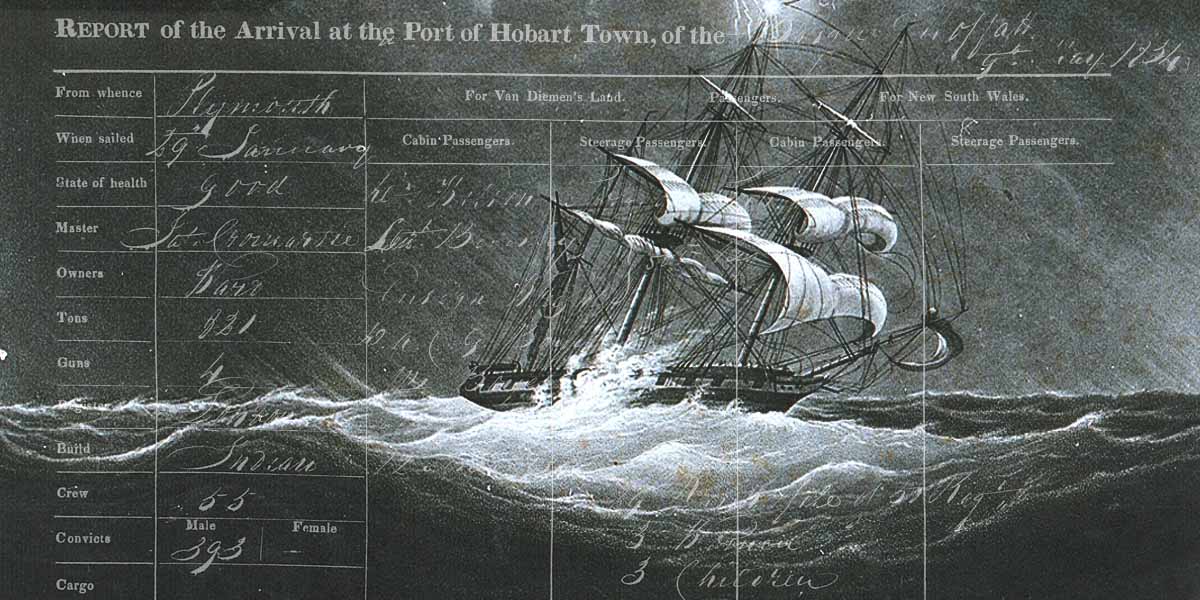
The Convict Ship Moffatt arrived in Hobart Town on 9 May 1834 carrying convict James Dyson. I’ve managed to piece together a pretty detailed narrative of the voyage by piecing together contemporary newspaper articles, The Surgeon-Superintendent’s report (translated from the Latin), the way the voyage was supposed to proceed (according to Thomas Braidwood Wilson’s book and Lieutenant Governor Arthur’s evidence to a parliamentary committee), and what actually happened (according to the diary of a private passenger onboard ship.)
The hitherto un-transcribed dossier of letters from the Colonial Secretary’s Office have proved to all be about the arrival of the Moffatt at Hobart and I’m relieved to find that I seemed to have got most of the facts straight — working it out the hard way. You, the potential reader of Dyson’s Swamp will have to endure many fewer “possibly’s” or “probably’s” when I review this chapter.
What makes me happiest is that it confirms to me that Thomas Braidwood Wilson (R.N) Esquire, Surgeon Superintendent in charge of the welfare of every Convict on board the Moffatt was as full of shit as I always suspected him to be.
I am also delighted to discover Captain William Moriarty plays an additional role in James Dyson’s history – it turns out he was the first new face he ever saw in Van Diemen’s Land.
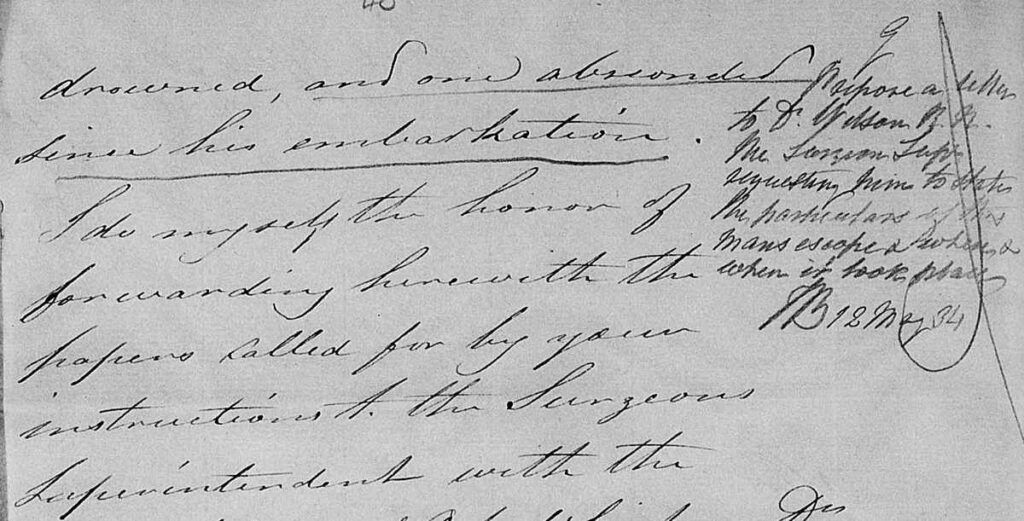
Sir I have the honor to acquaint you that agreeably to your request I have inspected the Transport Ship Moffatt arrived in this Port on the 9th Instant and have mustered the Convicts on board of her. The appearance of the vessel was creditable and cleanly, and that of the men healthy. I individually interrogated them as to the treatment they met with during the passage, and they expressed themselves perfectly satisfied thencewith, in regard to their provisions and in every other respect. Four Hundred Prisoners were embarked on board this Vessel five of whom have died during the passage, one drowned, and one absconded since his embarkation * I do myself the honor of forwarding herewith the papers called for by your instructions A. the Surgeons Superintendent with the exception of No. 4 which as Dr Wilson had [not?] closed his Accounts was not yet ready and Which he has promised to forward on Monday the 12th Inst
I have the honor to be Sir Your very Obedient Servant Wm Morriarty Port Officer
Jno Burnett Esq Colonial Secretary
CSO1/1/719 Page 15674 no 39, 40
* Then there was this glorious annotation to the report by the Colonial Secretary obviously on the behalf of an incensed Colonel Arthur:
Prepare a letter to Dr Wilson R N The Surgeon Supt requesting him to state the particulars of this man’s escape & where & when it took place
CSO1/1/719 Page 15674 no 40
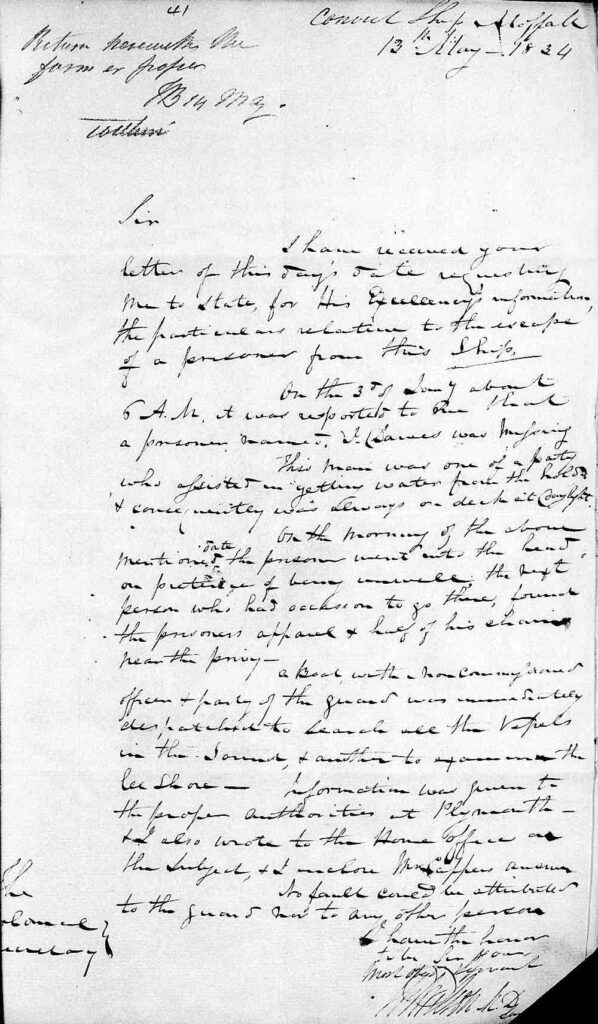
Wilson’s reply from onboard Moffatt proves once and for all that a medical man’s handwriting is always borderline unreadable (at least it was not in Latin this time). My interpretation of this scrawl is underneath the image (I’m not quite that much of a bastard). —
N.B. the original scans on a certain web site are of a much higher resolution.
Sir I have received your letter of this day’s date requesting me to state for His Excellency’s information, the particulars relative to the escape of a prisoner from this ship. On the 3rd Jany about 6 A.M. it was reported to me that a prisoner named J. Davies was missing. This man was one of a party who assisted in getting water from the hold & consequently was always on deck at daylight. On the morning of the above mentioned date, the prisoner went into the drop[!] on pretence of being unwell, the next person who had occasion to go there found the prisoners apparel & half of his chains near the privy. A boat with a non commissioned officer & party of the guard was immediately depart south to search all the Vessels in the sound & another to examine the lee Shore. Information was given to the proper authorities at Plymouth. & I also wrote to the Home office on the Subject & I enclose Mr Cappers answer No fault can be attributed to the guard nor to any other person
I have the honor to be Sir your most Obedient Servant [Mostly Illegible signature]
CSO1/1/719 Page 15674 no 41
So this is it. Probably the last post of 2022. A year I discovered this site still banned on Western Australian government filtered servers for reasons of … pornography. I am guessing this is down to my use of a certain … word. When I discovered this some years ago I removed what I thought was the offending word on a certain page. As I seem to be permanently on a black list with no obvious way of appealing the ban or even finding out on what grounds my domain was banned in the first place, I may as well use what words I feel like without filtering myself.
This particular entity was the New South Wales and Van Diemen’s Land Establishment, established 1825. After they failed to acquire any land in NSW for their venture into large scale farming in the colonies, it was rebranded as The Cressy Establishment, Cressy Company, or (most obscurely of all) the Van Diemen’s Land Establishment.
This Establishment should not be confused with the Van Diemen’s Land Company, ALSO founded at the same time and operated in both NSW and VDL. Most internet searches for the Establishment will return matches for the VDL Company instead, by virtue of the latter still being a going concern today (2022). The Establishment was over by 1855.
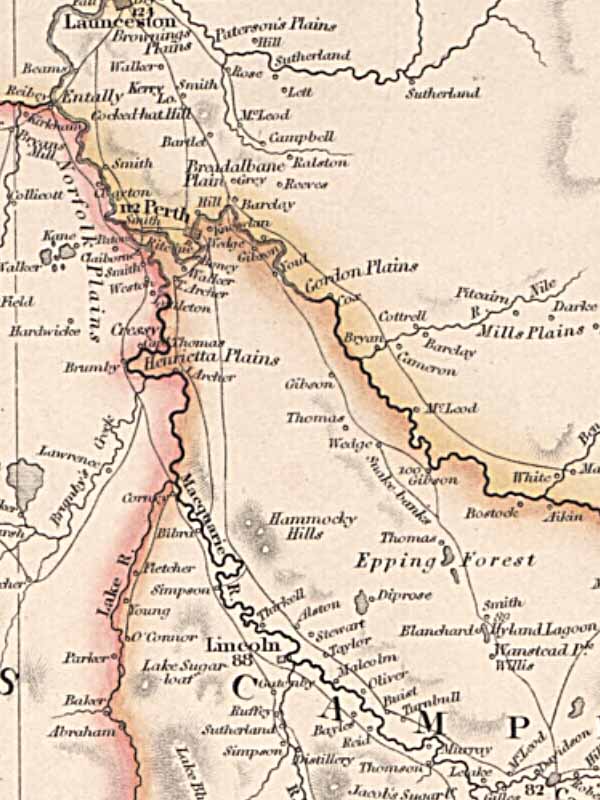
The VDL Company‘s estates were located in the north western corner of VDL, while the Establishment lands were located south of Launceston on the Norfolk Plains, around the towns of Longford and what would later be named Cressy.
Longford was initially named Latour after one of the seven gentlemen investors in the Establishment. Colonel Peter Lautour would later on destroy at least two investment and colonisation schemes in the Swan River Colony, which would directly impact the future of a VDL convict who was yet to be assigned to his VDL properties, before seeking a fresh start in Western Australia.
It’s all very convoluted.
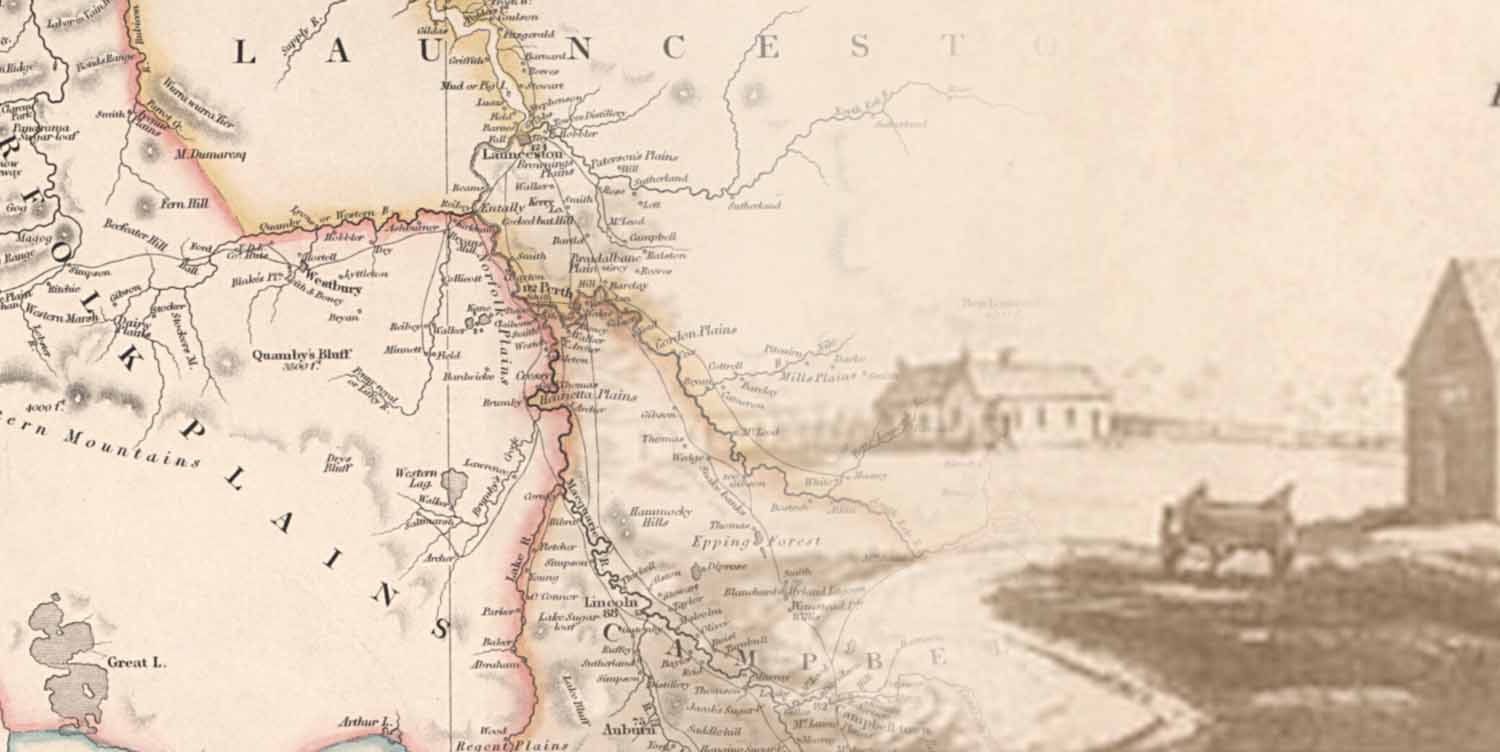
Convict James Dyson was assigned to work for the Van Diemen’s Land Establishment all of four days between 2 and 5 October 1837. The magistrate he was hauled before on that final date was James Cubbinston Sutherland, who farmed on the Isis River south of Cressy. Sutherland was a JP for the adjacent Campbell Town Police District, and that was where Dyson was sent for his next dose of condign chastisement.
Imperfect map with Cressy on it. Sutherland’s land is located centre bottom.
The manager of the VDL Establishment on these dates was James Denton Toosey. What is unascertainable by me is precisely which portion of the estate Dyson had been assigned to, other than that it was probably on the southern range of the Establishment. I have no idea if was to Toosey Dyson was insubordinate to, or some other overseer. I have not been able to find a decent map of the Cressy Establishment’s holdings — if such a beast has even been drawn up.
The relatively short history of the VDL Establishment, or Cressy Company is insanely complicated to investigate, due in large part to its principal investors litigating against each other incessantly. I’ve attempted to follow some of the court cases back in England where Colonel Lautour attempts to argue (unsuccessfully) that just because he was a blithering idiot was no reason he should not get his money back.
Unfortunately, you’ve not read the last of Colonel Peter Lautour.
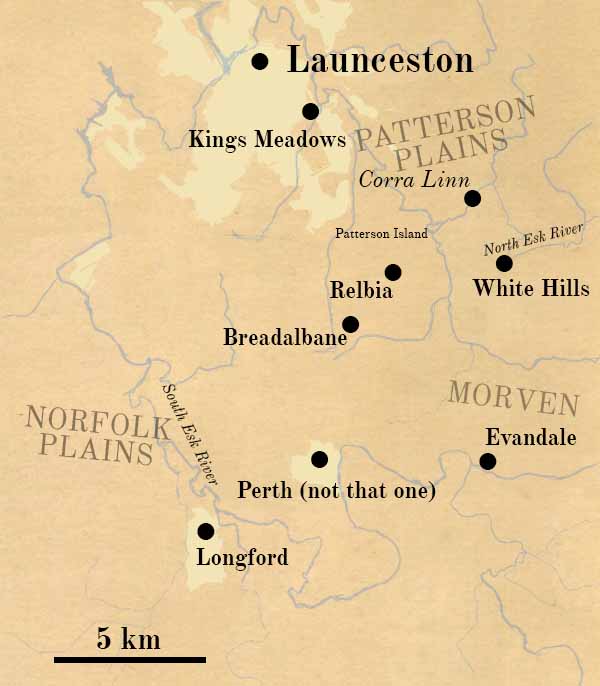
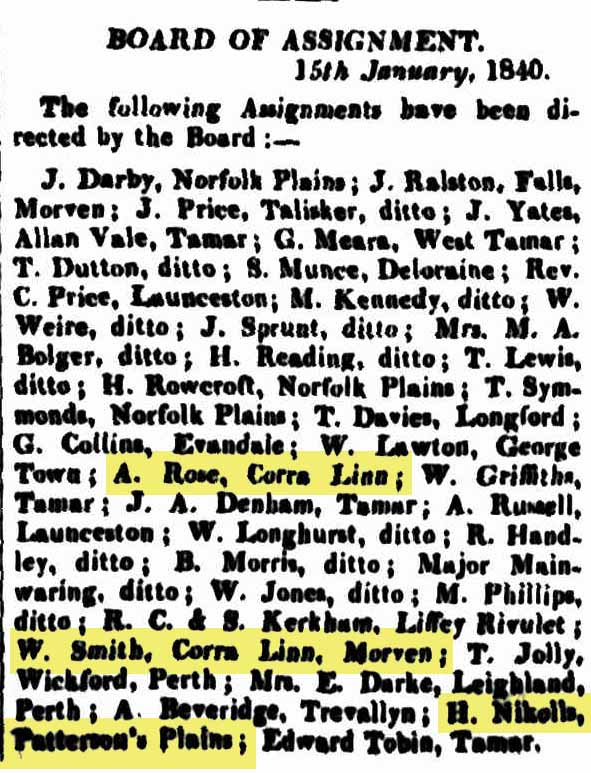
On, or just before 7 December 1837, Henry Nickolls, master of the Corra Linn estate on the Patterson Plains, was punched in the head by a newly-assigned employee and warned by him that “there was more where that came from”. Which is something of an inversion of the typical master / servant relationship.
This is only one of many possible interpretations that the historical record allows… but it’s how I’d like to imagine the confrontation between Nickolls and convict James Dyson played out. It makes for a more lurid opening line than “Assaulting and Threatening Violence to his Master” which is as close to an accurate translation as can be gleaned from James Dyson’s surviving Convict conduct record generated for his time in Van Diemen’s Land.
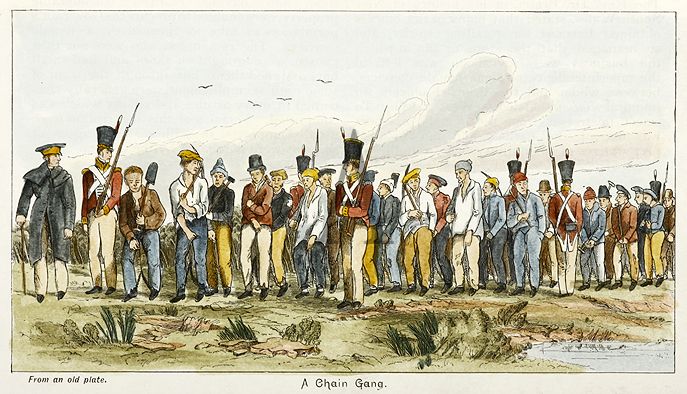
A generic Convict Chain Gang. Accuracy not vouched for.
But who was Henry Nickolls, about whom Dyson made a judgement call that it was better to spend the six months in a road gang than have to endure him as a master any more than three days?
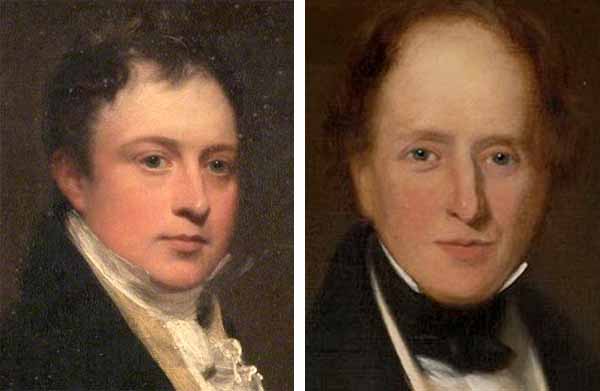
Henry Nickolls, Esq.
Was born in Little Stukely, Huntingdonshire (now part of Cambridgeshire) towards the end of the year 1793. Aged 33, he married 29 year old Charlotte Wilkins on 23 August 1826. The newly-weds sailed from London to Van Diemen’s Land on the ship Admiral Cockburn the following month, arriving in Hobart on 14 February 1827.
He was sent out there by two gentleman to manage and farm on their behalf, the extensive properties they had acquired in the Colony. Their names were…
These “gentlemen” — a politician and soldier respectively, were brothers. Sir John changed his name so he could inherit a prosperous estate in Pembrokeshire with a baronetcy attached. This estate in Wales (the old one, not the New South one) was named Orielton. He also inherited a seat in parliament as part of the deal.
Edward Lord had once been a soldier of the officer class. He had been kicking around Van Diemen’s Land since the time of the original British incursion. He had even been an acting-Governor briefly back in 1810. His most notable act in office was burning all the incriminating documents from his predecessor’s reign. He was not popular with his peers, but having a politician brother who was now a minor aristocrat meant both of them had wangled some of the choicest land grants the Colony had to offer.
Orielton in Van Diemen’s land, near the town of Sorrell, seems to have been run productively by their agent Nickolls. Nickoll’s speciality was cattle and horse breeding. The issues that eventually arose between he and his employers might have been due to one of his masters needing more and more money to fund an expensive political habit. (Owen was gobsmacked that his constituents keep fielding alternate candidates against him at election time just because he didn’t pretend to represent their interests). Richard Lord on the other hand, was probably just being a ruthless arsehole.
Whether Nickolls was replaced voluntarily or otherwise as agent for Owen and Lord is not clear. However from 1 September 1831, it was Alexander Goldie now in charge at Orielton and the brother’s other interests, with the mandate to wring as much cash out of the cows for his employers as possible.
Nickolls was also of the gentlemanly class. While still in the employ of Sir John Owen (Bart), he made successful application for land grants on his own account. His status was confirmed by an appointment to be a Justice of the Peace by the Lieutenant Governor very soon after his arrival — A mark of some esteem from a soldier for someone who only obvious connection with soldiering was with someone no-one else trusted as far as they could throw him.
Nickoll’s initial land grant in 1828 was for 2000 acres in the Brighton district. He next applied for 2500 acres more in the Morven District, close to the South Esk River, during 1833. “Corra Linn” is located by the North Esk in that district, so if this is not a typographical error, and his application really was approved — the latter may be the land near the town of Longford where he finally resided.
His first attempt at free enterprise, after separating from Owen and Lord, was winning a tender to provide a mail service between Hobart Town and Launceston. — Entirely on horse back. He purchased six used saddles from the government for the purpose. But the gloomy prediction of one of the Launceston newspapers proved prescient —
We have already stated that Mr. Nichols has obtained the contract for the conveyance of the mail throughout the Island. It is taken at £990, ferries free, and commences on the 2nd June. We wish him success. Individuals who by any means benefit the community are justly entitled to their earnings, but we fear that the present most infamous state of the roads, and want of bridges, are more likely to ruin a contractor than to put money in his pocket. The present system of colonial government is altogether bad, and until the desired change takes place, but little good may be expected by the community.”
We can probably assume that Henry Nickolls lost his deposit. To make ends meet, he was compelled to seek employment from the government.
His appointment as commandant of an institution on Flinders Island lasted between September 1834 and November 1835. He was not gaoler for any who were formal prisoners of the British crown, yet none of the 134 or so inhabitants under his management were free to leave.
They included as many of the First Nations peoples as could be captured alive after a genocidal war of conquest waged against them. It was never described as such in the terminology of the day, but Henry Nickolls was ruler of one of the world’s first concentration camps. By the time the Wybalenna Aboriginal Establishment was abandoned in 1847, only 47 Palawa were still alive.
He turned down further government employment as a manager on the Launceston docks. When he also appeared to reject an official appointment at Circular Head with the VDL Company (where his nemesis Alexander Goldie was once employed), that government was through with him.
He attempted to pressure the administration for more employment by name dropping all the worthies he was writing to back in Britain to lobby on his behalf. Being written to sternly by Lord Fitzwilliam and the Bishop of Chichester was not enough to sway the Colonial Secretary. The regretful notation to his letter of pleading reads-
I wish I could do something for Henry Nickolls but alas I cannot.
Instead, one year later (or by January 1837 at the latest), Henry Nickolls was in residence at Corra Linn.
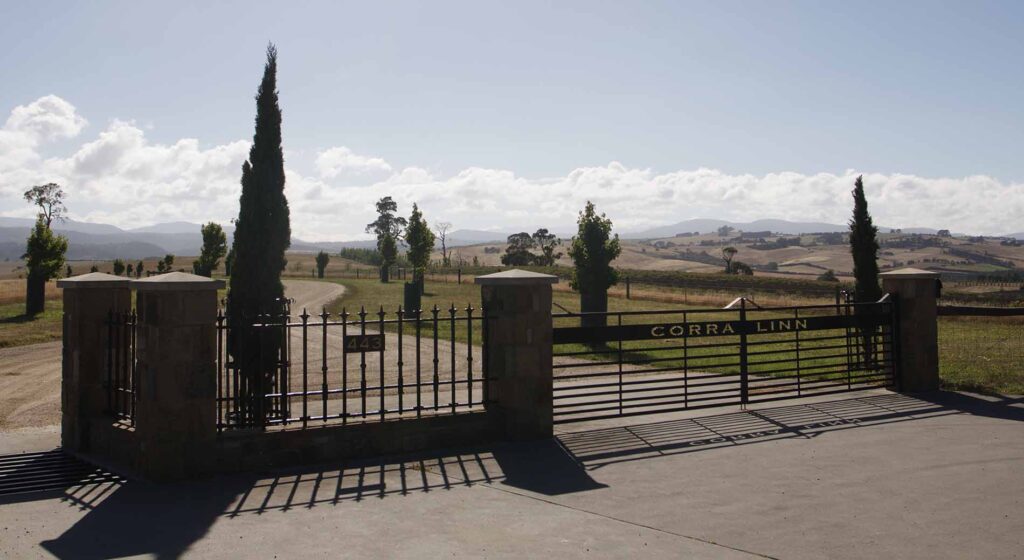
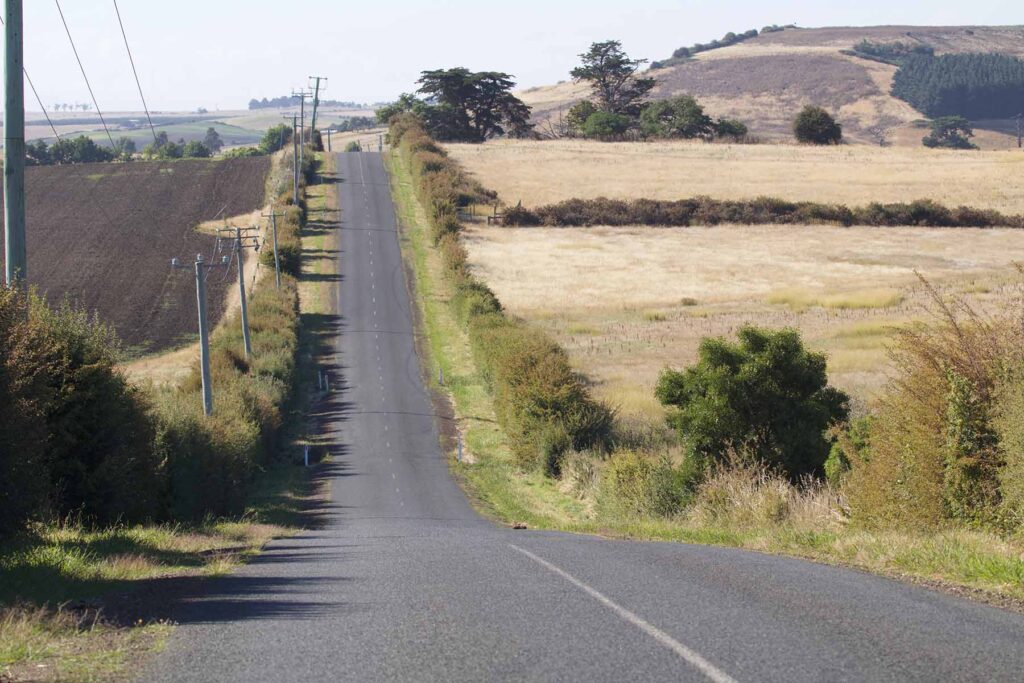
Gateway to the Corra Linn Estate off Relbia Road in 2017The road to Corra Linn 2017
Corra Linn / Corra Lynn
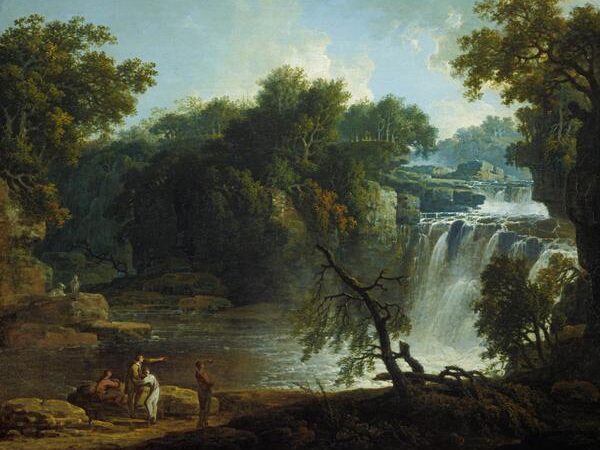
The land around the North Esk river known as Patterson Plains was the location of government stockyards acquired by a Lieutenant David Rose after he retired from the army in 1814. A waterfall and gorge on the North Esk river adjacent to the property resembled (somewhat) one from his native Scotland.
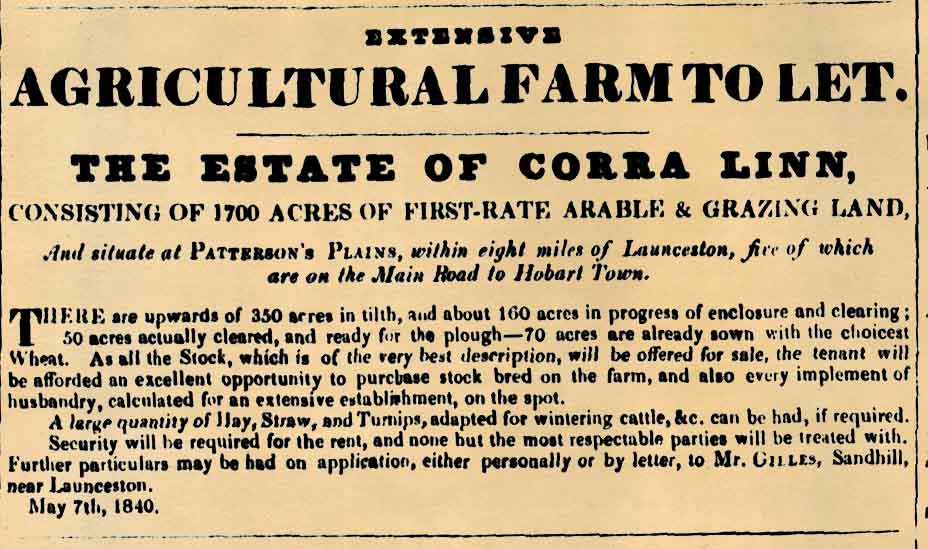
The heir to his estate seems have been a nephew, Alexander Rose. It must have been he, a decade later, who leased some of that land to Nickolls. The Rose family retained other portions of the inheritance to work themselves, so Henry Nickolls next did his bit for neighbourly relations by taking Alexander to court over a barn that he commissioned him to complete which did not live up to his gentlemanly expectations.
… At the instigation of Mr. Home, the witness, Gardiner, was asked how wide the spaces were between the logs, to which he answered that towards the ground they were not wider than to admit a man’s arm, but they encreased towards the top. Mr. Home — Cannot pigs get in ? Witness— Not unless they were to FLY !
Henry Nickolls was out of Corra Linn by January 1840, but was still a presence in the district. Then Alexander Rose and his family departed Van Diemen’s Land for a few years and the next time Corra Linn was up for rent, a Mr Gilles of Sandhill was managing the deal.
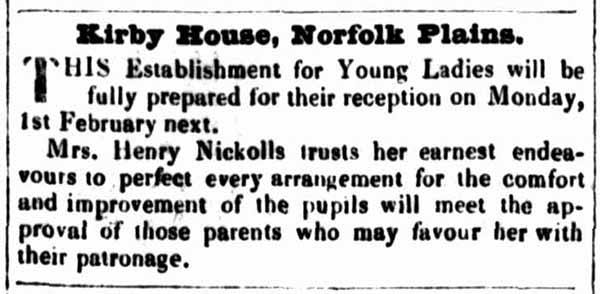
When the wife of a gentleman goes into business on her own account during this era, there are really only two ways of interpreting the situation. Either she has suddenly come into some wealth that her genteel husband has no access to, OR the couple’s finances have deteriorated so badly that he had to send the missus out to work to keep cigars and cognac on the table.
Henry Nickolls, Esquire, now of the town of Longford in Norfolk Plains district, placed himself into voluntary administration for insolvency on 18 July 1842.
Under the Insolvency of Mr. Henry Nickols, of Norfolk Plains, and by order of John Atkinson, Esq., Assignee. TO BE SOLD BY PUBLIC AUCTION, By Mr. B. Francis, On the premises at Norfolk Plains, on THURSDAY and FRIDAY, the 15th and 16th September, at twelve o’clock precisely, TWELVE FRENCH BEDSTEADS, Chintz and dimity furniture Wool mattresses Feather beds and bedding Rosewood, loo, telescope, and dining tables Cheffioniers, sofas, couches Sets of chairs, plate, linen China, glass And 150 volumes of sundry books Fourteen capital milch cows Thirteen steers and heifers Six working bullocks One Hereford bull Two useful saddle horses One jaunting car Sets of harness, &c. ALSO, All the farming implements A strong bullock cart One horse cart Ploughs, harness Dairy utensils And numerous other effects. The auctioneer particularly calls the attention of gentlemen and others to the above furniture, the whole being of a very superior order, and nearly new. The cattle have been selected with care, and known to be first class. TERMS — Under £25, cash ; above that sum, an approved endorsed bill at 3 months.
The Nickolls family lost their bedsteads but kept the house. Not much is heard from Henry Nickolls in the newspapers after that. He was presented to the Governor at a Levee held in Launceston during the year 1843. He resigned as a Justice of the Peace then, and tried his luck again with the Government for work, applying for a paid appointment in the Convict Department at Launceston. He also applied for a magistrates’ gig in his old stomping ground back in Sorrell during 1850.
By now, the next generation of his family were emerging into public view. His son Henry Berkeley Nickolls was appointed postmaster to Bishopsbourne, a locality east of Longford in 1849.
Henry Nickolls died at Longford 30 December 1872, aged 78.
Nickolls seems to be both the historically correct and the preferred spelling of his family name, however, every other permutation (Nickol, Nicholls, Nichols) will appear somewhere in relation to this individual or his family. Henry and Caroline did have other children, but a distressingly large number of then died in infancy during their years at Corra Linn.
He should not to be confused in the historical record with a Henry Nickolls, farmer of Brighton, Tasmania who died in 1885, or the convict named Henry Nickolls who arrived on the convict transport Moffatt, (but a later voyage than the one that brought James Dyson to Van Diemens’ Land!).
I’m a bit shocked to realise that it’s been six years since that I first posted a transcription of James Dyson’s conduct record as a convict in Van Diemen’s Land. For the past year I’ve been writing up the story of his time on the island. I think I understand now most of what happened between 1834-1840, and in the process I’ve revised that initial transcription quite considerably. As is always the case, the solutions only seem obvious with hindsight.
There is now only a single entry in the record that I have not been able to find a convincing explanation for. The context is this: At the bottom of the Convict record is a row of dates and abbreviations that indicate when, and to which authority a convict has been assigned. For example: C.P.M. would be the local Chief Police Magistrate the prisoner has been sent to. In the case of James Dyson, The Snake Banks road gang was the actual place this authority sent him to.
The place or authority our recalcitrant miscreant was sent to on 2 October 1838 probably is somewhere or someone related to the Cressy Estate around the Norfolk Plains District west of Campbelltown.
Update 15 September 2022: I think the mystery is now solved!See below…
It is something to do with the Van Diemen’s Land Establishment (also known as the Cressy Company to distinguish it from the VanDiemen’s Land Company of north western Tasmania). This we can deduce from the next record of Dyson’s misbehaviour dated only three days after he was sent there:
5/10/1838 VDL Establishment / Incorrigible idleness and using abusive language. 26 lashes & returned to Government / [ordered by] J[ames]. C[ubbiston]. S[utherland].
Sutherland was a land occupier on the Isis River who acted as a JP for those who could not get into town to see the Police Magistrate.
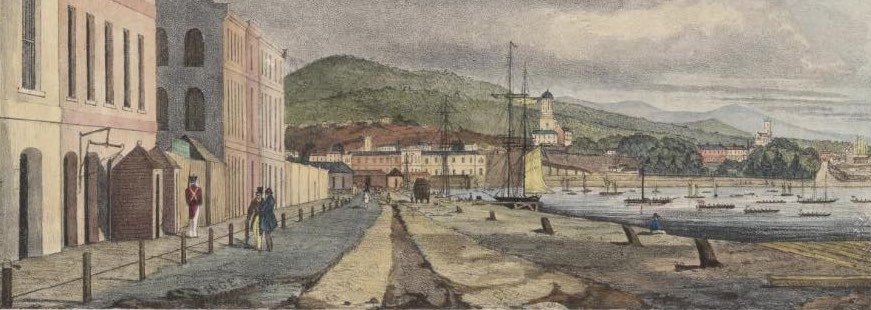
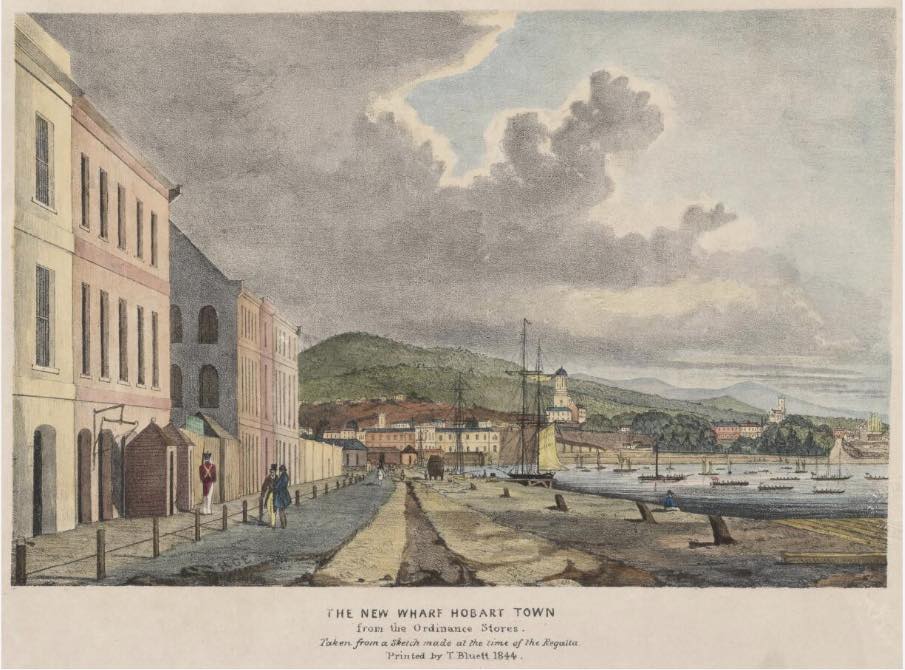
When he first arrived in VDL in 1834, one of Dyson’s first assignments was the completion of this wharf — these days part of Salamanca Markets
If I’ve been able to confirm nothing else about his time in Tasmania (and this is by no means an original observation) James Dyson was someone who seriously did not like authority.
Cemetery Hill in East Perth was the home of numerous discrete burial grounds for the occupants of the Perth settlement from the time it was set aside for that purpose in 1829 until its closure to fresh burials in 1916. Each of the grounds were — in theory — managed by various Christian religious sects or the representatives of certain ethnic minorities. In practice — who buried who/what/when was a free-for-all.
By the last decade of the nineteenth century — when the population of the city was suddenly swollen by those arriving on the coat-tails of the gold seekers, the rules of supply and demand ensured the profession of funeral director suddenly became an attractive one. Those best in a position to provide this unavoidable service were coach makers, wheelwrights, and those in associated trades. Not only had they the ready-to-go transport up the sandy road to Cemetery Hill, they could knock up the the coffins as well.
The Daily News, Friday 18 March 1892 p 2
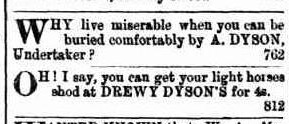
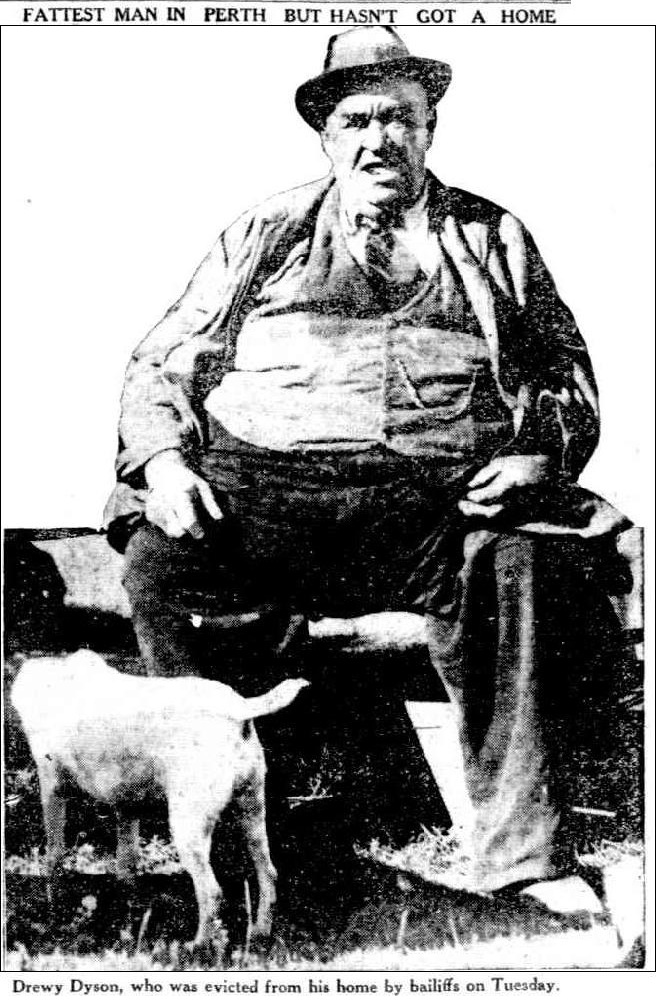
One such entrepreneur was Andrew “Drewy” Dyson, some time blacksmith, livery proprietor and coach builder. He would bury anyone, any denomination, any time,.. all for just £5. By the end of the boom he was broke…
All joking aside, by 1900, after Mrs Jane Dyson — Drewy’s mother, and the last verified family member of the Dyson family buried in East Perth — died, Drewy was verifiably down on his luck. The debts were mounting. His mourning carriage and hearse were offered for sale early in 1899, so it is a fair assumption he was no longer in the funeral trade from that time.
PERTH LOCAL COURT. THURSDAY, NOVEMBER 16. (Before Mr. J. Cowan, P.M.) […] APPLICATIONS, ETC.—W.A. Produce Co. v. A. Dyson, motion for committal for non-compliance of judgment order, £2 instalments due ; order to issue for seven days’ imprisonment, warrant to lie for a fortnight.”
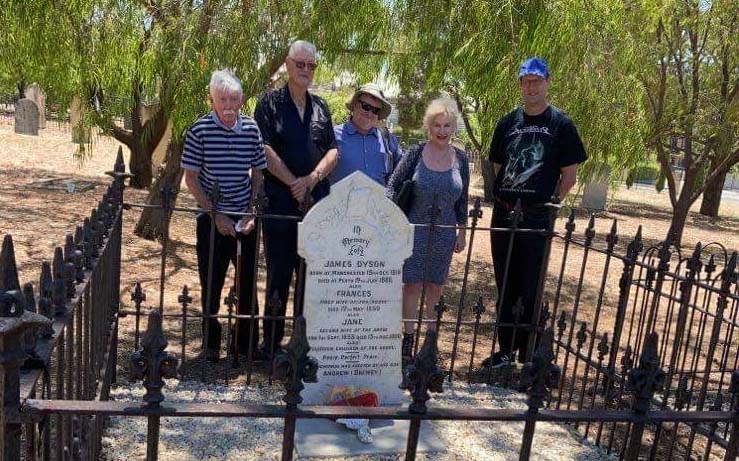
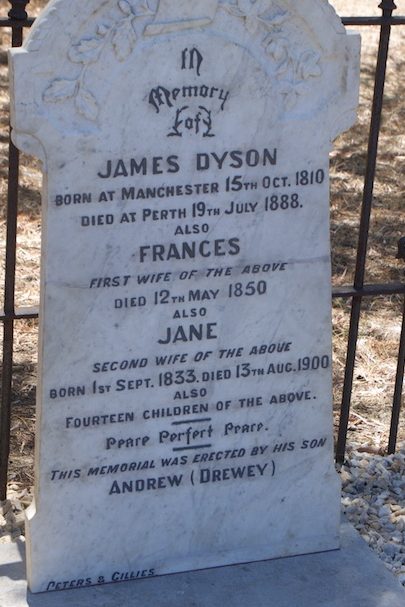
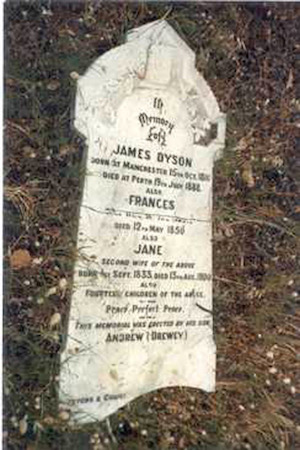
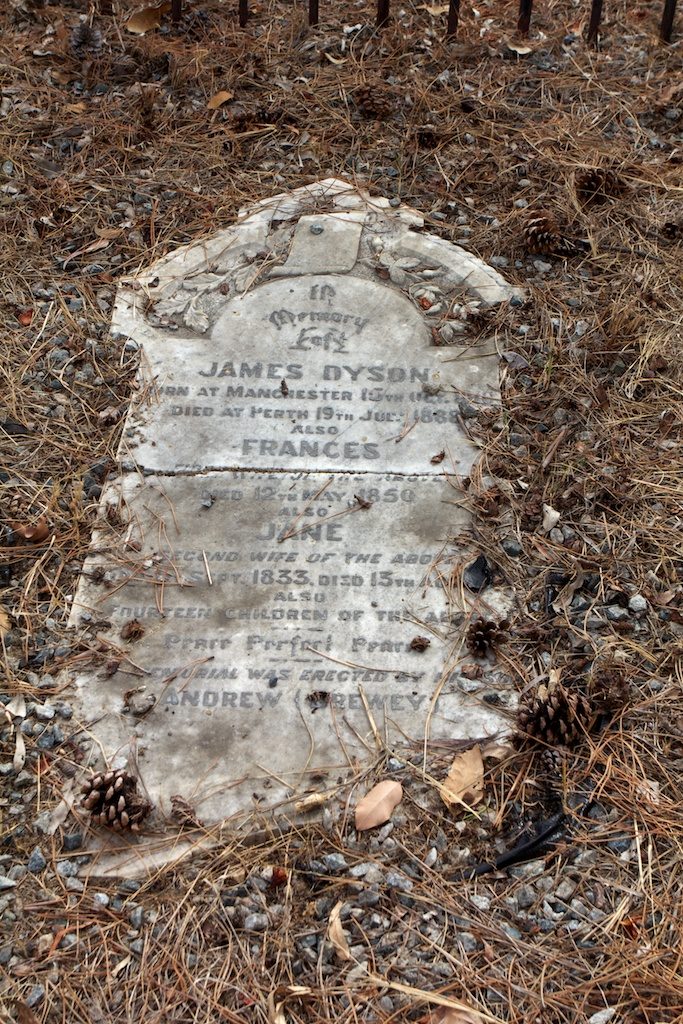
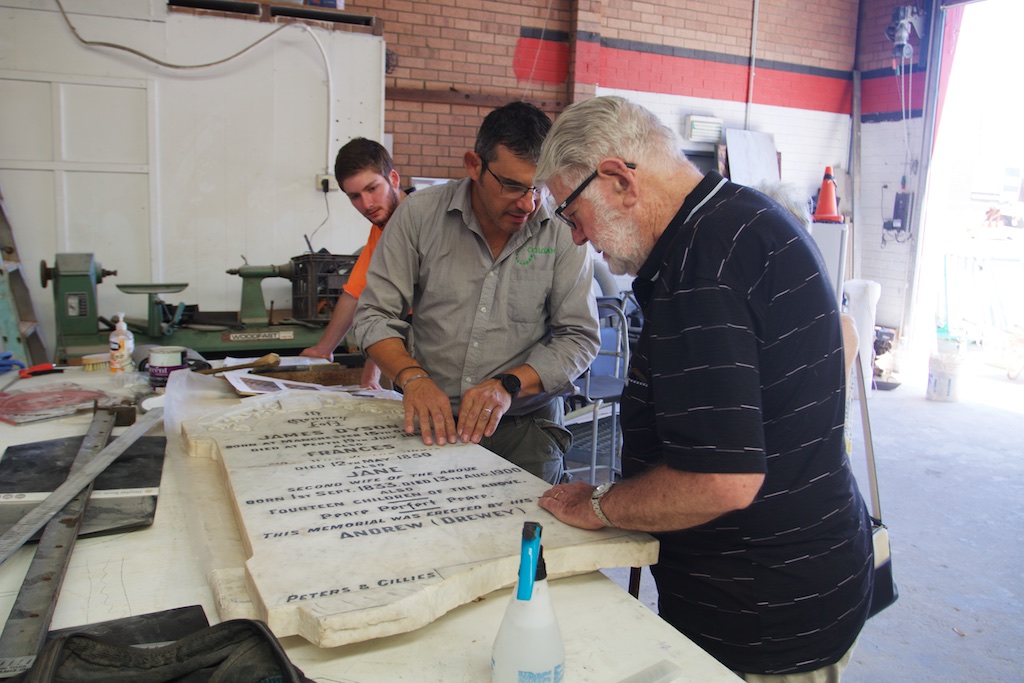
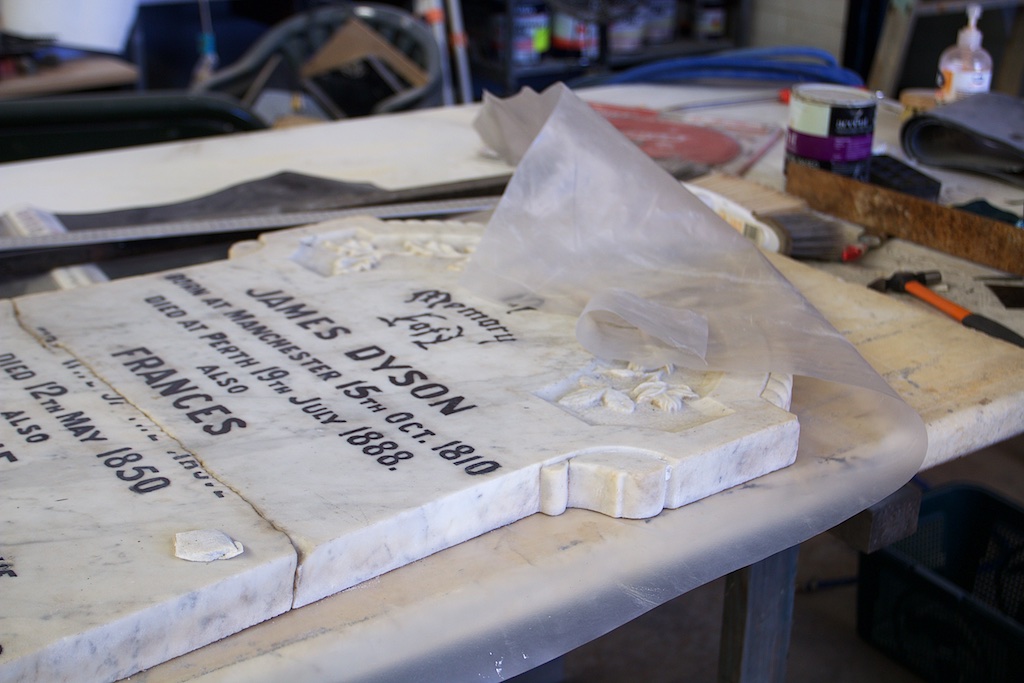
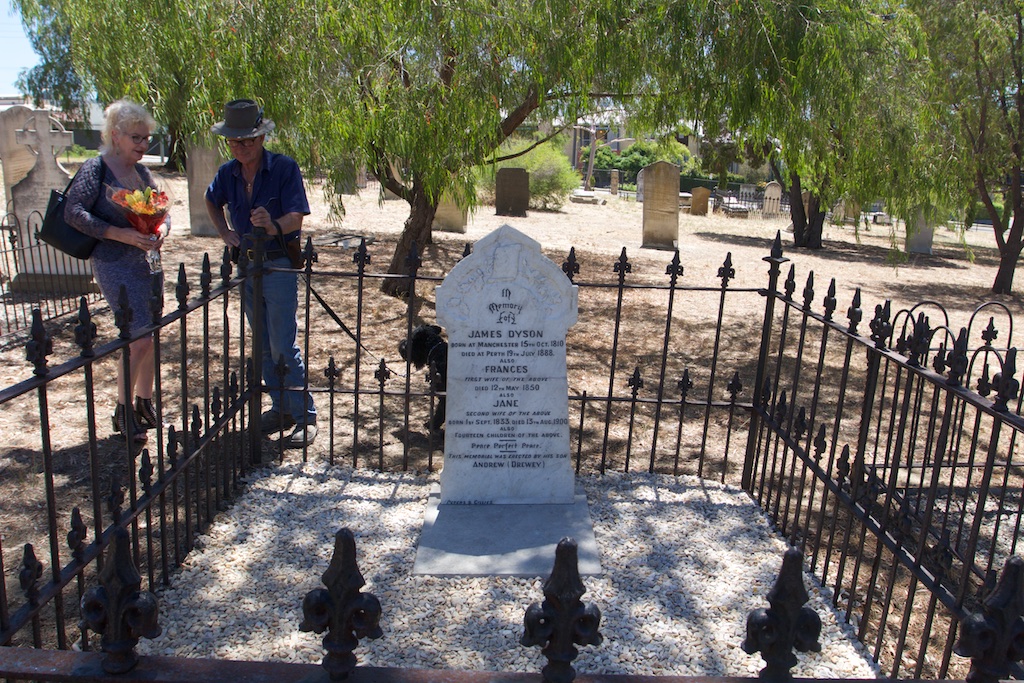
So how did he afford the headstone that commemorated the existence of his mother, father, and his father’s first wife? It was he who commissioned and paid for this monument, and we know this, because it says so on the inscription, and if he had not paid monumental masons Peters and Gillies for their work, the court action to recover the debt would have been in all the papers. Everything else Drewy Dyson ever said or did was reported in ridiculous detail at the time. E.g.:
Drewey Dyson, of the peculiar physical proportions, caused a commotion in Mounts’ Bay-road the other afternoon. He was swimming his horse in the river beyond the brewery, both he and the prad being in the altogether. After the natatorial exercise; the horse was in better wind than the man, and when Drewey reached the bank he collapsed, all his efforts not availing him to assume the perpendicular. An alarm was given, and the brewery people, the old men from the depot, and the young people from Crawley quickly assembled to view what appeared in the dim religious light to be a stranded whale. When the case was accurately diagnosed, the blushes that illuminated the landscape of Crawley were such as have never previously been called up by the sight of any other kind of fish. Drewey gradually recovered.”
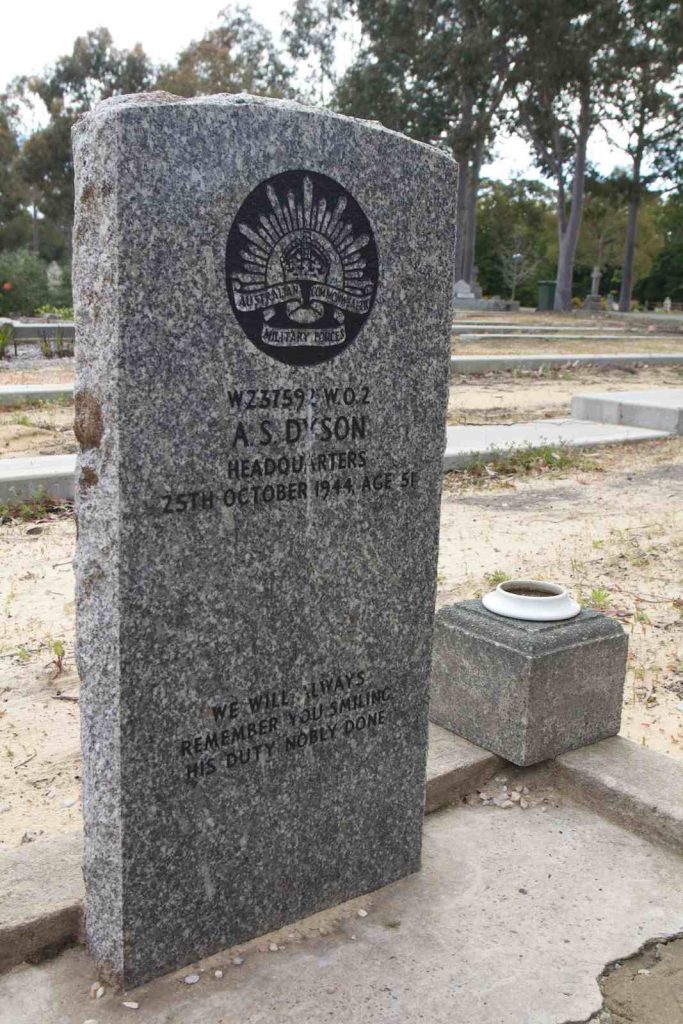
Andrew “Drewy” Dyson died on 17 April 1927. He was buried in the City’s replacement burial ground of Karrakatta Cemetery. If he was broke in 1900, he was positively destitute in 1927 — so it is probable he never had a headstone for himself. Even if he did, it would not have survived. This new official cemetery was a place of memory with a policy of “renewal” whereby the plots are respectfully bulldozed and headstones dumped in a skip (or at the very least stripped of any context) a few short years after interment. Thus it is a historical irony that it it is still possible to visit Drewy’s exact resting place. The name on the current headstone is not of he, but of his son, and that is the sole reason it survives.
Question: “Who do you have to try to kill to get your grave preserved in Karrakatta Cemetery?” Answer: “Yes”
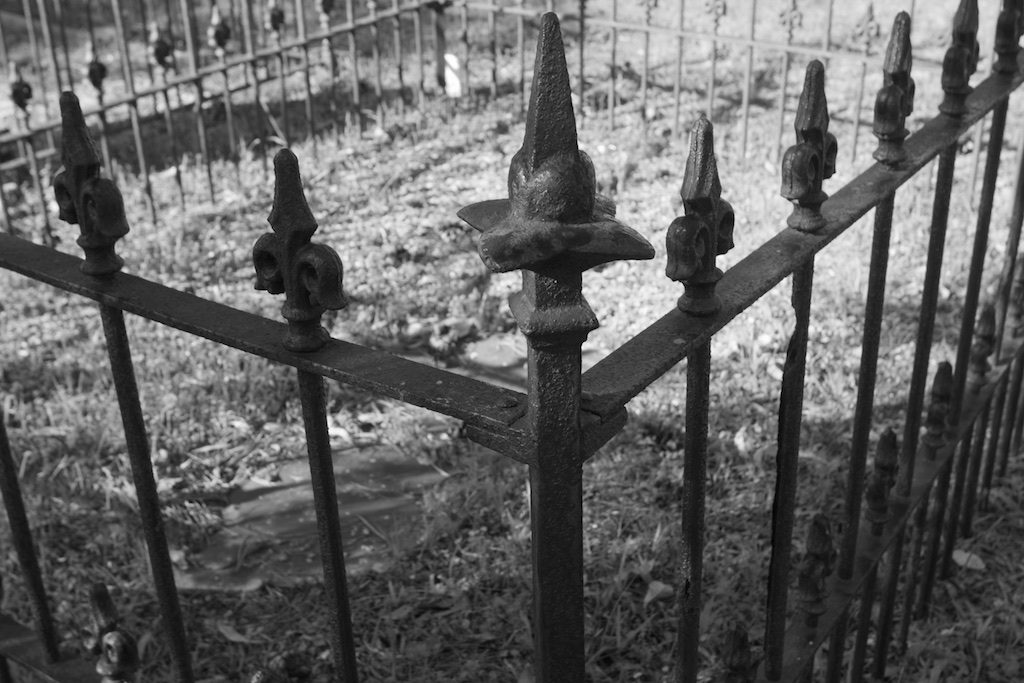
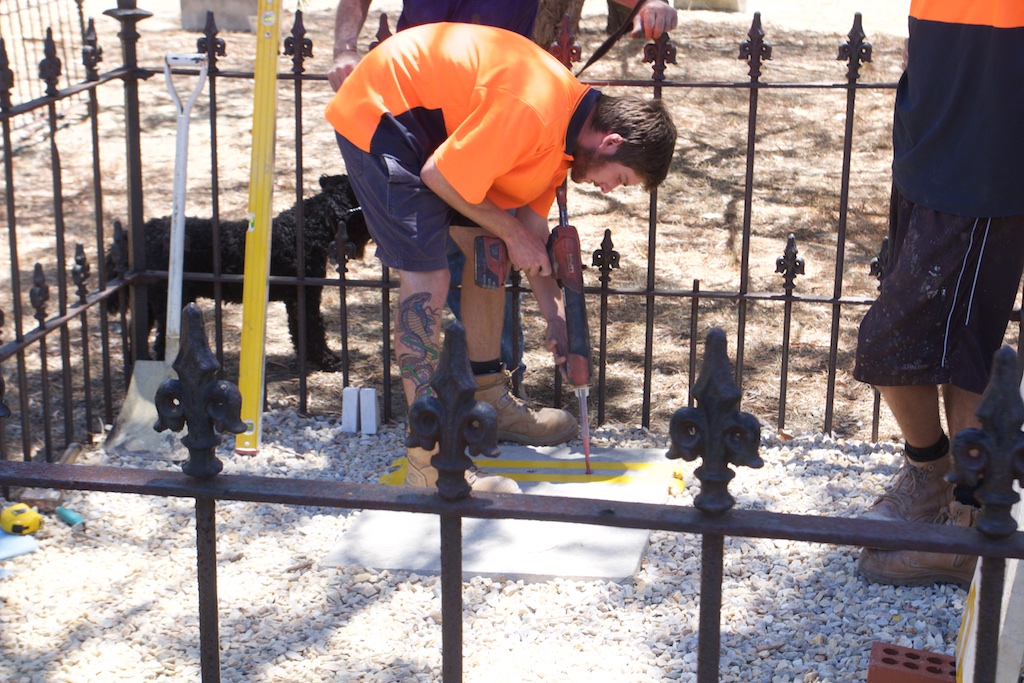
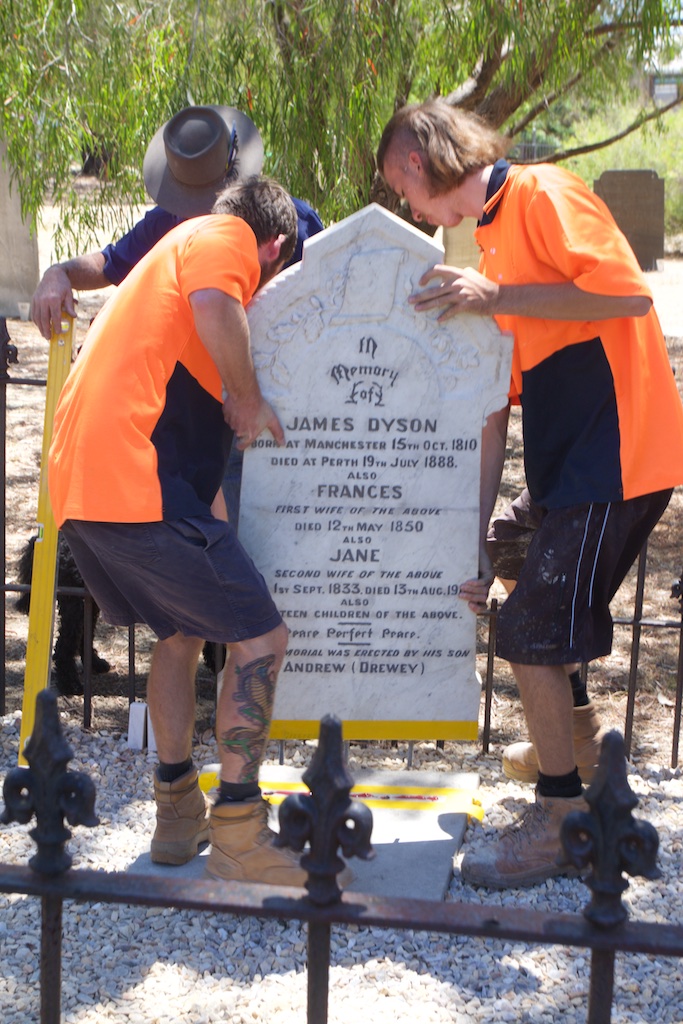
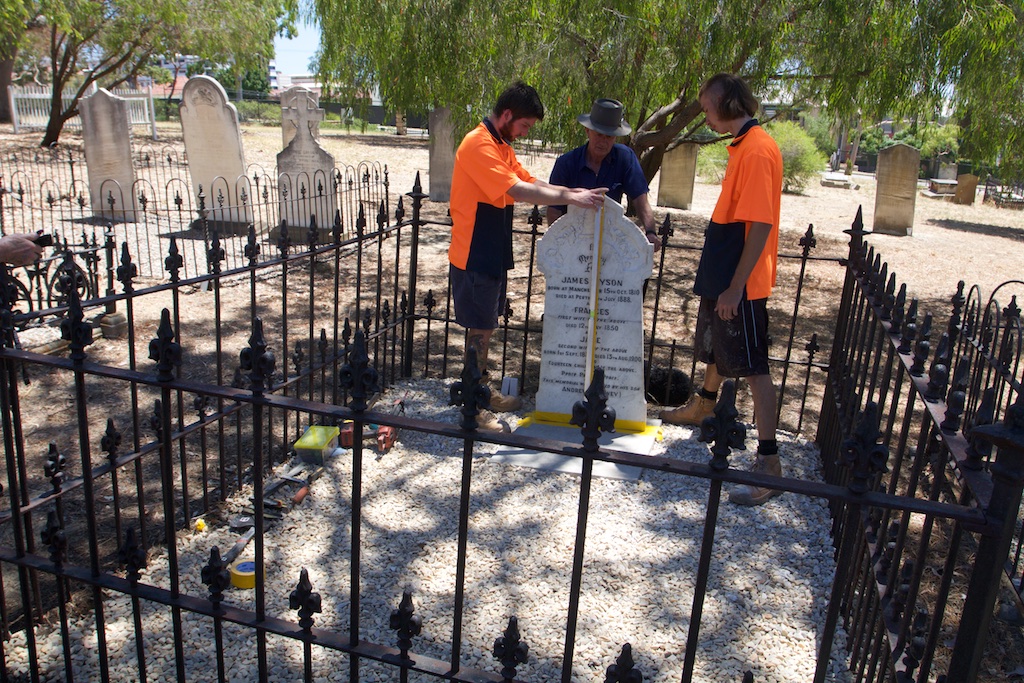
Some questions that could have been easily answered 100 years ago will, by the sheer entropy of time, be unanswerable today — Assuming that is, if there’s even enough information left to formulate a question. The quest to preserve one of the few tangible reminders of the Dyson family’s past in Western Australia would prove to be an opportunity not only to ask, but to answer some of these questions about the family grave site in East Perth. Not the the least of these questions has to be: How did it survive at all?
In the intervening 100 years or so since the East Perth Cemeteries were closed for new burials, responsibility for the maintenance of the monuments in the old burial grounds was vested in no-one. Bulldozers flattened large chunks of the site and any headstones found damaged were wilfully torn down and ground into rubble during the course of the twentieth century.
The degradation continued until the National Trust of Western Australia were finally permitted to assume control of what was left by the year 1994. Hundreds — if not thousands — of grave stones had by then been lost, and mediocre record keeping back when it was an active burial ground will ensure that many who lie in the entities of what is now collectively known as the East Perth Cemeteries will lie in anonymity for ever more.
Nevertheless, the Dyson family plot is one of the rare survivors. Maybe it is mostly intact because there was no one in authority to order its destruction.
Plot 75
East Perth Cemeteries Plot 75 (in 2018)
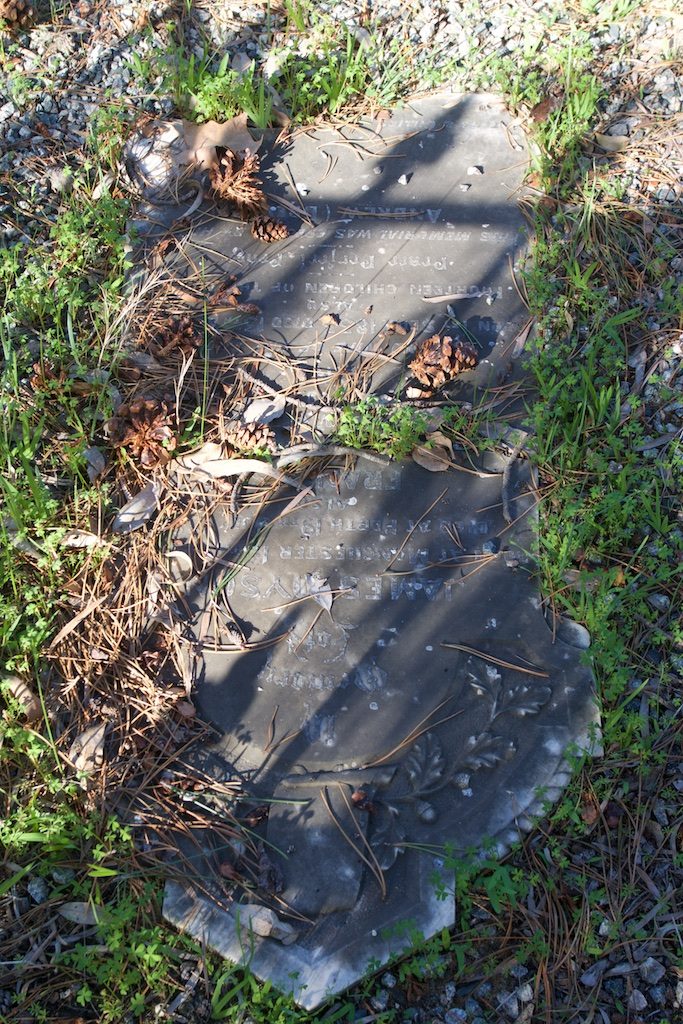
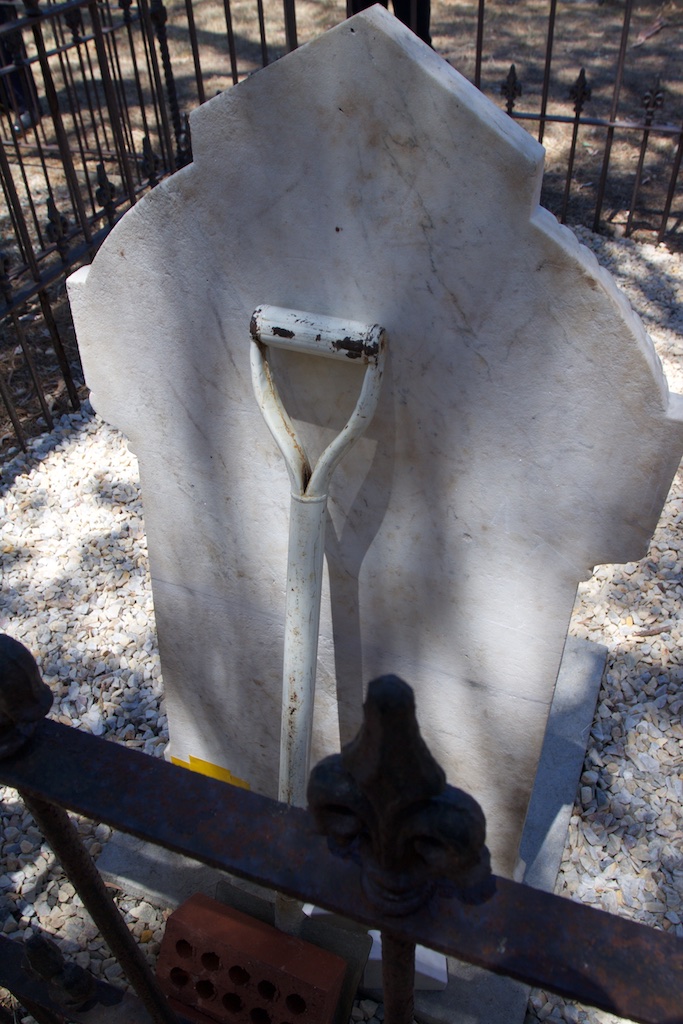
During the second decade of the twenty-first century, a number of descendents of those who lay in what had once been the Wesleyan Cemetery in East Perth — independently came to the realisation that one of the few physical reminders that their ancestors walked the earth was dissolving back into the earth at an accelerating pace. Photographs of the headstone taken over the past forty years illustrated a worrying trend.
1982
2013
2018
The National Trust WA’s website tells the story of what happened next:
The names of all the convicts are known, and the record of one particular convict on this voyage called James Dyson reports that he was in good heath and his conduct was “good”.
In neither of the additional accounts now uncovered, is Dyson mentioned at all. This was not unexpected. Neither narrative was ever going to mention the name of a common sailor, servant, or soldier on board ship, much less the name of convict — unless they had done something dramatic, criminal or terminal — preferably all three.
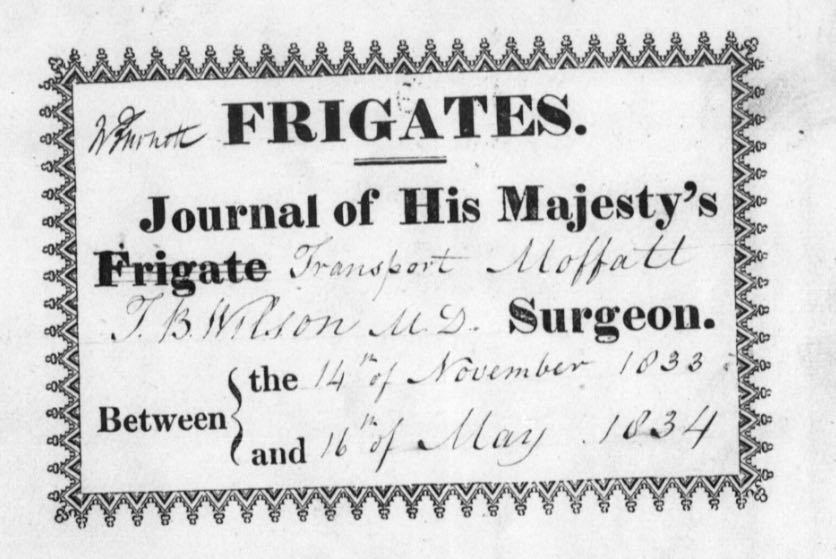
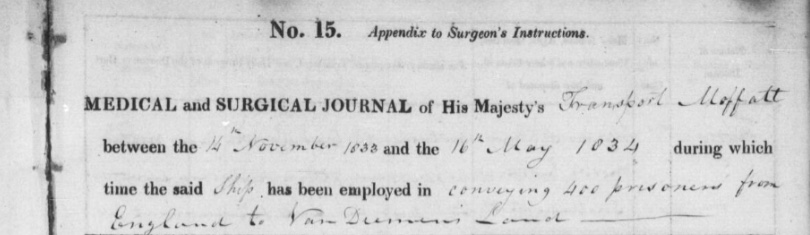
Of these two primary sources, the first is the Medical and Surgical Journal kept by T. B. Wilson, M.D., Ship’s surgeon and Superintendent of the convicts on this voyage. Both the medical notes he took, and the summary of the entire journey for his masters back in England, he recorded in Latin — apparently for no other reason that he was a pretentious wanker. An extremely rough translation of the “General Remarks” part of this report reinforces my opinion of his character — an opinion increasingly shared by the author of the other detailed account of the voyage — G.T.W.B. Boyes.
from Boyes’ journal
Boyes was a bureaucrat returning to his office in VDL. Apparently he had known Wilson well when they had last been in the Colony together and had even been friends. However they may not have been confined on the same ship before, and Boyes may never have seen Wilson in action in his role as Superintendent. Boyes’ day by day journal records his increasing misgivings as to how Wilson performed his duties. At the beginning of the voyage he refers to the activity of “Wilson,” by the end, he he just referred to as “the Surgeon”.
Boyes records events that are barely touched upon in Wilson’s journal, such as the unofficial trial conducted by the convicts when one of their number was caught stealing food — they had no faith justice would be done if they reported it to the superintendent— nor were the brawls among the convicts in the days afterwards. Six convicts did not survive the passage to Van Diemen’s Land. Not mentioned in the official account is that one of those drowned after falling overboard. Whether it was an accident, suicide, or he was given a push remains an open question. A seventh prisoner is sometimes referred to in other documents as having been “unloaded” before the voyage began. This is cute way of saying he jumped overboard, then either swam to shore or to an awaiting boat near Plymouth. Either way, he was not bound for Van Diemen’s Land.
The sections of Boyes’ handwritten diary concerned with the voyage of the Moffatt between 22 October 1833 ’til 9 May 1834 now exist in the form of a transcription produced by me. I would reproduce it here on this site in its entirety so others need not re-invent the wheel next time, but the copyright notice on the blurry PDF scans of the diary so far made publicly available clearly states:—
You may not develop a derivative version of the material.
In regards to the Surgeon’s Journal, a transcription has been made of the five pages of the “General Remarks” that conclude the report, and these have been transcribed into Latin. A crude machine translation of this text into English is laughably bad, but enough of the gist of it is comprehensible, in that specific events referred to, can be cross referenced with Boyes’ diary entries, and that Wilson is using ridiculously grandiose language to describe both himself and his actions.
My translation into English shall never be published while I still live. A representative paragraph is reproduced below to demonstrate WHY this shal be so:—
Although during the course of time, some people human beings are now and again tempted by disease, still ship health first name until the twelfth of May, when Scurvy he provided himself as a companion; and at once made an ambush among the exiles. It is known that the scurvy fall into other prone diseases else; for this reason various diseases of the various diseases rushed forward; among whom diarrhea has been cured he rejoiced.”
Google Translate
However, my transcription IN LATIN of the Surgeon’s general remarks can be read below, or downloaded here (PDF). I cannot read or write Latin, but I make this available for anyone else who would like to try themselves.—
GENERAL REMARKS
Page 1
Hiqus navis quadringentos exulum ab oris Anglicae pro legibus fractis, as Tasmanian usque deportatinuae decimo quinto kalendas Novembra, Chirungus Constitutus sum. Pridie Nonas qustem Mensis illam in fluno Tamesi prope “Deptford” jacentem conscende – Pridicque Idiis Militum trigintor, e legione qurm quorg es unmor exuled Custoditun navin conscenderment.
Decmo quanto Kalendus Decembras, Omnibus ad Navxgationem long ano peratis iter inceptum est, et sub vesperam ejusdem dieu, juxta Navale apund “Woolwich”, in situ idoneo, naevim posuimus ; ibmque tridunum in ueupiendis contum et octogenta exulum Moratin sumns. – Eo facto iter fluvratile capiamus, ad portum prope Insulam Tolapionis (vernacule “Sheerness” appellatum) centurn et quinguajuta exulum ibi loci recepturn. —
Quarto Kalendas Decembras, Exulibus conscensis, anchor soluta est, et veha fecimus, solliciti portum Damnonium, Plymouth Anglice nurcupatum, attingeie uti septuagenta exulum navim conscendere designate, adventurm nostriuan expectabantum. — attamen, ob ventis infaustis stationem adversnus Cantinm promontorium, “Margate” anglice dictam, non sine multo bidum detenti sumus. —
Pridie Kalend. Decembris –procella nonmihie sedata iter factum est, ad stationem Downs anglica dictam, ibique loci, situ commado, ut ventus ex occidente perflaret, anchor os jeeimuus —
Quarto Nones Decembras, qucamuis caelum minunre serenum est nee ventus secundus, tamin pertasi morae anchor as solvimes below venbus exparte adversis dedimuius, vrannguim anchor tem lentammus. Sed, tridnd consumpto in bane contentione cum procellis adversis, portum numis fistinantir ielictum repetere coacti sumus. Atque illic
page 2
sex dus ingratiis ad anchor as statum est.—
Pridie Idus Decembra Vento pacato et ealo aspectu propiore, cequor undosum iteravimus ; et cursum obliguamus per fictum Anglicanum, atque post aliguot dies nune or as galliae nunc Angliae legents, justatique spumantubus equries undis, Vindelim attiginus ; yinsque portu potiri strenui nitebumur ; sed non comotes voti, turbine inimica, vi magna saevunte. Quin der causir et non potentes cum mari irato dintinus certare, utio Dravigamus ad sepugium petemdum in stationem, inter insulam Victim et Hautoniam sitam, Nomine Spithead longi latique Notam ; im quam brevi, belis plenis, deferimur.—
Octavo Kalendar Januarius. Nucti ventum idoncums, Anchoris solutis, atgue carbasis expansis Aquiloni, sine mora “liqurmus portum pelagoque volannus.” — Postridie antem refugunm petre in sinum dictum Torbay, coacti sumus ; quppe “horrida tempertas calum contraxit”, et procella adversa magno furore fieniebatur.— tandem, die nempe quanto Kal. Jans. post conamina iterata, et caelo, et vento et mairn invitus, descoleratum portum attigimus.—
Kalendis Januarius, Septuagenta exerlum im havim reciptc sunt ; nune igitum recepta sunt ; sed, ob ventis adversis saevintibus, cum vati procellosi fatigati posuere, et Aquilo leniter spiravit; Re ita se habente, nos male tolerantes morans, anchoris solintis uclisque pansis, “Rovehimun portu tenæque urbesgre vecdent”
Vix autem a covspectu Darnmoniorius telluris deccsseranmus, quurm nubes pluviouxce calum obduceic inipicbant, et Ventus unfauste spiraie nihilominus, nollintibus cursum retio tenere gnavitei pugmatum est; et littoribus periculosis Cassiteri Sum ivitatis necnor, haus sune quadane diffecnbtate præternavigatis, Oceano Atlantico potiti surmis — Yandentesqure, ad plagas Austrinas liguidum iter prosequimur; pancisque in dicbus, regionibus procellarum pluvi amroque relictus mare acceptum legebamus. —
Decimo quarto Kelendas Marties Tropicum Canceri — Quinto Nonas Sincam Æqunoctiaem — Decimo Sexto Kalendas Aprilis,
page 3
Tropicum Capricorni — Sexto Kalend. longites dinem Grenovre in — Prideque honas gusdem Mensis, Promontorumn Bonae Sper ventis plerumque secundis — pace terivinmus. Demque Nonis nenper Maiis, hora octava matuterna Neptunis arvis immensis aratis, Sublimica tellu, is Tasmaniæ in Conspectum venicbant bidneque decinde exacto, via long a feliciter, celeriterque peracta, Portum intravimus læti optaturm.—
Hoc de itinere : nune quædam dicere de morbis qui sub ejus decursu obviam iverrnmut, transcundurm est.—
Imprimus mentioneni faceie oportet, tantos exerluim navim unam numquam antehac conscendisse; ob camque causam Calum serenum et Venti secumdi maxime desiderander; quirppe que ad Aortim æquam experimento præbendamus hand parum prodessent. Res autem lonhe aliter sise habueriment, ut suprascriptis comperturm sit Igiturque Land mirermdum nonmublos Nautaruns et militurn, plunimosque epulumn, Objectos ex rei necessitate din siutuis qune, Aeri mutabilis, procellis hybernis, pluvusque frigidis morbis acuties, præsertum pulmonum Corripimsse;— Lumat autem scire, Morbos istas omnes (duobus exceptis, quorum historiæ in ephemeride scriptæ sunt) remedus adhibitis succubuisse.—
Brevi post decessionem ab oris Angliæ, Ventum est, in regiones et salutiferas et Amænas; eodemgue tempore, Cohors morborum, ex causis Jam Memoratis Ortæ, in fingam se Vertebat, et socirtate Hygcia suavi inter oras longum Mansura refecti Sumus et accreati
Etsi inter decursum vice, Nonnulli hominum, nunc et iterum morbo tentarentur, tamen Navis salubus appelleretum ad usque duodecimumus Kalendarum Maii, quum Scorbutus comitem se præbebat; atque extemplo, inter exules insidiosw grassabatur.—
Notum est, Scorbuticos incidere in alias morbos proclivos else; ob eam rem, varii morbi in medium sese proferebaut; inter quos Diarrhoea sanatum obifficimes prima acii gaudebat.
Quadraginstæ hominum auplusque scmel et sinme male se habuerment;— Eo tempore, ut facile credatun, sategi rcrum; Nihilo tamen secius, præmumun mihi pergratum est, Methodum Medendi plurimun belinsses;
page 4
omnesque ita affectas (uno excepto) salutem aut recuperifse aut ucuperaturas efse, quo tempore in portum Tasmania vernicbamus.— atque summo officirbar gaudio, homines tantas, tamdum tot us valetudini Secundæ ininuicas pass os (tribus ex toto numero as hosoconupion Missis) san os et, ubus supra dictis Cognitis atgue spectatis validos terram tetegisse; quod. accidit decimo septo Kalendarum Maii.—
Quad attinet ad nationem Æportantes tractan Si, — ex ephemieridemetipsu, in qua omnes casus lethaliter finientes narrare curavi, discendum est.—
Hæ de morbis, — nune non alienum sit perpansa, de more meo solito, us gestuendi in navim exules vehentem dicere; qupope que (rerum scilicet administratio) etsi non duecti ad onedice officium spectet, tamen, ut ad morbos præfutum, nee sine jure, sibi vindicat.—
Haud ita multo post conscensionem exulem, quam commodissune distribute sunt atique in locis statutis collocati. Nonnulli, bene moratis, quibus quadam Auctontas ad alios intuendos concedenden selectisent;—hone securitas, Inpundities et decentia morum, facilius consererentus.—
Quod attinet ad cibum eorum et potum; — ambobus liberie suppedit antum, et semper curaturm est, ut cibana bene cocta sint, et idoneis temporibus distributa. Sex libræ interque legiones tropicas Congius Agnæ, sime ullen deductione, quotidie, unicuique conceduntum. etiamque omnis exul fubet, singulis diebus, by orthum vini, succi limonumun, et Saecham a in 3 cum libra Aquæ Mixton — Ciyius portus salutiferi et grati, partem demodtatum, hors undecimis ante mundum altheramque horis quartis post meudiem coramne presente vice sua quisque bibit. Hoe in modo omnes exulum bis undu sigillatim, sub menm Conspectum benuent us Land levis Momenti natione facile perspicienda.—
Inter toturn itineris cursum, attentio summer ad muniditiem et corporusm et vestimentorum exulum, etiamque as vertilationem navis idoneum, quesque pumficatronerm, semper perseduli adhibetur —
Cursu pelago inito, terraque relietea, exullum omines e catenis liberare consuctus sum ; illisque bene se germtibus, ad libitum, forum superiorem perambulare, ab orient solis ad occasuns usque, libertatem Concedeie; talique libertate concesson exiles abesos afer numguamn obsirn ern, e contrauio, est anihi voluptati profan,
page 5
necessitindinem quern quam unum pumende nun quam ortam ifse ; Etsi auten de ea re haud decet gloriari; tarnen, multitundine et genere hominum perpensis, liceat administrationem talem rerum, quadam laudes dignam else, arbitrari.
Hac sunt que scriptu necessarius opinatus sum,— hunc nihu nuhi restat, hisi aveie, mithodum meurn munus perficiendir Archiatro nostio approbatum iri.—
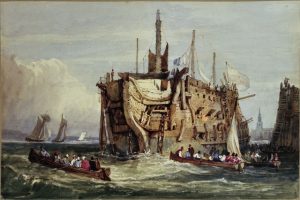
James Dyson (1810-1888), civic leader and businessman of Perth, Western Australia had also been a convicted criminal in a former life. Sentenced to seven years transportation beyond the seas in July 1833, he spent the first few weeks of his sentence imprisoned in York Castle, then four months on the prison hulk Justitia anchored off Woolwich near London on the river Thames.
Representative image of a hulk.
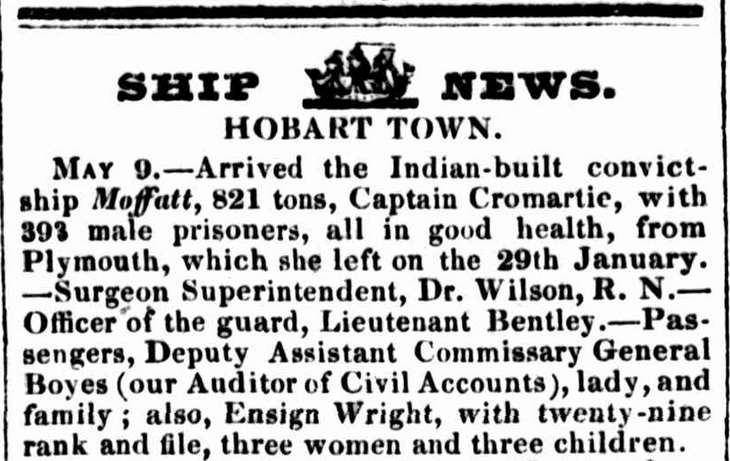
On 20 November 1833 he was bundled on to the merchantman Moffatt at Woolwich, but the formal date of sailing from England to Van Diemen’s Land was not until 6 January 1834. The port of departure was Plymouth. One hundred days later the Moffatt arrived at Hobart town in the convict colony. It was a record speed for a crossing and the vessel carried a record number of convicts within its Indian teak hull.
Of the four hundred prisoners loaded on board, 393 made it to their destination alive. Given that I would not be writing this if he had not made it — Dyson survived the voyage. Still, I would like to know more about this part of his life than what is regularly regurgitated in the standard sources.
Moffatt hauled convicts to Australia four times — Three to Van Diemen’s Land, and one to New South Wales. Convicts were categorised by which ship and voyage they arrived on, so James Dyson was linked to Moffatt (1).
This was the Moffatt’s first time as a convict transport. Prior to that, she was an East India Company ship (The British cartel that owned India for the moment) and her master for her last voyage for the EIC who also commanded her first as prison transport was a young man named James Cromarty (also spelt Cromartie). He was 28 when he became master of the Moffatt in 1832.
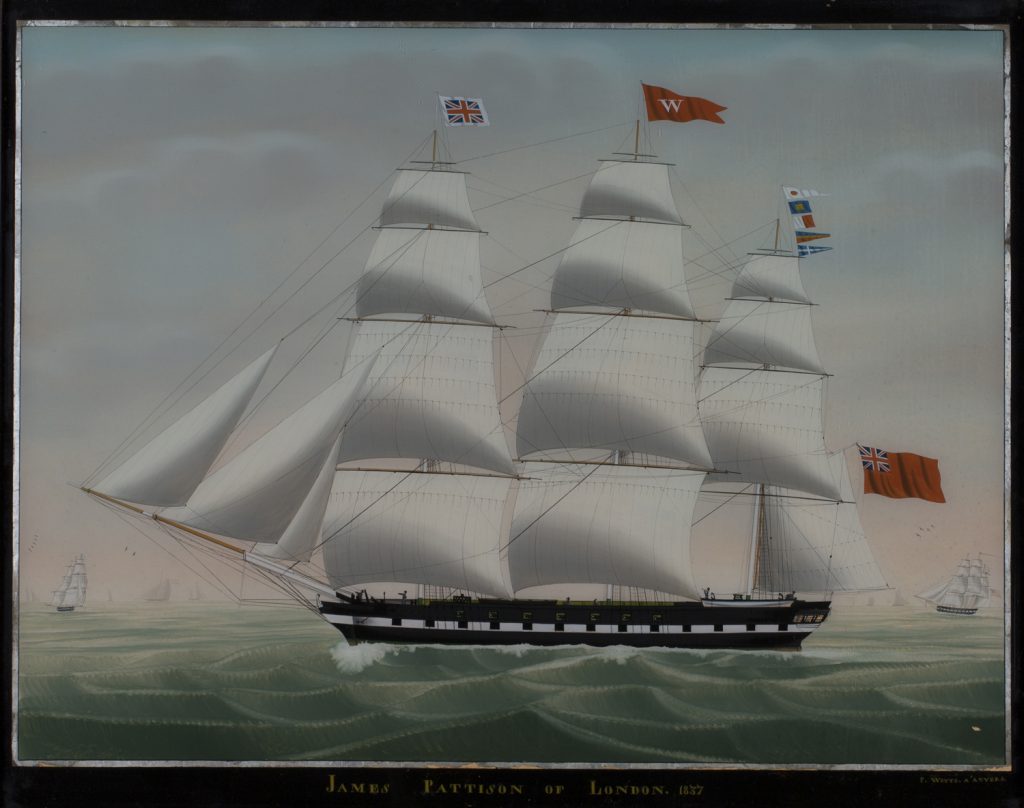
A brief biography of him here would be a lot more published about him than I have so far found written: — Cromarty was born on South Ronaldsay amid the Orkney islands north of the Scottish mainland. Up until the captaincy of the Moffatt for the EIC in 1832, I know nothing about him. It may have been his first command but researching this point has been inconclusive so far. Then, between 1836-1840, he captained the sailing ship James Pattison until she was lost at sea due to fire. He and all his crew were rescued. He was then master of the Chieftain (1841) and then the Equestrian (1844-1847). He married a Miss Charlotte Kelly in Sydney back in 1836. Their home was in London and they had at least two sons together. Charlotte Cromarty disappears from the record after 1847 and by census time 1851, James Cromarty has retired from the sea and taken up farming near his birthplace on South Ronaldsay. He dropped dead 13 July 1882. He was 78 years old.
Petrus Cornelis Weyts – ‘James Pattison of London’, reverse painting on glass, signed and dated 1837
Whether deliberately or by chance, Cromarty was master of many immigration voyages to the Australian colonies. Whether his passengers were free or unfree, one thing both types of voyage shared in common was the presence of a surgeon to ensure that as many of the cargo got to their destination alive as possible. After many years of trial (and mostly) error, the best way found to achieve this outcome was to ensure that neither of these parties got paid unless either gave the other a good report and the cargo arrived mostly intact. Convict ships had surgeons from the Royal Navy. On board the Moffatt during 1834, this was Thomas Braidwood Wilson, RN (1792-1843).
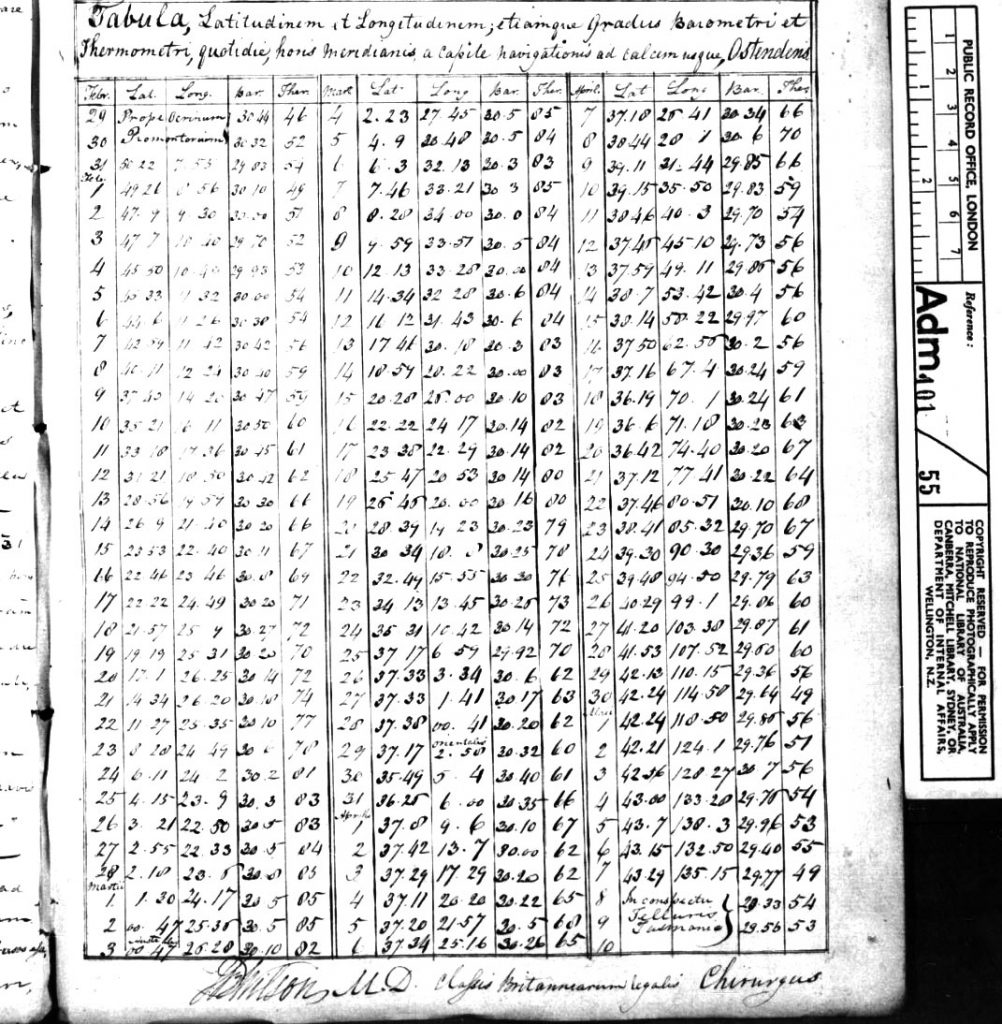
Unlike that for Captain Cromarty, Surgeon T. B. Wilson’s official log of the 1834 voyage of the Moffatt survives. Further more, images of the original pages are now easily available for study. Just one little problem — This tosser wrote most of his journal in Latin — a dead language only specialist scholars can now read.
You. berk.
Marvel at the handwriting in the Journal images on Trove
Unfortunately learning the language of the ancient Romans and the medieval church is somewhat outside my capabilities. There are some broad summaries of what the journal contains in the index of the archive where the originals are stored. The name of James Dyson is not mentioned, as far as I can decipher.
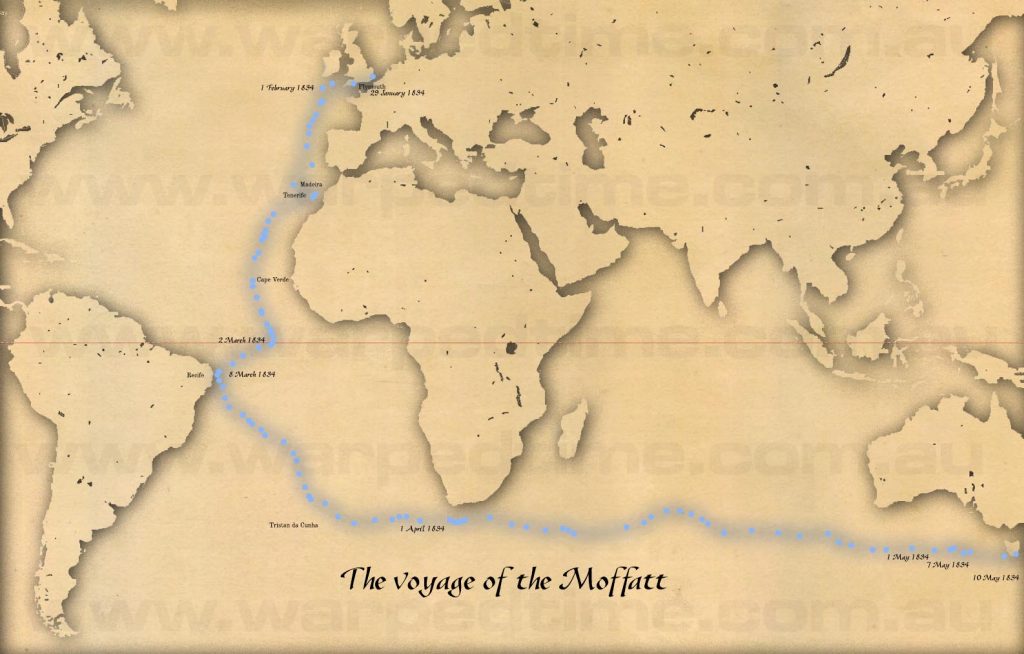
There are no convict diaries for the Moffatt. Those that I have perused date a few years earlier or later on different ships, and all describe very different conditions on every separate journey. It is very frustrating not even being able to generalise on the experience. I could not even be sure exactly what was the route the Moffatt took. However, the one useful bit I could glean from the journal was this table:—
This is actually useful.
From which I was able to generate the following map:—
Then I learnt a bit more about Surgeon T. B. Wilson. It turns out he had quite the career as an explorer — In Western Australia he named Mount Barker in the South West of the colony after his colleague Captain Collett Barker. In return, Wilson’s Inlet, near the town of Denmark on the south coast is named after him. Further more, this bastard who could not be bothered to write his official report in anything other than a language most — even then — could not read, then published a book of his travels in 1835.
Note the date: Narrative of a Voyage Round the World by T. B. Wilson was published in London only a year after he sailed on the Moffatt, and lo! There is an appendix to this tome intituled: —
Remarks on Transportation &c., &c.
AS the subject may not be unacceptable to some of my readers, I shall make a few observations relative to convict ships,—the management of prisoners during the voyage, and their disposal and treatment in New South Wales, and Van Dieman’s Land.
He then goes on to describe the same in meticulous detail, there is even a footnote in the manuscript relating to the troops guarding the prisoners on the voyage..
* Last year (1834), I had charge of 400 prisoners (the greatest number sent in one ship), without any additional guard.
So it turns out this dude was a diarist, and further more, his diaries have been transcribed and published — Oh wait, just Volume I: 1820-1832 — Thats… Oh bugger!
Fortunately for me, the rest of his oeuvre is available for download on the website of the University of Tasmania Library Special and Rare Materials Collection. The downside is that the dates I require have not been transcribed and the pdf that contains the images has been compressed almost beyond the borders of illegibility. However, now I have a complete account of sailing ship Moffatt’s 100 days at sea in 1834. All that remains for me now to translate G. T. W. B. Boyes’ thoroughly indifferent handwriting. However, at least its not in Latin.
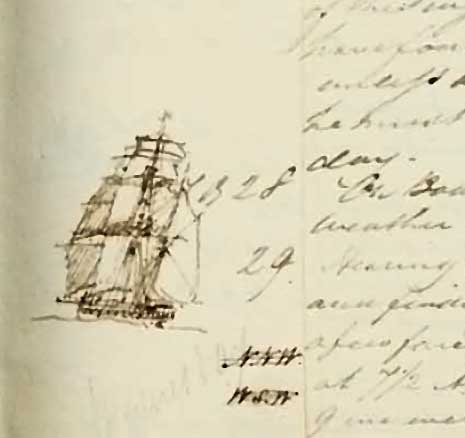
Segment of a diary page by G. T. W. B. Boyes. Was this just a passing vessel or is it a portrait of the Moffat herself?